

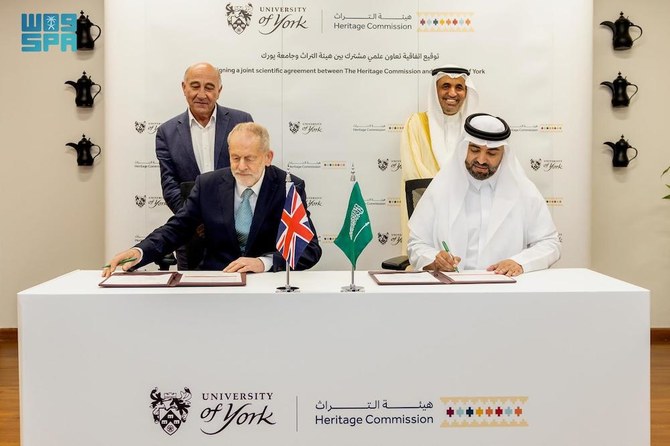
Saudi, British teams to explore prehistoric sites in Farasan Islands and Jazan

The agreement is part of the Saudi Heritage Commission’s ongoing effort to expand field archaeological surveys and excavation work across the Kingdom. (SPA)
Short Url
Updated 08 May 2024
Follow

Saudi, British teams to explore prehistoric sites in Farasan Islands and Jazan

  • Saudi Heritage Commission, York University ink pact in Riyadh
  • Survey, excavation data will help rehabilitate archeological sites

RIYADH: The Saudi Heritage Commission has signed a scientific cooperation agreement with the University of York in the UK for archaeological surveys at prehistoric sites on the Farasan Islands in the Jazan region, as well as along the Red Sea coast in the southwest of the Kingdom.

Representing the commission at the signing ceremony, held recently at its headquarters in Riyadh, was the general manager of archaeology, Abdullah Al-Zahrani, along with the commission’s CEO, Jasser Al-Harbash. The University of York was represented by the project director at the archaeological site, Prof. Geoff Bailey.

This agreement is part of the commission’s ongoing effort to expand field archaeological surveys and excavation work across the Kingdom. And to prepare and rehabilitate archaeological sites by expanding the base of scientific partnerships with universities and international research centers specializing in heritage.

Through this agreement, the commission aims to gather more scientific data on prehistoric sites and understand patterns of ancient pastoral activity.

Field studies will be conducted, and the publication of the findings from archaeological surveys and excavations will be broadened as a result of this collaboration.

The aim is also to attract top-notch scientific talent to assist with such projects.

The agreement calls for the joint preparation of periodic reports and scientific studies, as well as the exchange of information and expertise in related fields.

Last week, the Heritage Commission signed an agreement with Japan’s Kanazawa University to collaborate on archaeological work at two prehistoric sites in Jouf and Tabuk.

It highlights the commission’s commitment to expanding its field work and archeological surveys across the Kingdom and enhances its scientific partnerships with specialist universities and centers around the world.


Celestial spectacle in Saudi Arabia’s north on first day of Ramadan

Updated 19 February 2026
Follow

Celestial spectacle in Saudi Arabia’s north on first day of Ramadan

  • Venus-crescent moon alignment visible over Northern Borders Region skies
  • Meteorology Center completes operational plan for the holy month

ARAR/JEDDAH: The holy month of Ramadan has commenced in Saudi Arabia with a striking astronomical display in the Northern Borders Region, setting a serene tone for the month as meteorological authorities confirmed full readiness to support pilgrims in Makkah and Madinah, the Saudi Press Agency (SPA) reported.

On Tuesday evening, the skies over Arar witnessed a rare alignment as the planet Venus paired with the slender crescent moon marking the first day of Ramadan. Appearing shortly after sunset, the crescent shimmered low on the western horizon above Venus — one of the brightest celestial bodies — in a display enhanced by clear skies.

While the conjunction is a recurring astronomical phenomenon caused by the apparent proximity of the two bodies as viewed from Earth,  its coincidence with the start of the holy month added a special aesthetic and spiritual dimension to the atmosphere in the north, SPA said.

Meteorological readiness

As the faithful began their fasting, the National Center for Meteorology (NCM) announced the completion of its operational and technical preparations for Ramadan 1447 AH.

The plan includes heightened performance levels at observatories in the Kingdom’s airports to manage increased flight traffic and aviation safety. (SPA)

NCM Chief Executive Dr. Ayman bin Salem Ghulam confirmed that the center has finalized a comprehensive plan to ensure round-the-clock weather monitoring for Makkah, Madinah, and the roads leading to the Two Holy Mosques. The initiative aims to provide accurate forecasting to enhance the safety and comfort of the influx of visitors and Umrah pilgrims.

The plan includes heightened performance levels at observatories in the Kingdom’s airports to manage increased flight traffic and aviation safety.

To ensure pilgrims have real-time access to information, the NCM has integrated its data with the "Nusuk" and "Tawakkalna" smart applications. Ten-day extended forecasts and real-time alerts will also be available via the "Anwaa" app and displayed on guidance boards along highways.

The center has mobilized 14 media platforms to deliver swift weather alerts, ensuring high standards of security and logistical support throughout the season.