

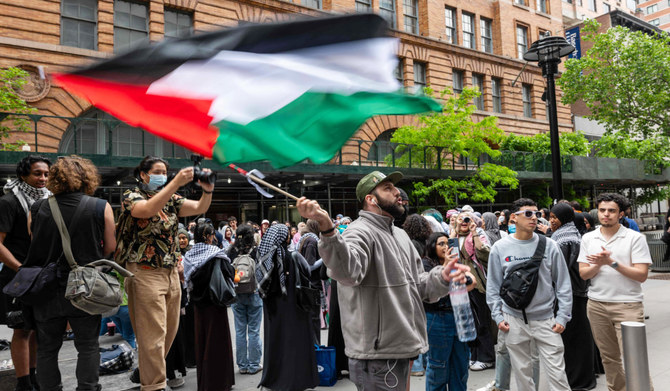
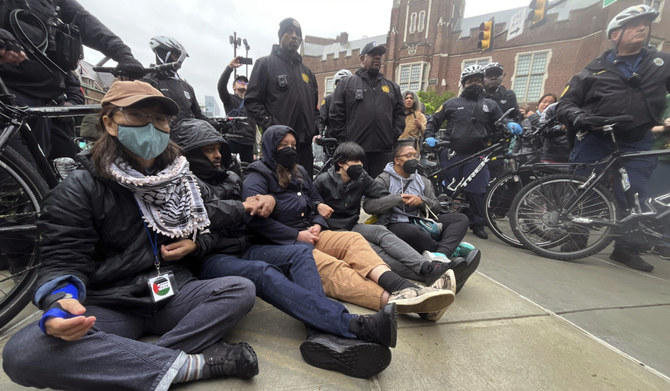
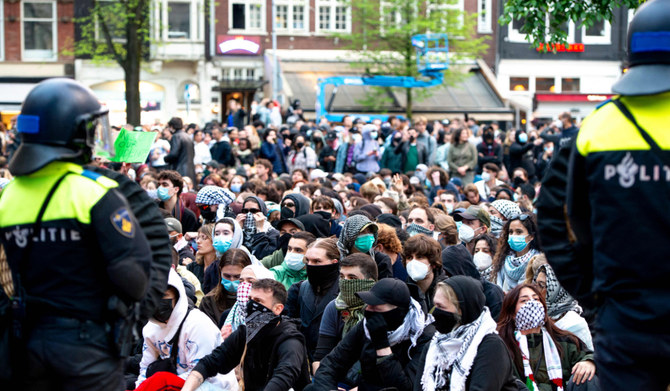
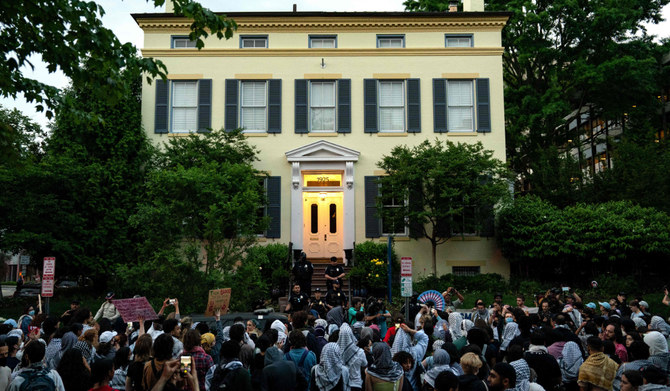

NEW YORK: Police made dozens of arrests as pro-Palestinian protest encampments were dismantled Friday at the University of Pennsylvania and the Massachusetts Institute of Technology, hours after police tear-gassed demonstrators and took down a similar camp at the University of Arizona.
Philadelphia and campus police at Penn took action around daybreak to remove protesters from an encampment in place for more than two weeks. School officials said protesters were given warnings and the chance to leave without being detained. About 33 people, including faculty members and seven students, were among those arrested and charged with trespass, the school said.
Protest camps have sprung up across the US and in Europe in recent weeks as students demand their universities stop doing business with Israel or companies that support its war efforts. Organizers seek to amplify calls to end Israel’s war against Hamas in Gaza, which they describe as a genocide against the Palestinians. The top United Nations court has concluded there is a “plausible risk of genocide” in Gaza — a charge Israel strongly denies.
In Cambridge, Massachusetts, police in riot gear arrived at MIT around 4 a.m., encircled the camp and gave protesters about 15 minutes to leave. Ten students who remained were arrested, the university’s president said. A crowd outside the camp began chanting pro-Palestinian slogans but was quickly dispersed.
At the University of Arizona in Tucson, campus police in riot gear fired tear gas at protesters late Thursday — the day before the school’s main commencement ceremony — before tearing down an encampment that included wood and plastic barriers. The school said police vehicles were spiked, and rocks and water bottles were thrown at officers and university staff. Two people were arrested, a university spokesperson said. Friday night’s commencement will go forward, university President Robert Robbins said.
And at New Mexico State University in Las Cruces, police arrested 13 people Thursday night after they refused to leave a damaged and vandalized building. The charges ranged from misdemeanor trespass to felonies including battery on a peace officer, school spokesperson Amanda Bradford said. The building, Hadley Hall, was cleared and open Friday.
Protesters at the University of Wisconsin-Madison agreed Friday to permanently dismantle their 2-week-old encampment and not disrupt graduation ceremonies this weekend, in return for the opportunity to connect with “decision-makers” who control university investments by July 1. The university agreed to increase support for scholars and students affected by wars in Gaza and Ukraine.
Graduates from Pomona College in Southern California will have to travel 40 miles (65 km) for their commencement ceremony Sunday, as administrators seek to avoid a current encampment. The college said it will provide transportation to the venue, a historic theater in Los Angeles. In April, protesters entered an administration building and police arrested 20 people.
The protest movement began nearly three weeks ago at Columbia University in New York City. Some colleges nationwide cracked down immediately, while others tolerated the demonstrations. Some recently started calling in the police, citing concerns about disruptions to campus life and safety.
The Associated Press has recorded at least 75 instances since April 18 in which arrests were made at US campus protests. Nearly 2,900 people have been arrested at 57 colleges and universities. The figures are based on AP reporting and statements from schools and law enforcement agencies.
Arizona State University on Friday confirmed that it had placed its campus police chief on paid administrative leave pending a review of “complaints filed related to his actions” two weeks ago when an encampment was removed and police made more than 70 arrests during a pro-Palestine rally on the campus in Tempe.
The school said it was reviewing actions surrounding the establishment and removal of the encampment. Local news outlets reported earlier that ASU Police Chief Michael Thompson had been placed on leave after he had been seen out of uniform cutting and removing tents during the protest. The school told ABC15 Arizona earlier he had left a meeting to respond to the rally.
Although their encampment was cleared after two weeks, demonstrators at George Washington University vowed Friday to keep up their protest campaign.
Police arrested 33 people on Wednesday while ousting the initial encampment. The next night, a crowd of chanting demonstrators returned to the university about five blocks from the White House, setting up tents while a large Metropolitan Police Department force assembled. After multiple warnings to disperse, protests leaders ended the demonstration around midnight. One person was arrested for throwing water at a police officer.
The move at MIT came several days after police first attempted to clear the camp, only to see protesters storm past barriers and restore the encampment, which includes about a dozen tents in the heart of the campus in Cambridge.
Before removing the encampment, MIT earlier in the week started suspending dozens of students, meaning they’re barred from academic activities or commencement.
Protesters insist they will keep demanding MIT cut all ties to the Israeli military. The encampment was up for weeks and especially angered Jewish students, who held counterprotests nearby.
“This is only going to make us stronger. They can’t arrest the movement,” said Quinn Perian, an undergraduate student and organizer for MIT Jews for Ceasefire. “MIT would rather arrest and suspend some students than they would end their complicity with the genocide going in Gaza.”
MIT President Sally Kornbluth, in a letter confirming Friday’s arrests, wrote that her responsibility is “to make sure that the campus is physically safe and functioning for everyone ... and that everyone feels free to express their views.” The encampment, she wrote, “increasingly made it impossible to meet all these obligations.”


