

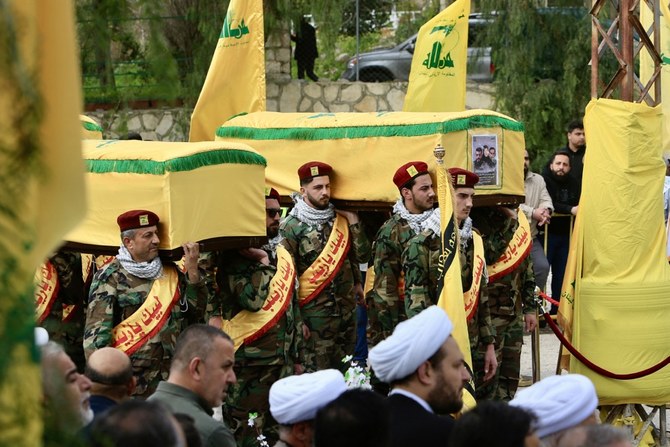
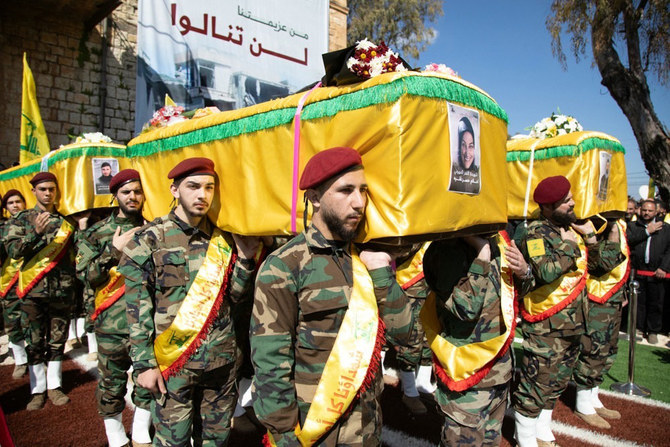

BEIRUT: Israel claims its forces have eliminated half of Hezbollah’s commanders in southern Lebanon in a series of targeted strikes since the two sides began trading fire in the wake of the Oct. 7 Hamas-led attack on southern Israel.
Hezbollah has acknowledged it is “facing a war led by artificial intelligence,” with its secretary-general, Hassan Nasrallah, urging members near the border to avoid using cell phones and the internet, as these devices could be used to track targets.
“The Israelis take advantage of all modern technologies, social networking sites, and information warfare, carrying out new types of operations through systematic destruction and access to cadres and fighters who are influential to (Hezbollah’s) resistance,” Qassem Kassir, a political writer who specializes in Islamic movements, told Arab News.
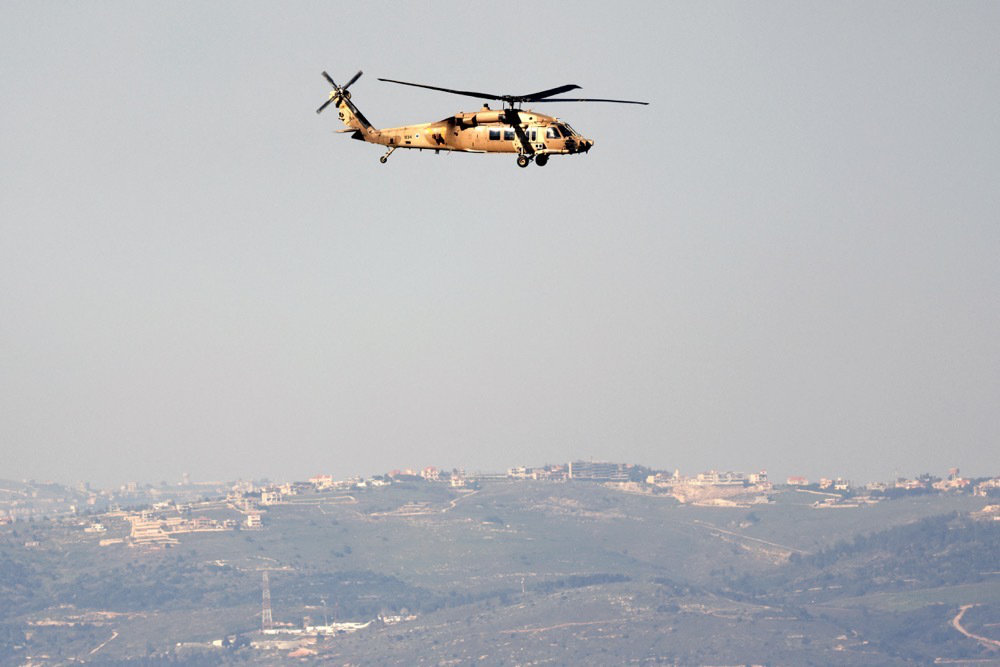
An Israeli Air Force helicopter hovers over the border area with south Lebanon in northern Israel on February 28, 2024, amid ongoing cross-border tensions with Hezbollah. (AFP File Photo)
While Hezbollah has no doubt lost a significant number of fighters and commanders since the outbreak of hostilities, it also has what analysts have called “a deep bench,” capable of fighting a full-scale war.
Given Hezbollah’s demographic advantage and its formidable local support base, analysts express skepticism about whether Israel can achieve its goal of pushing Hezbollah north of the Litani River in Lebanon.
“Today, Hezbollah is fighting a new battle, whether via direct confrontations, which is different from their traditional hit-and-run or guerrilla warfare tactics, or in terms of the quality of weapons and various capabilities that develop day after day,” said Kassir.
Nevertheless, Hezbollah’s ongoing war of attrition with Israel has produced an unexpected psychological, social, and military reality in southern Lebanon, which could cost it dearly if the conflict continues or escalates.
The majority of Lebanese deaths have been recorded on the southern front, with more than 438 noted by Lebanon’s Disaster Risk Management Unit. Most of these deaths are among military-aged males — fighters, rather than civilians.
According to a tally taken by the Associated Press, Israeli strikes have killed more than 350 people in Lebanon, most of them fighters with Hezbollah and allied groups, but also including more than 50 civilians.
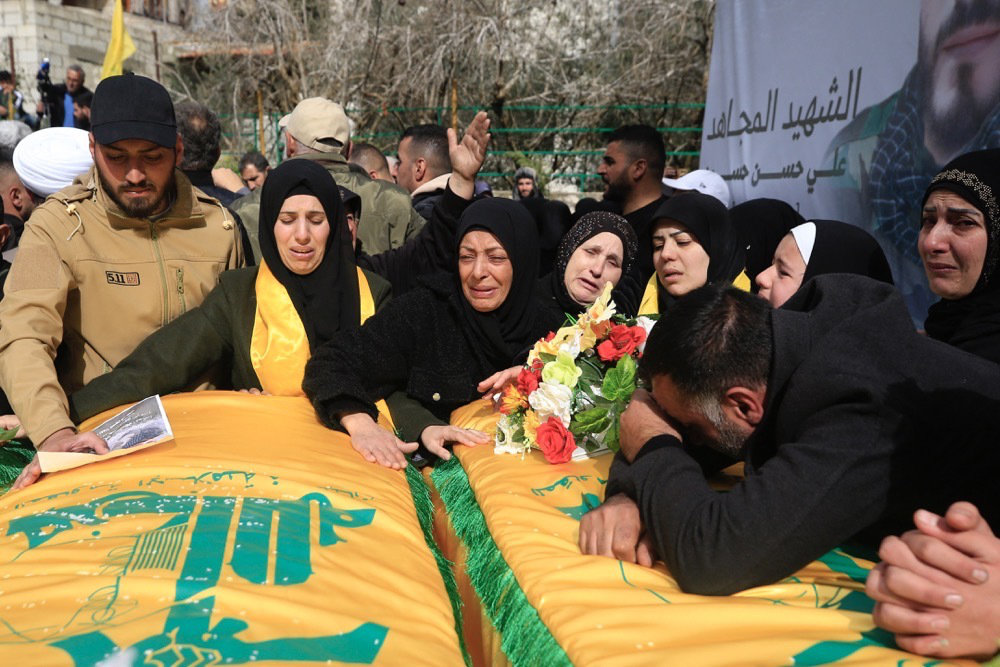
village of Houla on March 6, 2024. The trio were killed a day earlier in Israeli bombardment. (AFP)
Meanwhile, strikes by Hezbollah have killed at least 10 civilians and 12 soldiers in Israel, and have forced authorities to evacuate civilians away from the border, fearing a possible raid akin to Oct. 7.
Despite its losses, Hezbollah says it has used only a fraction of its capabilities against Israel, with the bulk of its arsenal of drones, missiles, and other advanced weapons supplied by Iran held in reserve should the conflict escalate.
Kassir believes recent Israeli wins have barely made a dent in Hezbollah’s combat machinery, and that the militia has sufficient means and manpower to continue fighting for the long haul.
“The Israeli talk about Hezbollah’s defeat is a kind of psychological warfare,” he said. “Hezbollah can continue fighting. It has so far used only 10 percent of its capabilities and is ready for any battle.
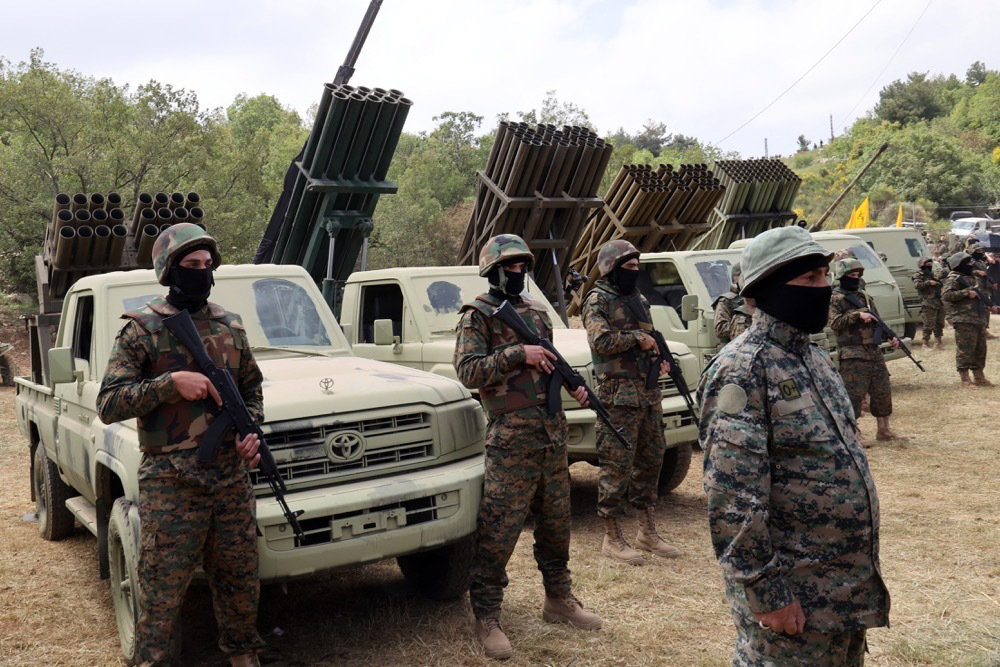
Lebanese Hezbollah fighters stand near multiple rocket launchers during a press tour in the southern Lebanese village of Aaramta on May 21, 2023. (AFP)
While Hezbollah may be resilient enough to withstand current Israeli attacks, that says nothing of the communities along Lebanon’s southern border.
The daily exchange of fire has maimed and killed scores of civilians and caused significant damage to homes, businesses, farmland, and forests. Tens of thousands of residents have fled their towns and villages for the relative safety of the north.
Some analysts and observers believe support for Hezbollah could quickly wane if the civilian population continues to bear the brunt of these armed exchanges, or if the recent spate of setbacks undermines public confidence.
“There is no doubt that there has been a radical change in the perception of Hezbollah’s circumstances towards the power and deterrence that the party used to boast about,” Ali Al-Amin, editor of the Lebanese news site Janoubia, told Arab News
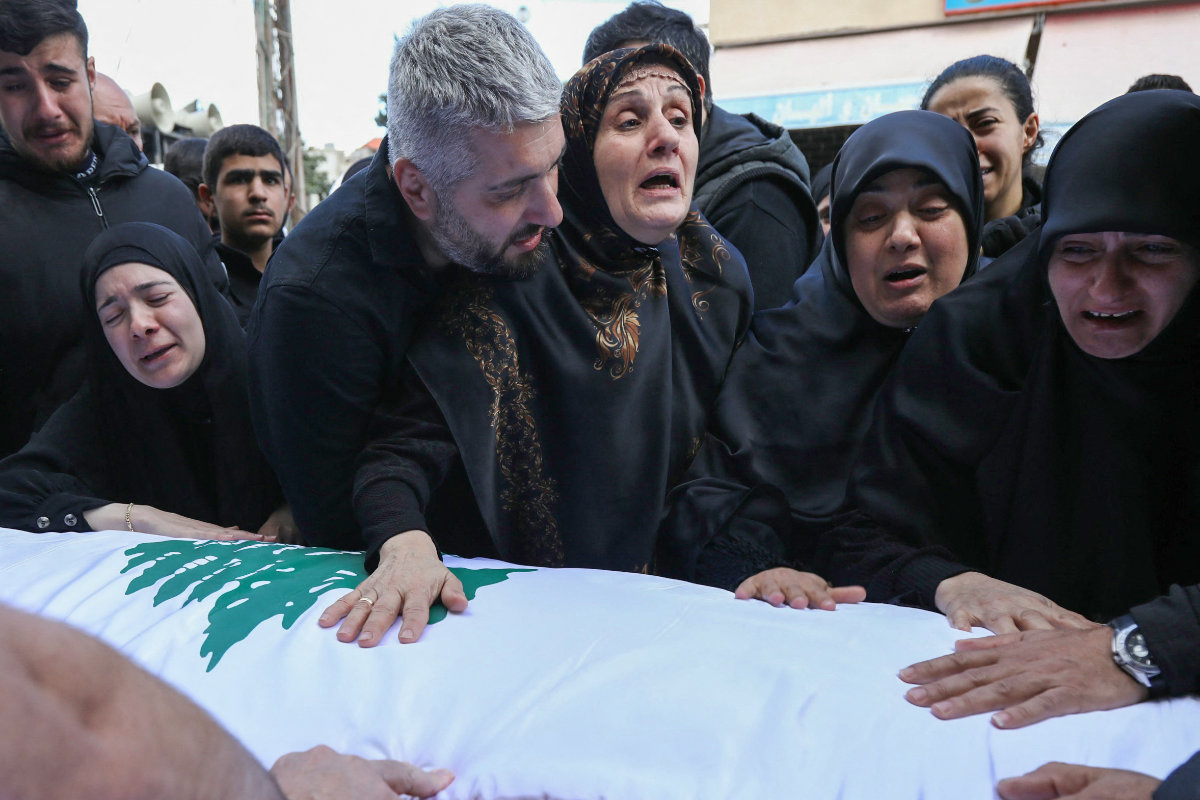
Mourners and family members attend the funeral of May Ammar and her son Ahmad Hnaiki on May 6, 2024, killed the previous day in an Israeli air strike on the southern Lebanese border village of Meis al-Jabal. The daily exchange of fire between Israel and Hezbollah has maimed and killed scores of civilians and caused significant damage to homes, businesses, farmland, and forests. (AFP)
Indeed, as the confidence the group once instilled in the Lebanese population after the 2006 war with Israel begins to dissipate, Al-Amin says Hezbollah may be losing its wider backing.
In particular, residents and business owners in the border regions, who previously built mansions and villas and invested heavily in tourism projects there, are now doubting Hezbollah’s promise to protect them and their assets.
“Hezbollah has not been able to protect this environment, and there is a rift between this environment and what is happening on the border,” said Al-Amin.
“In the villages where the displaced have taken refuge, there are questions such as: ‘Why did Israel manage to catch so many Hezbollah members and not the same in the Gaza Strip? Why were our homes destroyed and on the other side, the settlers’ homes are still standing and were not targeted by Hezbollah’s weapons, as is the case in the Lebanese Kafr Kila? Why does the enemy have so much accurate information about Hezbollah cadres and their movements and thus targets them?’”
Caption
Mindful of the reputational risks, Hezbollah has tried to stage-manage its image and conceal any perceived blunders.
“In the July 2006 war, there was a kind of contract between Nasrallah and his supporters which translated into blind trust in what he says,” said Al-Amin. “But, the scenes of destruction in the frontline villages are not allowed to be published in the media.
“This is because it would give the impression of an Israeli victory and that the rockets fired from Lebanon are for reconnaissance and not to harm, unlike Israel’s scorched-earth tactics for southern Lebanon.”
Nonetheless, the militia’s failings have not gone unnoticed.
“Hezbollah is facing a crisis due to the length of the conflict and its losses, and because of its security weaknesses, which enabled Israel to assassinate its field commanders and fight a war of attrition,” Harith Suleiman, an academic and political writer, told Arab News.
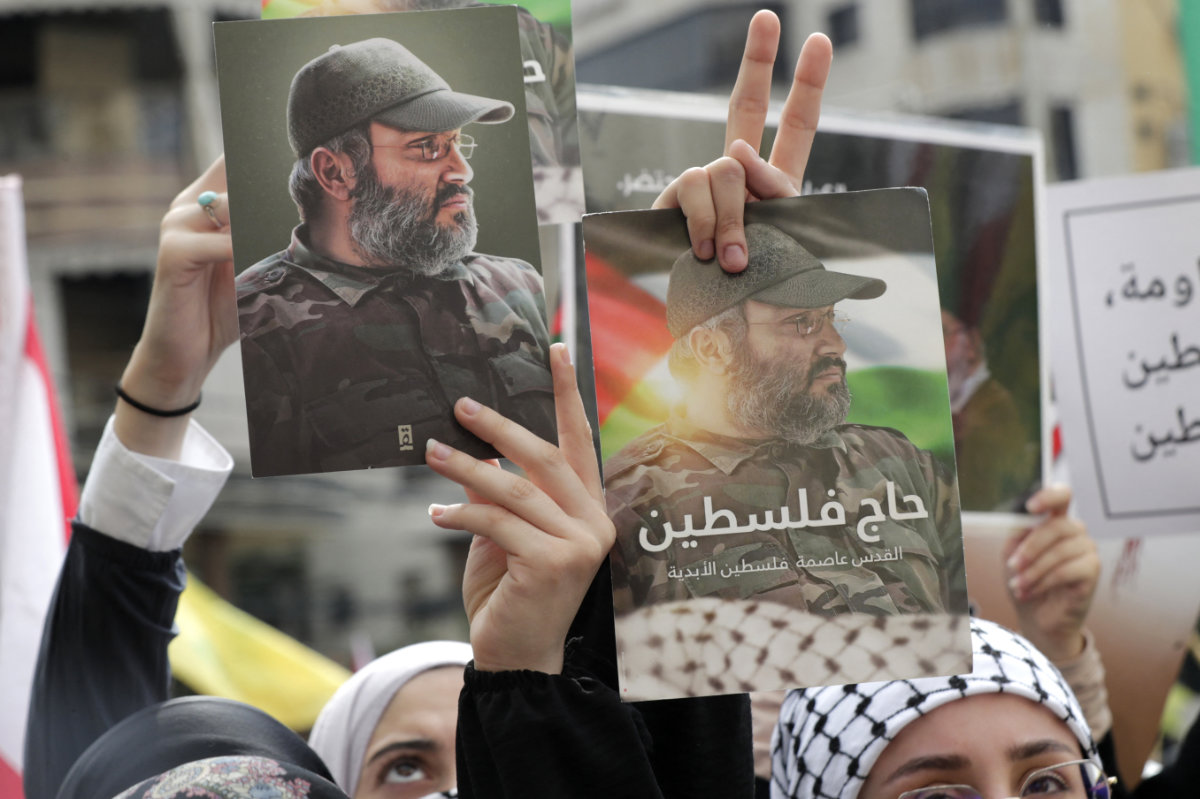
Hezbollah protest in Beirut on October 13, 2023, after the assassination of Hezbollah top commander Imad Mughnieh by Israeli agents. (AFP)
“The Israeli side did not incur high political, human and military costs.”
Thus far, there has been little in the way of international condemnation concerning Israeli strikes on southern Lebanon. Western diplomatic efforts have instead focused on Hezbollah’s demilitarization and demands for its separation from the conflict in Gaza.
Western diplomats, primarily led by France, have brought forward a series of proposals for a cessation of hostilities between Israel and Hezbollah.
Most of these hinge on Hezbollah moving its forces several kilometers from the border, a beefed-up Lebanese Army presence, and negotiations for Israeli forces to withdraw from disputed points along the border.
The eventual goal is the full implementation of UN Security Council Resolution 1701 that brought an end to the month-long war between Israel and Hezbollah in 2006 and that stipulated the full withdrawal of Israeli forces from Lebanon, their replacement by Lebanese and UNIFIL forces, and the disarmament of Hezbollah.
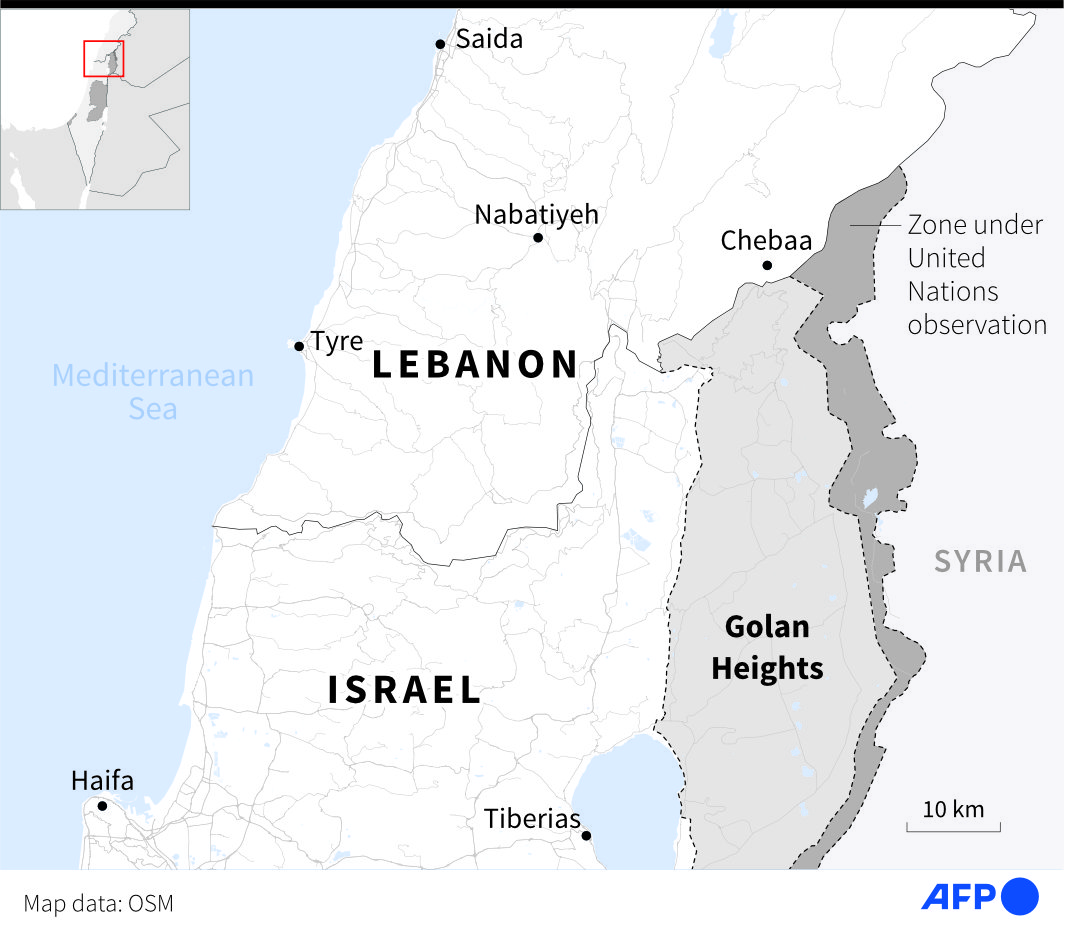
Map of the border area between Lebanon and Israel. (AFP)
Hezbollah has signaled its willingness to entertain the proposals but has said there will be no deal in Lebanon before a ceasefire in Gaza. Israeli officials, meanwhile, have said a Gaza ceasefire does not automatically mean it will halt its strikes in Lebanon, even if Hezbollah does so.
“Hezbollah will accept the offered option to stop the confrontations in southern Lebanon and implement Resolution 1701,” said Suleiman.
However, Hezbollah’s acceptance of this agreement is contingent upon Israel’s acceptance of Egyptian-mediated deals with Israel, Suleiman added.
While life elsewhere in Lebanon continues as normal despite the armed exchanges in the south, discussions in the districts of Bint Jbeil, Tyre, and Nabatieh — just 5 km north of the border — are dominated by the question of who will compensate communities for their damaged homes, farms and businesses.
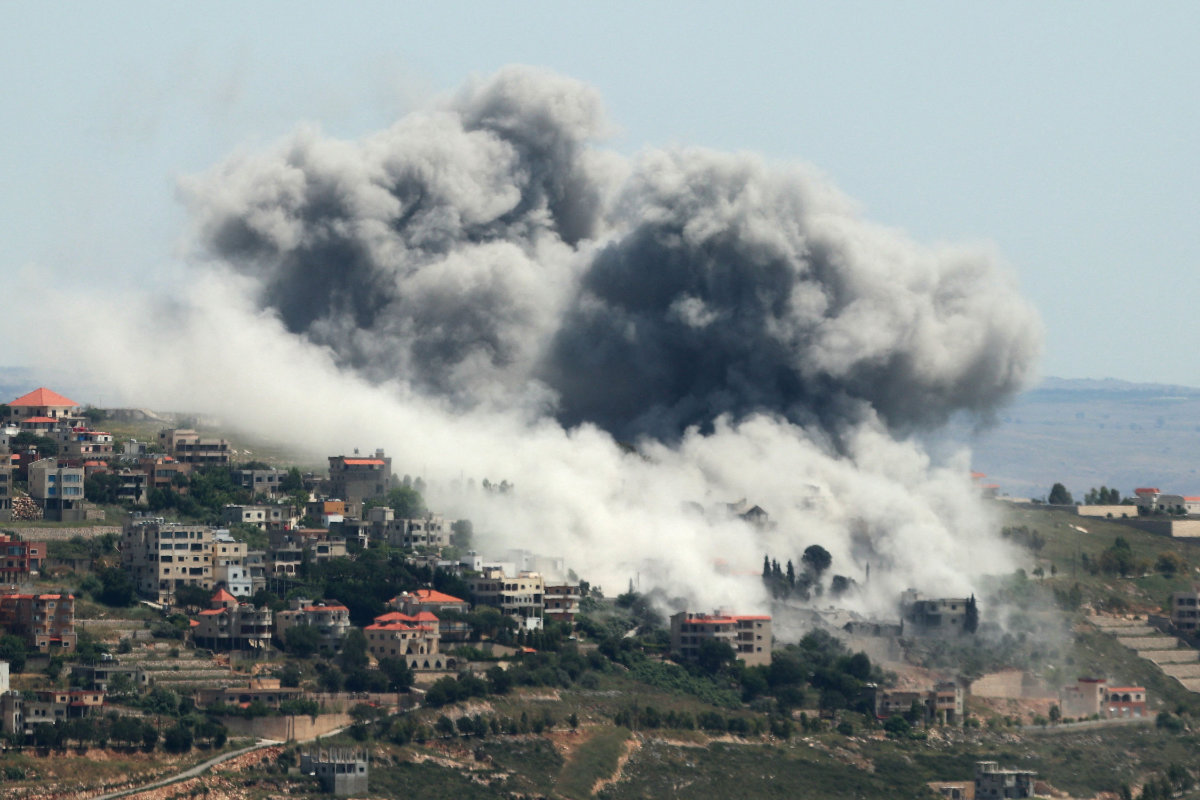
Smoke billows from the site of an Israeli airstrike on the southern Lebanese village of Khiam near the border on May 8, 2024, amid ongoing cross-border tensions between Israel and Hezbollah. Hezbollah has reportedly offered compensation for families whose houses had been destroyed in the conflict. (AFP)
This uncertainty over compensation and how long the conflict will last has the potential to fuel resentment.
“Hezbollah is currently offering a displaced person whose house was destroyed $40,000, or he must wait for the end of the war for Hezbollah to rebuild his house,” said Al-Amin.
There is a lack of clarity, however, as to how equally this compensation will be distributed.
“Does Hezbollah, for example, reconstruct mansions, including what are considered architectural masterpieces that cost hundreds of thousands of dollars, at a different cost than ordinary houses destroyed by the bombing?” said Al-Amin.
“Does the average citizen accept this unfairness in compensation? This is one of the issues that awaits Hezbollah and causes a rift between it and its supporters.”


