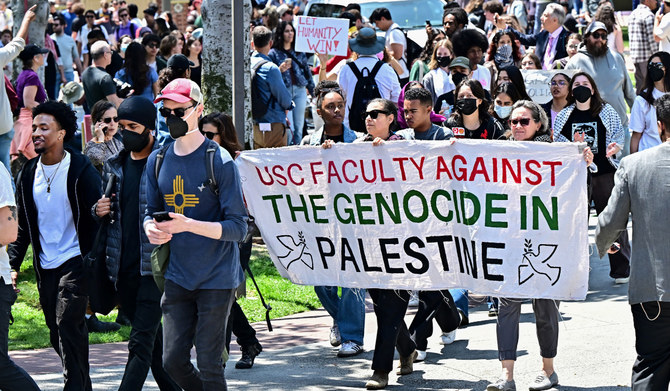
WASHINGTON: Students protesting the war in Gaza abandoned their camp at the University of Southern California early Sunday after being surrounded by police and threatened with arrest, while Northeastern University’s commencement began peacefully at Boston’s Fenway Park.
Developments in both places were being watched closely following scores of arrests last month — 94 people at USC in Los Angeles and about 100 at Northeastern in Boston.
Dozens of Los Angeles Police Department officers arrived about 4 a.m. at USC to assist campus safety officers. The university had warned of arrests on social media and in person. Video showed some protesters packing up and leaving, while officers formed lines to push others away from the camp as it emptied out. The university said there were no reports of any arrests.
USC President Carol Folt said it was time to draw a line because “the occupation was spiraling in a dangerous direction” with areas of campus blocked and people being harassed.
“The operation was peaceful,” Folt wrote in an update. “Campus is opening, students are returning to prepare for finals, and commencement set-up is in full swing.”
USC earlier canceled its main graduation ceremony while allowing other commencement activities to continue.
At the Northeastern commencement Sunday, some students waved small Palestinian and Israeli flags, but were outnumbered by those waving the flags of India and the US, among others. Undergraduate student speaker Rebecca Bamidele drew brief cheers when she called for peace in Gaza.
The Associated Press has tallied about 2,500 people arrested at about 50 campuses since April 18, based on its reporting and statements from universities and law enforcement.
Arrests continued apace over the weekend. At the University of Virginia, there were 25 arrests Saturday for trespassing after police clashed with protesters who refused to remove tents. At the Art Institute of Chicago campus, police cleared a pro-Palestinian encampment hours after it was set up Saturday and arrested 68 people, saying they would be charged with criminal trespass.
ARRESTS IN VIRGINIA
In Charlottesville, Virginia, student demonstrators began their protest on a lawn outside the school chapel Tuesday. Video on Saturday showed police in riot gear and holding shields lined up on campus, while protesters chanted “Free Palestine.”
As police moved in, students were pushed to the ground, pulled by their arms and sprayed with a chemical irritant, Laura Goldblatt, an assistant professor who has been helping the demonstrators, told The Washington Post. The university said protesters were told that tents were banned under school policy and were asked to remove them.
Virginia Attorney General Jason Miyares told Fox News on Sunday the police response was justified because students had been warned repeatedly to leave, were violating the school’s conduct code, and that outsiders who were not students provided protesters with supplies like wooden barriers.
“We’ve seen folks that are not students show up in riot gear with bull horns to direct the protesters on how to flank our officers,” Miyares said.
He said some had put bear spray into water bottles and thrown them at officers.
It was the latest clash in weeks of protests and tension at US colleges and universities.
Tent encampments of protesters urging universities to stop doing business with Israel or companies they say support the war in Gaza have spread in a student movement unlike any other this century. Some schools reached agreements with protesters to end the demonstrations and reduce the possibility of disrupting final exams and commencements.
DEMONSTRATIONS AMID COMMENCEMENT
The University of Michigan was among the schools bracing for protests during commencement this weekend, as were Indiana University, Ohio State University and Northeastern. More ceremonies are planned in the coming weeks.
In Ann Arbor, there was a protest at the beginning of the event at Michigan Stadium. About 75 people, many wearing traditional Arabic kaffiyehs along with their graduation caps, marched up the main aisle toward the stage.
They chanted “Regents, regents, you can’t hide! You are funding genocide!” while holding signs, including one that read: “No universities left in Gaza.”
Overhead, planes pulled banners with competing messages. “Divest from Israel now! Free Palestine!” and “We stand with Israel. Jewish lives matter.”
Officials said no one was arrested, and the protest didn’t seriously interrupt the nearly two-hour event, attended by tens of thousands of people, some of them waving Israeli flags.
OTHER PROTESTS CONTINUE
At Indiana University, protesters urged supporters to wear their kaffiyehs and walk out during remarks by school President Pamela Whitten on Saturday evening. The Bloomington campus designated a protest zone outside Memorial Stadium, where the ceremony was held.
At Princeton University in New Jersey, 18 students began a hunger strike to try to push the university to divest from companies tied to Israel. Students at other colleges, including Brown and Yale, launched similar hunger strikes this year before the more recent wave of demonstrations.
The protests stem from the conflict that started Oct. 7 when Hamas militants attacked southern Israel, killing about 1,200 people, mostly civilians, and taking roughly 250 hostages. Vowing to destroy Hamas, Israel launched an offensive in Gaza that has killed more than 34,500 Palestinians, about two-thirds of them women and children, according to the Health Ministry in the Hamas-ruled territory. Israeli strikes have devastated the enclave and displaced most of its inhabitants.


![]()


Anti-war protesters leave USC after police arrive, while Northeastern ceremony proceeds calmly
Short Url
https://arab.news/juv9w
Anti-war protesters leave USC after police arrive, while Northeastern ceremony proceeds calmly
- Israel has killed more than 34,000 Palestinians, according to Gaza’s Health Ministry


Chile wildfires leave 19 dead amid extreme heat as scores evacuated
- Fast-moving wildfires being worsened by intense heat, winds
- Firefighters battling 23 active blazes spreading toward cities
CONCEPCION, Chile: Wildfires in Chile have left at least 19 people dead, authorities said on Monday, as the government carried out mass evacuations and fought nearly two dozen blazes exacerbated by intense heat and high winds.
While weather conditions overnight helped control some fires, the largest were still active, with adverse conditions expected throughout the day, security minister, Luis Cordero, said at a news briefing on Monday.
“The projection we have today is of high temperatures,” Cordero said, and the main worry was that new fires would be triggered throughout the region.
Parts of central and southern Chile were under extreme heat warnings with temperatures expected to reach up to 37 Celsius (99 Fahrenheit).
STATE OF EMERGENCY DECLARED IN NUBLE, BIO BIO
As of late Sunday, Chile’s CONAF forestry agency said firefighters were combating 23 fires across the country, the largest of which were in regions of Ñuble and Bío Bío, where President Gabriel Boric declared a state of catastrophe.
Over 20,000 hectares (77 square miles) have been razed so far, an area about the size of Seattle, with the largest fire surpassing 14,000 hectares on the outskirts of the coastal city Concepcion.
The fast-moving blaze tore through the towns of Penco and Lirquen over the weekend, destroying hundreds of homes and killing several people, with authorities still assessing the damage.
HEAT, BLAZES ALSO IMPACT ARGENTINA
Authorities are currently battling the fire as it threatened Manzano prison on the edge of Concepcion and the town of Tome to the north.
Both Chile and Argentina rang in the new year with heat waves which have continued into January. Earlier this month, wildfires broke out in Argentina’s Patagonia, burning around 15,000 hectares.
While weather conditions overnight helped control some fires, the largest were still active, with adverse conditions expected throughout the day, security minister, Luis Cordero, said at a news briefing on Monday.
“The projection we have today is of high temperatures,” Cordero said, and the main worry was that new fires would be triggered throughout the region.
Parts of central and southern Chile were under extreme heat warnings with temperatures expected to reach up to 37 Celsius (99 Fahrenheit).
STATE OF EMERGENCY DECLARED IN NUBLE, BIO BIO
As of late Sunday, Chile’s CONAF forestry agency said firefighters were combating 23 fires across the country, the largest of which were in regions of Ñuble and Bío Bío, where President Gabriel Boric declared a state of catastrophe.
Over 20,000 hectares (77 square miles) have been razed so far, an area about the size of Seattle, with the largest fire surpassing 14,000 hectares on the outskirts of the coastal city Concepcion.
The fast-moving blaze tore through the towns of Penco and Lirquen over the weekend, destroying hundreds of homes and killing several people, with authorities still assessing the damage.
HEAT, BLAZES ALSO IMPACT ARGENTINA
Authorities are currently battling the fire as it threatened Manzano prison on the edge of Concepcion and the town of Tome to the north.
Both Chile and Argentina rang in the new year with heat waves which have continued into January. Earlier this month, wildfires broke out in Argentina’s Patagonia, burning around 15,000 hectares.
Latest updates


© 2026 SAUDI RESEARCH & PUBLISHING COMPANY, All Rights Reserved And subject to Terms of Use Agreement.