

Students in Ireland, Switzerland join the protest wave over Gaza

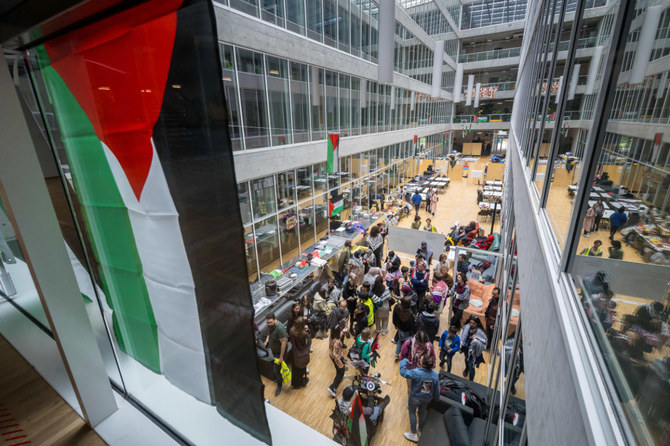
Around 100 pro-Palestinian students occupy the entrance hall of a building of the University of Lausanne, demanding an academic boycott of Israeli institutions. (AFP)
Short Url
Updated 04 May 2024
Follow

Students in Ireland, Switzerland join the protest wave over Gaza

  • Dublin students build encampment, forcing university to restrict campus access and close Book of Kells exhibition
  • Israel has killed more than 34,000 Palestinians in Gaza, mostly women and children, according to the health ministry in the Hamas-run territory

DUBLIN: Students at Trinity College Dublin and Lausanne University in Switzerland have staged occupations to protest against Israel’s war in Gaza, joining a wave of demonstrations sweeping US campuses.

In Dublin, students built an encampment on Friday, forcing the university to restrict campus access on Saturday and close the Book of Kells exhibition, one of Ireland’s top tourist attractions.
The camp was set up after the students’ union said the university had fined it €214,000 ($230,000) for losses caused by protests in recent months, not exclusively over Gaza.
The protesters were demanding that Trinity cut academic ties with Israel and divest from companies with ties to Israel.

BACKGROUND

The protesters were demanding that Trinity College Dublin cut academic ties with Israel and divest from companies with ties to Israel.

Students’ union president Laszlo Molnarfia posted a photograph of benches piled up at the entrance to the building housing the Book of Kells, an illuminated manuscript created by Celtic monks in about 800 AD.
Trinity College said it had restricted access to students, staff, and residents to ensure safety and that the exhibition would be closed on Saturday.
More than 34,600 Palestinians have been killed in Israel’s seven-month-old assault on the Gaza Strip, say health officials in the enclave.
The war began when Hamas militants attacked Israel on Oct. 7.
Pro-Palestinian protests have also been held at universities in Australia and Canada.
In Lausanne, around 100 students occupied a building to back demands, including an end to scientific cooperation with Israel.
“Palestinians have been dying for over 200 days, but we are not being heard,” one protester told Swiss television on Saturday.
“There’s a global movement to get governments to take action, but it’s not happening. That’s why we want to get universities involved now.”
The university said the occupation could continue until Monday, provided it did not disrupt work on campus.
“We universities are not called upon to take political stands,” the university’s rector, Frederic Herman, told RTS radio.
Last week, the head of Trinity College, Linda Doyle, said it was reviewing its investments but that it was for individual academics to decide whether to work with Israeli institutions.


Central African Republic president seeks third term in election

Updated 7 sec ago
Follow

Central African Republic president seeks third term in election

  • Since Touadera was first elected in 2016, in the middle of a civil war, the CAR has seen unrest ease despite feuds between armed groups and the government in some regions

BANGUI: Voters in the Central African Republic cast their ballots for a new president on Sunday, with incumbent Faustin-Archange Touadera widely expected to win a third term after touting his success in steadying a nation long plagued by conflict.

Around 2.3 million people are eligible to vote, with parliamentary, municipal and regional polls taking place at the same time.

Escorted by members of the presidential guard, Touadera arrived at a high school to cast his own ballot.

He urged people to vote “to allow our country to develop, to allow our country to regain peace and security.”

“It’s a very important issue,” Touadera, 68, told reporters.

Streets in the capital Bangui were quiet, with armored vehicles of the UN peacekeeping mission MINUSCA deployed at road junctions.

Heavy security was posted outside voting stations, and helicopters flew overhead at a school near where Touadera was voting, while a long queue had formed. Since Touadera was first elected in 2016, in the middle of a civil war, the CAR has seen unrest ease despite feuds between armed groups and the government in some regions.

“We need a leader elected by the people, not someone who takes power by force,” teacher Julie Odjoubi, 44, said, her left thumb stained with purple ink to show she had voted.

Touadera is in pole position to win in a seven-strong field, after a new constitution was adopted in 2023.