PARIS: Chinese President Xi Jinping arrived in France Sunday on a state visit hosted by Emmanuel Macron where the French leader will seek to warn his counterpart against backing Russia in the conflict over Ukraine.
Xi’s arrival for the visit marking 60 years of diplomatic relations between France and China heralded the start of his first trip to Europe since 2019, which will also see him visit Serbia and Hungary.
But Xi’s choice of France as the sole major European power to visit indicates the relative warmth in Sino-French relations since Macron made his own state visit to China in April 2023 and acknowledges the French leader’s stature as an EU powerbroker.
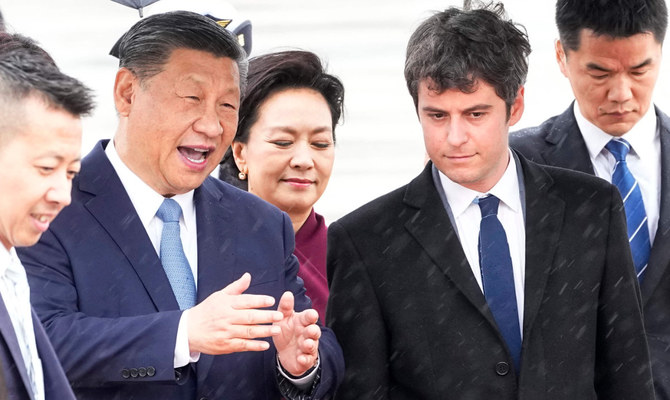
The leader of the one-party Communist state of more than 1.4 billion people, accompanied by his wife Peng Liyuan, was welcomed under umbrellas at a drizzly Paris Orly airport by Prime Minister Gabriel Attal.
Xi is to hold a day of talks in Paris on Monday — also including EU Commission chief Ursula von der Leyen — followed by a state banquet hosted by Macron at the Elysee.
Tuesday will see Macron take Xi to the Pyrenees mountains to an area he used to visit as a boy for a day of less public talks.
In an op-ed for Le Figaro daily, Xi said that he wanted to work with the international community to find ways to solve the conflict sparked by Russia’s invasion of Ukraine, while emphasising that China was “neither a party nor a participant” in the conflict.
“We hope that peace and stability will return quickly to Europe and intend to work with France and the entire international community to find good paths to resolve the crisis,” he wrote.
A key priority of Macron will be to warn Xi of the danger of backing Russia, with Western officials concerned Moscow is already using Chinese machine tools in arms production.
Beijing’s ties with Moscow have, if anything, warmed after the invasion and the West wants China above all not to supply weapons to Russia and risk tipping the balance in the conflict.
“It is in our interest to get China to weigh in on the stability of the international order,” said Macron in an interview with The Economist published on Thursday.
Macron also said in the interview that Europe must defend its “strategic interests” in its economic relations with China, accusing Beijing of not respecting the rules on international trade.
But he acknowledged in an interview with the La Tribune Dimanche newspaper that Europeans are “not unanimous” on the strategy to adopt as “certain actors still see China essentially as a market of opportunities” while it “exports massively” to Europe.
The French president had gladdened Chinese state media and troubled some EU allies after his 2023 visit by declaring that Europe should not be drawn into a “bloc versus bloc” standoff between China and the United States, particularly over democratic, self-ruled Taiwan.
China views the island as part of its territory and has vowed to take it one day, by force if necessary.
Rights groups are urging Macron to bring up human rights in the talks, accusing China of failing to respect the rights of the Uyghur Muslim minority and of keeping dozens of journalists behind bars.
“President Macron should make it clear to Xi Jinping that Beijing’s crimes against humanity come with consequences for China’s relations with France,” said Maya Wang, acting China director at Human Rights Watch.
The group said human rights in China had “severely deteriorated” under Xi’s rule.
A crowd of protesters on Sunday unfurled a Tibetan flag at a demonstration in Paris, accusing Xi of being a “dictator” and wanting to erase local culture in the Tibet region, an AFP reporter said. Paris police put the number of protesters at two thousand.
However analysts are skeptical that Macron will be able to exercise much sway over the Chinese leader, even with the lavish red carpet welcome and a trip to the bracing mountain airs of the Col du Tourmalet over 2,000 meters (6,560 feet) above sea level on Tuesday.
The other two countries chosen by Xi for his tour, Serbia and Hungary, are seen as among the most sympathetic to Moscow in Europe.
“The two core messages from Macron will be on Chinese support to Russia’s military capabilities and Chinese market-distorting practices,” said Janka Oertel, director of the Asia program at the European Council on Foreign Relations.
“However, both messages are unlikely to have a significant impact on Chinese behavior: Xi is not on a mission to repair ties, because from his point of view all is well.”


![]()

China’s Xi in France for Macron talks on Ukraine
Short Url
https://arab.news/4jse5
China’s Xi in France for Macron talks on Ukraine
- Tuesday will see Macron take Xi to the Pyrenees mountains to an area he used to visit as a boy for a day of less public talks


Latest updates





© 2026 SAUDI RESEARCH & PUBLISHING COMPANY, All Rights Reserved And subject to Terms of Use Agreement.