

Send us Patriots: Ukraine’s battered energy plants seek air defenses against Russian attacks

1 / 2
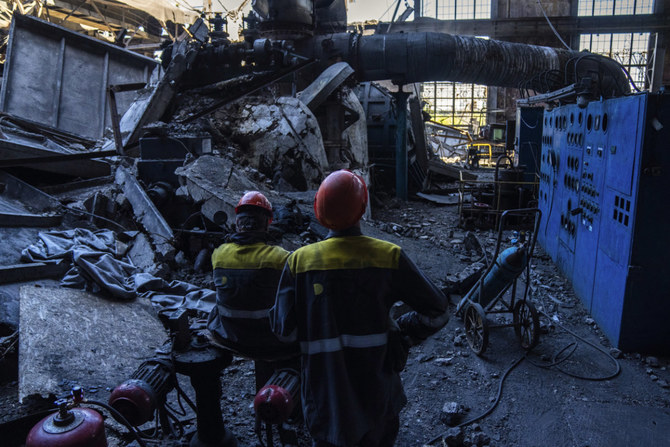
Workers stand among debris in a damaged DTEK thermal power plant after a Russian attack in Ukraine, on May 2, 2024. (AP)
2 / 2
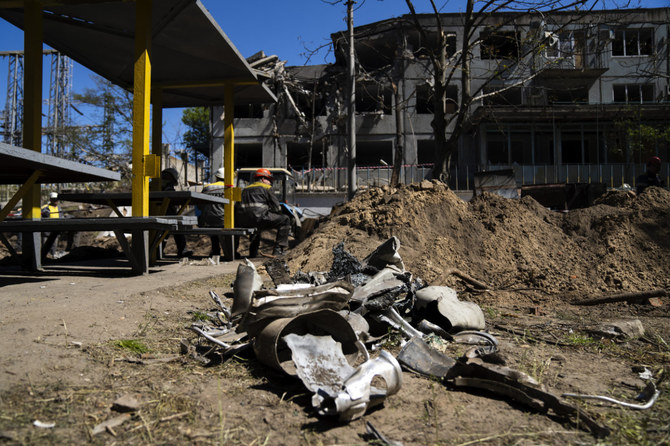
Debris of a Russian missile are gathered next to a damaged building in a DTEK thermal power plant after a Russian attack in Ukraine on May 2, 2024. (AP)
Short Url
Updated 03 May 2024
Follow

Send us Patriots: Ukraine’s battered energy plants seek air defenses against Russian attacks

  • Ukraine's foreign minister has said half of the country’s energy system has been damaged by Russian attacks
  • Russian President Vladimir Putin has framed the attacks as retaliation for Ukrainian strikes on Russian oil refineries

KYIV, Ukraine: At a Ukrainian power plant repeatedly hit by Russian aerial attacks, equipment department chief Oleh has a one-word answer when asked what Ukraine’s battered energy industry needs most: “Patriot.”

Ukrainian energy workers are struggling to repair the damage from intensifying airstrikes aimed at pulverizing Ukraine’s energy grid, hobbling the economy and sapping the public’s morale. Staff worry they will lose the race to prepare for winter unless allies come up with air-defense systems like the US-made Patriots to stop Russian attacks inflicting more destruction on already damaged plants.
“Rockets hit fast. Fixing takes long,” Oleh said in limited but forceful English.
The US has sent Ukraine some Patriot missile systems, and said last week it would give more after entreaties from President Volodymyr Zelensky.
The Associated Press on Thursday visited a plant owned by DTEK, the country’s biggest private energy supplier, days after a cruise-missile attack left parts of it a mess of smashed glass, shattered bricks and twisted metal. The coal-fired plant is one of four DTEK power stations struck on the same day last week.
The AP was given access on the condition that the location of the facility, technical details of the damage and workers’ full names are not published due to security concerns.
During the visit, State Emergency Service workers in hard hats and harnesses clambered atop the twisted roof of a vast building, assessing the damage and occasionally dislodging chunks of debris with a thunderous clang.
Ukrainian Foreign Minister Dmytro Kuleba told Foreign Policy magazine that half of the country’s energy system has been damaged by Russian attacks.
DTEK says it has lost 80 percent of its electricity-generating capacity in almost 180 aerial attacks since the start of Russia’s full-scale invasion in 2022. It estimates that repairing all the damaged plants would take between six months and two years — even if there are no more strikes.
Shift supervisor Ruslan was on duty in the operations room when the air alarm sounded. He sent his crew to a basement shelter but remained at his post when the blast struck only meters (yards) away.
He rushed out to darkness, dust and fire. He said he wasn’t scared because “I knew what I needed to do” – make sure his team was OK and then try to help put out the flames.
Russia pummeled Ukraine’s energy infrastructure to devastating effect during the “blackout winter” of 2022-23. In March it launched a new wave of attacks, one of which completely destroyed the Trypilska power plant near Kyiv, one of the country’s biggest.
Russian President Vladimir Putin has framed the attacks as retaliation for Ukrainian strikes on Russian oil refineries.
Oleh said the Russians are “learning all the time” and adapting their tactics. Initially they targeted transformers that distribute power; now they aim for the power-generating equipment itself, with increasing accuracy. The Russians also are sending growing numbers of missiles and exploding drones to exhaust Ukraine’s air defenses, and striking the same targets repeatedly.
DTEK executive director Dmytro Sakharuk said in March that out of 10 units the company had repaired after earlier strikes, two-thirds had been hit again.
More Russian missiles have been getting through in recent months as Ukraine awaited new supplies from allies, including a $61 billion package from the US that was held up for months by wrangling in Congress. It was finally approved in April, but it could be weeks or months before all the new weapons and ammunition arrives.
Ukraine’s energy firms have all but exhausted their finances, equipment and spare parts fixing the damage Russia has already wrought. The country’s power plants urgently need specialist equipment that Ukraine can no longer make at sufficient speed and scale.
Some 51 DTEK employees have been wounded in attacks since 2022, and three have been killed. Staff say they keep working despite the danger because they know how crucial their work is.
Machine operator Dmytro, who was on shift during the recent attack and took shelter in the basement, said that when he emerged, “my soul was bleeding when I saw the scale of the destruction.”
He thought of the many people who had poured heart and soul into building the mammoth power plant.
“This was destroyed in a few seconds, in an instant,” he said.
Dmytro, who worked at Ukraine’s Zaporizhzhia nuclear power plant before it was seized by Russia, said he would continue to show up for work every day, “as long as I’m able.”
“It’s our duty toward the country,” he said


Counter protesters chase off conservative influencer during Minneapolis immigration crackdown

Updated 59 min 28 sec ago
Follow

Counter protesters chase off conservative influencer during Minneapolis immigration crackdown

MINNEAPOLIS: Hundreds of counterprotesters drowned out a far-right activist’s attempt to hold a small rally in support of the Trump administration’s latest immigration crackdown in Minneapolis on Saturday, as the governor’s office announced that National Guard troops were mobilized and ready to assist law enforcement though not yet deployed to city streets.
There have been protests every day since the Department of Homeland Security ramped up immigration enforcement in the Twin Cities of Minneapolis and St. Paul by bringing in more than 2,000 federal officers.
Conservative influencer Jake Lang organized an anti-Islam, anti-Somali and pro-ICE demonstration, saying on social media beforehand that he intended to “burn a Qur’an” on the steps of City Hall. But it was not clear if he carried out that plan.
Only a small number of people showed up for Lang’s demonstration, while hundreds of counterprotesters converged at the site, yelling over his attempts to speak and chasing the pro-ICE group away. They forced at least one person to take off a shirt they deemed objectionable.
Lang appeared to be injured as he left the scene, with bruises and scrapes on his head.
Lang was previously charged with assaulting an officer with a baseball bat, civil disorder and other crimes before receiving clemency as part of President Donald Trump’s sweeping act of clemency for Jan. 6 defendants last year. Lang recently announced that he is running for US Senate in Florida.
In Minneapolis, snowballs and water balloons were also thrown before an armored police van and heavily equipped city police arrived.
“We’re out here to show Nazis and ICE and DHS and MAGA you are not welcome in Minneapolis,” protester Luke Rimington said. “Stay out of our city, stay out of our state. Go home.”
National Guard ‘staged and ready’
The state guard said in a statement that it had been “mobilized” by Democratic Gov. Tim Walz to support the Minnesota State Patrol “to assist in providing traffic support to protect life, preserve property, and support the rights of all Minnesotans to assemble peacefully.”
Maj. Andrea Tsuchiya, a spokesperson for the guard, said it was “staged and ready” but yet to be deployed.
The announcement came more than a week after Walz, a frequent critic and target of Trump, told the guard to be ready to support law enforcement in the state.
During the daily protests, demonstrators have railed against masked immigration officers pulling people from homes and cars and other aggressive tactics. The operation in the deeply liberal Twin Cities has claimed at least one life: Renee Good, a US citizen and mother of three, was shot by an ICE officer during a Jan. 7 confrontation.
On Friday a federal judge ruled that immigration officers cannot detain or tear gas peaceful protesters who are not obstructing authorities, including while observing officers during the Minnesota crackdown.
Living in fear
During a news conference Saturday, a man who fled civil war in Liberia as a child said he has been afraid to leave his Minneapolis home since being released from an immigration detention center following his arrest last weekend.
Video of federal officers breaking down Garrison Gibson’s front door with a battering ram Jan. 11 become another rallying point for protesters who oppose the crackdown.
Gibson, 38, was ordered to be deported, apparently because of a 2008 drug conviction that was later dismissed. He has remained in the country legally under what’s known as an order of supervision. After his recent arrest, a judge ruled that federal officials did not give him enough notice that his supervision status had been revoked.
Then Gibson was taken back into custody for several hours Friday when he made a routine check-in with immigration officials. Gibson’s cousin Abena Abraham said Immigration and Customs Enforcement officials told her White House Deputy Chief of Staff Stephen Miller ordered the second arrest.
The White House denied the account of the re-arrest and that Miller had anything to do with it.
Gibson was flown to a Texas immigration detention facility but returned home following the judge’s ruling. His family used a dumbbell to keep their damaged front door closed amid subfreezing temperatures before spending $700 to fix it.
“I don’t leave the house,” Gibson said at a news conference.
DHS said an “activist judge” was again trying to stop the deportation of “criminal illegal aliens.”
“We will continue to fight for the arrest, detention, and removal of aliens who have no right to be in this country,” Assistant Homeland Security Secretary Tricia McLaughlin said.
Gibson said he has done everything he was supposed to do: “If I was a violent person, I would not have been out these past 17 years, checking in.”