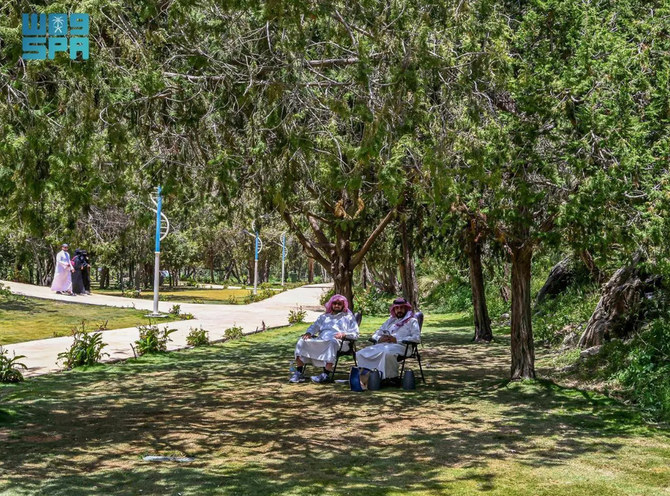
RIYADH: For centuries, the juniper tree has proudly stood as a symbol of picturesque beauty in Al-Baha region, adorning its slopes and mountain peaks with vibrant green hues.
Nourished by recent heavy rains in the region, these majestic trees have flourished, forming expansive forests that eagerly await the arrival of summer, and the embrace of nature enthusiasts seeking tranquility and solace.
Mohammed bin Saeed Al-Qudwa, a representative of the National Center for Vegetation Development and Combating Desertification in the Al-Baha region, told the Saudi Press Agency that juniper trees make up 30 percent of wild plants in Al-Baha.
The coniferous trees and shrubs can also been found in forested areas of Baljurashi, Beni Hassan, and Al-Mandaq governorates.
Al-Qudwa said that the National Center for Vegetation Development and Combating Desertification, through its forest department in the region, is dedicated to year-round efforts aimed at preserving forests, with a particular emphasis on safeguarding the juniper, Al-Atm, and talh populations.
These endeavors align closely with the strategic objectives outlined in the national action plan for forests in the Kingdom, a crucial component of Saudi Vision 2030.
Al-Qudwa said that security and protection patrols stationed at forest sites throughout the region swiftly intervene to address violations such as unauthorized tree felling or logging.
Patrols can impose penalties in accordance with legal provisions and regulations, ensuring accountability through investigations carried out by inspectors and observers.
Heavy rainfall this year has been beneficial for juniper trees, which have responded with alluring fragrance, interwoven branches, and evergreen foliage.
Junipers are a central feature of the natural forests in the Al-Baha region. Their verdant presence not only enhances the allure of the landscape, but also serves as vital vegetation, safeguarding waterfalls, regulating rainwater runoff, and protecting against erosion.
The majestic trees are also a major attraction for tourists.
More than 30 forests in the Al-Baha region welcomed visitors earlier than usual this year, coinciding with a surge in weekend visitors from within and outside the Kingdom.
Authorities in the region are working tirelessly to prepare the forests, which are complemented by numerous parks, gardens, and traditional villages, for the large number of visitors.
This effort aims to uphold the region’s tourist status by also offering a wide range of activities and services.

Juniper tree stands tall as a symbol of Al-Baha’s beauty
https://arab.news/682a8
Juniper tree stands tall as a symbol of Al-Baha’s beauty
- Nourished by recent heavy rains in the region, these majestic trees have flourished, forming expansive forests
- The coniferous trees and shrubs can also been found in forested areas of Baljurashi, Beni Hassan, and Al-Mandaq governorates
Local ZUMI thermos bottle has heritage-inspired design
- References Zamzam and Hajar’s search for water
- Helps to tell Kingdom’s story, says firm Teeb Made
ZUMI, a thermos bottle unveiled this month by Saudi Arabia brand Teeb Made, has a design referencing local memory, ritual and place, according to its producers.
“We believe meaningful design can influence how people live, feel, and connect,” said Abeer Alessa, CEO of The Bold Group and co-founder of Teeb Made.
“ZUMI draws from our heritage yet speaks to a global audience seeking intention and authenticity in the objects they choose.”
Developed under The Bold Group, ZUMI reflects a growing movement within Saudi Arabia’s creative sector to translate cultural narratives into tangible products.
Rather than following global design trends, the team focused on grounding the product in a story that resonates locally while remaining accessible internationally.
The name ZUMI is inspired by Hajar’s call, “Zummi, zummi,” meaning “gather, gather,” during her search for water for her son Ismail between the hills of Safa and Marwah.
That moment led to the emergence of Zamzam water, a source revered for centuries and deeply embedded in Islamic and Saudi identity. For the creators, this origin story became the philosophical core of the product.
“Culture starts with a story,” Alessa explained. “With Teeb Made, we wanted to tell our story not only through communication, but through a product you can touch, live with, and keep close to you.”
Visually, ZUMI draws inspiration from the dorag, the historical vessel used by the Zamazmah men of Makkah to serve Zamzam water to pilgrims for more than 1,400 years.
Traditionally utilitarian, the dorag carried spiritual weight through its purpose rather than ornamentation. Teeb Made reinterpreted this form into a minimal, contemporary silhouette suited for modern lifestyles.
“We wanted ZUMI to be a vessel of meaning, not just water,” said Mohamad Baalbaki, executive creative director of The Bold Group and co-founder of Teeb Made.
“Its form, its patented base, and its simplicity all serve one purpose: to create something that feels familiar, timeless, and deeply personal.”
The design process was extensive. Translating a historical silhouette into a thermos bottle required more than 18 months of research and development.
The final product received a patented design certification from the Saudi Ministry of Culture, marking a milestone in original Saudi intellectual property within product design.
One of ZUMI’s most talked-about features is that it does not stand upright. This decision was entirely intentional.
“We wanted people to carry it, not leave it on a table,” Baalbaki said. “It’s a statement piece, but more importantly, it’s a personal object that invites interaction and conversation.”
Color selection further reinforces the connection to place. The launch collection features hues inspired by Saudi landscapes, including tin (mud), forest, and matar (rain), reflecting the Kingdom’s environmental diversity and grounding the product visually in its origins.
“ZUMI is a product with a Saudi story that is scalable and built to last,” said Souad Merheb, general manager of Teeb Made. “Our vision is to create intellectual property that can live long, grow as a brand, and carry these stories to new generations without losing their meaning.”
“Teeb Made is, at its core, a product design company,” Merheb added. “Our expertise lies in design and creativity, and ZUMI is a reflection of that focus, a piece of IP developed with intention, patience, and depth.”
“There are many rich and insightful stories in Saudi Arabia that remain untapped,” Alessa said. “With ZUMI, this is just the beginning.”
Beyond the product itself, ZUMI aligns with broader national efforts to elevate Saudi culture through the creative economy.
Teeb Made has engaged with several government entities and cultural platforms that recognize the value of culturally rooted products in shaping global perceptions of the Kingdom.
“Today, every Saudi has a role in telling our story to the world,” Alessa said. “For us, it is an honor to contribute to that narrative through design.”
ZUMI also signals the beginning of a wider design ecosystem under Teeb Made, with future editions and complementary accessories already in development.
According to the team, this is only the first chapter in a larger effort to revive untapped cultural stories through modern design.
ZUMI is available at www.zumibottle.com and on Instagram @zumibottle.