At least 20 killed as bus plunges into gorge in northern Pakistan

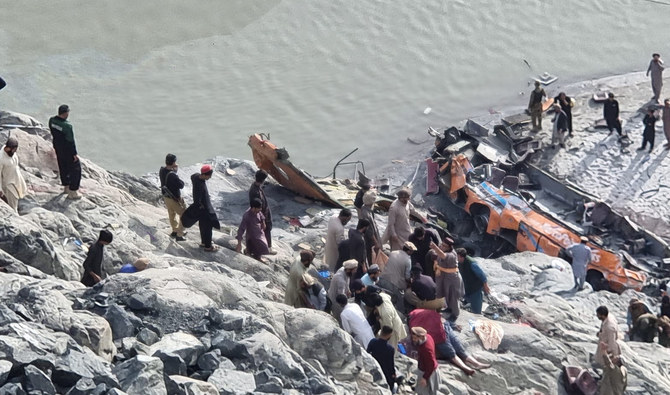
Rescue workers and local residents search for victims in the wreckage of a bus following an accident in Diamer district of Gilgit-Baltistan region on May 3, 2024. (Photo courtesy: SSP Diamer Sardar Sheheryar Khan/ Facebook)
Short Url
Updated 03 May 2024
Follow

At least 20 killed as bus plunges into gorge in northern Pakistan

  • The bus, which carried 42 passengers, was en route to Rawalpindi from Hunza
  • Road accidents are common in Pakistan, where traffic rules are rarely followed

KHAPLU, Gilgit-Baltistan: At least 20 people were killed and over a dozen others were injured after a bus plunged into a gorge in Pakistan’s northern Gilgit-Baltistan (GB) region, officials said on Friday.
The passenger bus was en route to Hunza from the garrison city of Rawalpindi when it plunged into a 300-meter-deep ravine near the Gunar Farm area in GB’s Diamer district, according to Sardar Sheheryar Khan, senior superintendent of police (SSP).
Rescue 1122, police and paramilitary Frontier Constabulary and GB Scouts immediately reached the site and shifted all bodies and injured persons to the Regional Headquarters Hospital in Chilas.
“Soon after the accident, announcements were made from loudspeakers of mosques and local people rushed to the site and joined hands with the administration for the rescue,” Khan told Arab News.
“Dozens of locals are at the hospital for blood donation. Emergency has been imposed at the hospital and all doctors and paramedical staff are busy treating the injured.”
The driver lost control of the bus, which carried 42 passengers, while navigating a curve and it fell into the ravine, according to officials.
“Among the five critically injured, two were shifted to Gilgit via road and three others will be airlifted by army helicopter soon,” Fiaz Ahmad, the Diamer deputy commissioner told reporters.
“Best treatment was being given to injured,” he added.
Prime Minister Shehbaz Sharif expressed regret over the loss of precious lives in the accident. “The prime minister issued directives to provide all possible medical aid to the injured,” Sharif’s office said in a statement.
Interior Minister Mohsin Naqvi extended his condolences to the families of the deceased. “We equally share the sorrow of the bereaved families in this hour of grief,” he said in a statement.
Road accidents are common in Pakistan, where traffic rules are rarely followed and roads, particularly in many rural areas, are in poor condition. In the mountainous Gilgit-Baltistan region, road tragedies are daily news.
In July 2023 alone, at least 41 people, including tourists, were killed in road mishaps across the region, according to rescue officials. In 2022, at least 77 people died and 467 were wounded in accidents in GB.


ADB approves $381 million for climate-resilient agriculture, social services in Punjab

Updated 8 sec ago
Follow

ADB approves $381 million for climate-resilient agriculture, social services in Punjab

  • Support will upgrade Punjab’s education and nursing systems, improving learning outcomes and health care capacity
  • Package includes $124 million for agriculture, $107 million for STEM schooling and $150 million for nursing reforms

KARACHI: The Asian Development Bank (ADB) said on Saturday it approved $381 million in financing for Pakistan’s Punjab province to modernize agriculture and strengthen education and health services, with a major focus on building climate resilience after monsoon floods this year caused widespread destruction across the country’s most populous province.

The package includes concessional loans and grants for farm mechanization, STEM education, and nursing sector reforms.

ADB said the investments are intended to help Punjab, home to more than half of Pakistan’s population and a key contributor to its economy, recover from climate shocks and transition toward more sustainable and resilient development.

“Investing in education, health, and agricultural mechanization will play a transformative role in driving the growth of Punjab, a vital pillar of Pakistan’s economy,” said ADB Country Director for Pakistan Emma Fan. “These strategic investments will modernize agriculture, enhance human capital, and significantly improve livelihoods for millions of people across Punjab.”

The bank approved $120 million in concessional loans and a $4 million grant for the Punjab Climate-Resilient and Low-Carbon Agriculture Mechanization Project, which will support 220,000 rural farm households.

The program aims to reduce climate vulnerability by shifting farmers toward modern, low-emission machinery, provide alternative livelihoods for agricultural workers and train 15,000 women in new skills. It will also introduce a financing model to help small farmers access advanced equipment.

Punjab produces most of Pakistan’s wheat, rice, and maize but still relies on outdated machinery, contributing to grain losses and routine burning of crop residues, a major source of air pollution, said ADB.

It noted the new project will promote modern mechanization, including rice harvesters, to address these issues.

ADB also approved $107 million for the Responsive, Ready, and Resilient STEM Secondary Education in Punjab Program, including a $7 million grant from the Asian Development Fund.

The results-based program aims to modernize secondary schooling by expanding inclusive STEM education, improving access and quality across the province.

A further $150 million concessional loan was approved for the Punjab Nursing and Health Workforce Reform Program, which will upgrade nursing curricula, develop disaster-resilient training facilities, strengthen workforce governance, and introduce digital human-resource systems.

The program seeks to expand the pool of qualified nurses to strengthen health service delivery and meet rising national and global demand.

Key components include the establishment of three centers of excellence in Lahore, Multan and Rawalpindi, equipped with simulation labs, digital learning platforms, and gender-responsive hostels.

ADB said it remains committed to supporting climate-resilient and inclusive development across Asia and the Pacific through innovative financing tools and partnerships.