


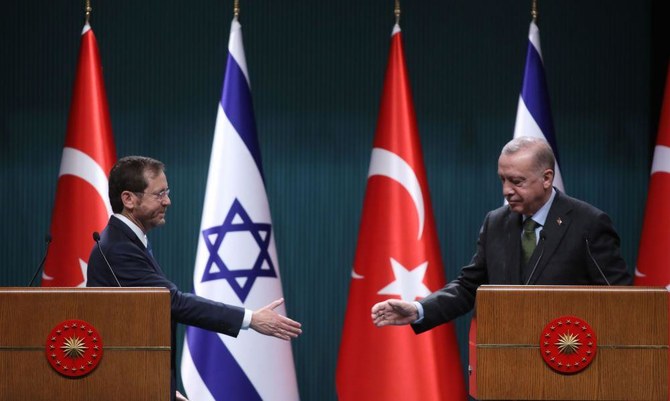
ISTANBUL: Turkiye said on Friday it will not resume trade with Israel, worth $7 billion a year, until a permanent ceasefire and humanitarian aid are secured in Gaza, becoming the first of Israel’s key commercial partners to take such a step.
Israel’s “uncompromising attitude” and the worsening situation in Gaza’s Rafah region, a refuge for displaced people that Israel has threatened to storm — prompted Ankara to halt all exports and imports, Trade Minister Omer Bolat said.
Israeli Foreign Minister Israel Katz criticized Turkish President Tayyip Erdogan’s move, enacted late on Thursday, saying it breaks international trade agreements and was “how a dictator behaves.”
The militant group Hamas, which rules Gaza, praised the decision as brave and supportive of Palestinian rights.
It marks Ankara’s strongest step after months of sharp criticism of Israel’s military campaign, which has laid waste to the densely populated Palestinian enclave. Erdogan had faced growing domestic calls for more tangible action.
Turkiye could not remain idle in the face of “Israeli bombardment of defenseless Palestinians,” Erdogan said after Friday prayers. Israel says it is targeting militants hiding in residential areas.
Erdogan later told Turkish business people that Ankara would manage problems stemming from this decision “in coordination and dialogue” with its business world, adding he believed this would serve as an example for other countries that are “uncomfortable with the current situation.”
“I want this to be known: we aren’t chasing animosity or a fight with any country in our region,” Erdogan said, adding he was aware of “how the West will attack us” over the move.
“We have a single goal here: to force the (Israeli Prime Minister Benjamin) Netanyahu leadership, which has gotten out of control with the West’s unconditional military and diplomatic support, to a ceasefire,” he added.
Bolat said Turkiye was in talks with “Palestinian brothers on alternative arrangements to ensure that they are not affected by this decision.”
Last month, Turkiye curbed exports of steel, fertilizer and jet fuel among 54 product categories over what it said was Israel’s refusal to allow Ankara to take part in aid air-drop operations for Gaza.
BIG HIT TO TRADE
The new ban covers all remaining trade, amounting to $5.4 billion in Turkish exports — or nearly 6 percent of all of Israel’s imports — and $1.6 billion in imports to Turkiye last year.
Top Turkish exports to Israel are steel, vehicles, plastics, electrical devices and machinery, while imports are dominated by fuels at $634 million last year, Turkish trade data show.
Wall Street bank JPMorgan said the halt may marginally raise price pressures for goods in Israel in the short term.
Four Turkish exporters told Reuters the move blindsided them and left those with firm orders looking for ways to send goods to Israel via third countries.
Katz said blocking ports for Israeli imports and exports ignores trade deals, adding on social media platform X that Israel would work toward alternatives for trade with Turkiye.
However, Meltem Saribeyoglu-Skalar, professor at Marmara University’s Faculty of Law, said the move is likely a legal counter-measure by Turkiye against Israeli breaches of universally accepted rules of humanitarian law in Gaza.
Turkiye has denounced Israel’s military campaign in Gaza, sent thousands of tons of aid for Gazans and, this week, said it would join South Africa’s genocide case against Israel at the International Court of Justice (ICJ).
Israel denies committing acts of genocide in Gaza or violating humanitarian law there.
Sinan Ulgen, a former Turkish diplomat and director of the Center for Economic and Foreign Policy Studies, said the move is widely backed by Turks given the “the common opinion that the government’s reaction toward Israel has been inadequate.”
The Turkish Exporters Assembly said the country would have to trim year-end export targets toward $260 billion from $267 billion unless trade resumes with Israel in a couple of months. Exports to Israel are down 24 percent through April this year compared with 2023, its data show.


