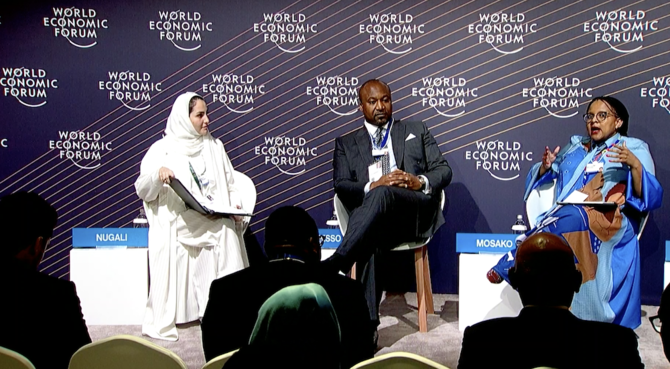

RIYADH: Member nations of the Gulf Cooperation Council can play a pivotal role in developing African economies, a special meeting of the World Economic Forum in Riyadh was told on Sunday.
Economic relations between Africa and the GCC are set to grow significantly in the coming years, economists have said, driven by mutual interests in economic diversification, investment and sustainable development.
Denis Christel Sassou Nguesso, the Republic of Congo’s international cooperation minister, said countries in central and western Africa had traditionally looked to Western powers, such as the US, France and the UK, for assistance with their development but were increasingly looking to forge links with GCC countries.
“It’s a good opportunity and position to start to work on this cooperation with (countries such as) Saudi Arabia, UAE, Qatar, Oman and Bahrain. They can help (African) countries to develop their economies and infrastructure projects,” he said.
“We’re not looking for an equal economy (with GCC states), but we’d like to build some bridges toward partnerships between our countries, to promote the public-private partnership.”
Boitumelo Mosako, CEO at the Development Bank of Southern Africa, told the panel that the GCC and African Union were founded on the same date, which coincides with Africa Day.
The GCC and the Organization of African Unity, which was replaced by the African Union, were both founded on May 25.
This was a symbol of the strong partnerships that had evolved between Africa and GCC countries, especially in direct trade, Mosako said.
“When it comes to infrastructure, that is where I see the greatest opportunity. As we all know, (Africa) is a continent with an infrastructure backlog, but we are one with aspirations of implementing an African free-trade agreement.”
But in order for this to be achieved, infrastructure projects had to be built quickly, which would not only benefit African economies but also global partners as Africa’s exports to those countries would be able to increase exponentially, Mosako said.
Highlighting opportunities in energy investment from GCC countries, she added: “We have seen this in South Africa, where GCC companies have partnered local entities as part of a renewable energy program, so it’s not something far-fetched, it’s actually happening. It’s an opportunity to close the energy gap for the continent.”
Ousmane Dione, vice president for the Middle East and North Africa at the World Bank, said that at its shortest distance, there were only 26 km between Africa and the GCC, but there was a much bigger metaphorical gap in investment from the GCC states into Africa, which he called a “land of opportunity.”
He said that by 2035, there would be 430 million young Africans coming into the labor market competing for just 100 million jobs if current policies remained in place.
This could either be a “demographic liability or a demographic dividend” depending on how other countries viewed it, he said.
“I see the GCC countries really being a part of what will be the future of that relationship, in terms of a partnership.”