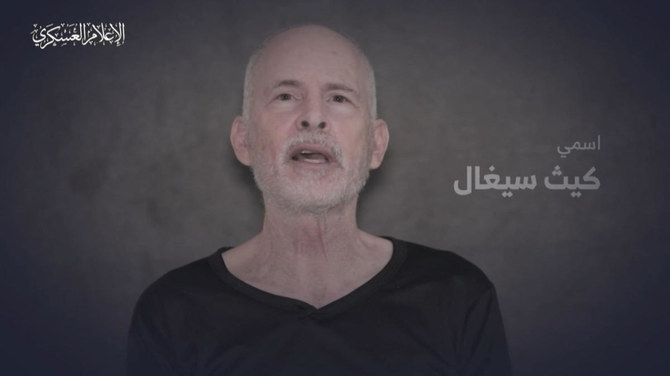
GAZA STRIP, Palestinian Territories: Hamas’s armed wing released video Saturday of two men held hostage in Gaza who are seen alive and urging Israeli authorities to strike a deal for the release of all the remaining captives.
Campaign group the Hostages and Missing Families Forum identified the two as Keith Siegel and Omri Miran who were abducted by militants during the Hamas attack on southern Israel on October 7.
“The proof of life from Keith Siegel and Omri Miran is the clearest evidence that the Israeli government must do everything to approve a deal for the return of all the hostages before Independence Day (on May 14),” the forum said in a statement.
“The living should return for rehabilitation, and the murdered should receive a dignified burial.”
The latest video comes just three days after Hamas released another video showing hostage Hersh Goldberg-Polin alive.
Siegel and Miran appeared to speak under duress.
“I have been here in Hamas captivity for 202 days. The situation here is unpleasant, difficult and there are many bombs,” Miran, 47, is heard saying in the footage, indicating it was taken earlier this week.
“It’s time to reach a deal that will get us out of here safe and healthy... Keep protesting, so that there will be a deal now.”
Saturday’s video comes as Hamas says it is studying Israel’s latest counterproposal for a Gaza ceasefire after reports that mediator Egypt had sent a delegation to Israel to jump-start stalled negotiations.
Siegel, 64, who also spoke in the video, broke down as he talked of their captivity.
“We are in danger here, there are bombs, it is stressful and scary,” he said, burying his face in his arms as he cried.
“I want to tell my family that I love you very much. It’s important to me that you know that I am fine.
“I have very, very beautiful memories of last year’s Passover that we all celebrated together. I really hope that we will have the best possible surprise,” he said, appealing to Prime Minister Benjamin Netanyahu to reach a deal soon.
Siegel said he seen footage of demonstrations in Israel calling for a deal to secure the release of hostages.
“I hope and believe that you will all continue,” he said, addressing the demonstrators who have been holding regular rallies calling on Netanyahu to agree a deal.
The Ezzedine Al-Qassam Brigades, the armed wing of Hamas, published some lines in Hebrew in the video.
“The military pressure did not succeed in freeing your captive sons,” it said.
“Do what you need to do before it is too late,” said another message in Hebrew.
Later on Saturday, crowds of protesters gathered in Tel Aviv demanding that the authorities strike a deal for the release of the hostages.
“A deal now,” chanted demonstrators as they called for Netanyahu and his government to resign.
Miran’s father Dani attended the rally and urged Hamas leader in Gaza Yahya Sinwar to agree a deal.
“All the people of Israel and the nations of the world want to see an end to the bloodshed and especially an end to the suffering of your people,” he said.
“Please, one request — make a decision now.”
Organizers of the rally showed the video as protesters chanted against the authorities, an AFP correspondent reported.
“Keith, I love you. We will fight until your return,” said Siegel’s wife Aviv who took part in the protest.
Israeli authorities accuse Sinwar of planning the October 7 attack during which Hamas-led militants abducted some 250 people.
The military says 129 of them are still held captive in Gaza, including 34 who are dead.
The attack resulted in the deaths of 1,170 people, most of them civilians, according to an AFP tally of Israeli official figures.
Israel’s retaliatory military offensive in Gaza has killed 34,388 people, most of them women and children, according to the territory’s health ministry.

Hamas releases video of two hostages calling for Gaza deal
Short Url
https://arab.news/bpte5
Hamas releases video of two hostages calling for Gaza deal
- “The situation here is unpleasant, difficult and there are many bombs,” Miran is heard saying
- “We are in danger here, there are bombs, it is stressful and scary,” Siegel, 64, said burying his face in his arms as he cried
Gaza amputees struggle to rebuild lives as the enclave faces shortages of prosthetic limbs
NUSEIRAT: Sitting in her wheelchair, Haneen Al-Mabhouh dreams of rebuilding her family, of cradling a new baby. She dreams of walking again. But with her leg gone, her life in Gaza is on hold, she says, as she waits to go abroad for further treatment.
An Israeli airstrike in July 2024 smashed her home in central Gaza as she and her family slept. All four of her daughters were killed, including her 5-month-old baby. Her husband was severely burned. Al-Mabhouh’s legs were crushed under the rubble, and doctors had to amputate her right leg above the knee.
“For the past year and a half, I have been unable to move around, to live like others. For the past year and a half, I have been without children,” she said, speaking at her parents’ home.
The 2-month-old ceasefire in Gaza has been slow to bring help for thousands of Palestinians who suffered amputations from Israeli bombardment over the past two years. The World Health Organization estimates there are some 5,000 to 6,000 amputees from the war, 25 percent of them children.
Those who lost limbs are struggling to adapt, faced with a shortage of prosthetic limbs and long delays in medical evacuations out of Gaza.
The WHO said a shipment of essential prosthetic supplies recently made it into Gaza. That appears to be the first significant shipment for the past two years.
Previously, Israel had let in almost no ready-made prosthetic limbs or material to manufacture limbs since the war began, according to Loay Abu Saif, the head of the disability program at Medical Aid for Palestinians, or MAP, and Nevin Al Ghussein, acting director of the Artificial Limbs and Polio Center in Gaza City.
The Israeli military body in charge of coordinating aid, known as COGAT, did not respond when asked how many prosthetic supplies had entered during the war or about its policies on such supplies.
‘My future is paralyzed’
Al-Mabhouh was asleep with her baby girl in her arms when the strike hit their home in Nuseirat, she said. For several weeks while recovering in the hospital, Al-Mabhouh had no idea her children had been killed.
She underwent multiple surgeries. Her hand still has difficulty moving. Her remaining leg remains shattered, held together with rods. She needs a bone graft and other treatments that are only available outside of Gaza.
She was put on the list for medical evacuation 10 months ago but still hasn’t gotten permission to leave Gaza.
Waiting for her chance to go, she lives at her parents’ house. She needs help changing clothes and can’t even hold a pen, and remains crushed by grief over her daughters. “I never got to hear her say ‘mama,’ see her first tooth or watch her take her first steps,” she said of her baby.
She dreams of having a new child but can’t until she gets treatment.
“It’s my right to live, to have another child, to regain what I lost, to walk, just to walk again,” she said. “Now my future is paralyzed. They destroyed my dreams.”
Medical evacuations remain slow
The ceasefire has hardly brought any increase in medical evacuations for the 16,500 Palestinians the UN says are waiting to get vital treatment abroad — not just amputees, but patients suffering many kinds of chronic conditions or wounds.
As of Dec. 1, 235 patients have been evacuated since the ceasefire began in October, just under five a day. In the months before that, the average was about three a day.
Israel last week said it was ready to allow patients and other Palestinians to leave Gaza via the Israeli-held Rafah crossing between Gaza and Egypt. But it’s unsure that will happen because Egypt, which controls the crossing’s other side, demands Rafah also be opened for Palestinians to enter Gaza as called for under the ceasefire deal.
Dr. Richard Peeperkorn, the WHO’s representative in the occupied Palestinian territory, told The Associated Press that the backlog is caused by the lack of countries to host the evacuated patients. He said new medevac routes need to be opened, especially to the Israeli-occupied West Bank and east Jerusalem, where hospitals are ready to receive patients.
For those waiting, life grinds to a standstill
Yassin Marouf lies in a tent in central Gaza, his left foot amputated, his right leg barely held together with rods.
The 23-year-old and his brother were hit by Israeli shelling in May as they returned from visiting their home in northern Gaza that their family had been forced to flee. His brother was killed. Marouf lay bleeding on the ground, as a stray dog attacked his mangled left leg.
Doctors say his right leg will also need to be amputated, unless he can travel abroad for operations that might save it. Marouf said he can’t afford painkillers and can’t go to the hospital regularly to have his bandages changed as they’re supposed to.
“If I want to go to the bathroom, I need two or three people to carry me,” he said.
Mohamed Al-Naggar had been pursuing an IT degree at the University of Palestine before the war.
Seven months ago, shrapnel pierced his left leg during strikes on the house where his family was sheltering. Doctors amputated his leg above the knee. His right leg was also badly injured and shrapnel remains in parts of his body.
Despite four surgeries and physical therapy, the 21-year-old Al-Naggar can’t move around.
“I’d like to travel abroad and put on a prosthetic and graduate from college and be normal like young people outside Gaza,” he said.
Gaza faces prosthetic limb shortage
Some 42,000 Palestinians have suffered life-changing injuries in the war, including amputations, brain trauma, spinal cord injuries and major burns, the WHO said in an October report.
The situation has “improved slightly” for those with assistance needs but “there is still a huge overall shortage of assistive products,” such as wheelchairs, walkers and crutches. Gaza has only eight prosthetists able to manufacture and fit artificial limbs, the WHO said in a statement to the AP.
The Artificial Limbs and Polio Center in Gaza City, one of two prosthetics centers still operating in the territory, received a shipment of material to manufacture limbs just before the war began in 2023, said its director, Al Ghussein. Another small shipment entered in December 2024, but nothing since.
The center has been able to provide artificial limbs for 250 cases over the course of the war, but supplies are running out, Al Ghussein said.
No pre-made prosthetic legs or arms have entered, according to Abu Saif of MAP, who said Israel does not ban them, but its procedures cause delays and “in the end they ignore it.”
Ibrahim Khalif wants a prosthetic right leg so he can get a job doing manual labor or cleaning houses to support his pregnant wife and children.
In January, he lost his leg when an Israeli airstrike hit Gaza City while he was out getting food.
“I used to be the provider for my kids, but now I’m sitting here,” Khalif said. “I think of how I was and what I’ve become.”
An Israeli airstrike in July 2024 smashed her home in central Gaza as she and her family slept. All four of her daughters were killed, including her 5-month-old baby. Her husband was severely burned. Al-Mabhouh’s legs were crushed under the rubble, and doctors had to amputate her right leg above the knee.
“For the past year and a half, I have been unable to move around, to live like others. For the past year and a half, I have been without children,” she said, speaking at her parents’ home.
The 2-month-old ceasefire in Gaza has been slow to bring help for thousands of Palestinians who suffered amputations from Israeli bombardment over the past two years. The World Health Organization estimates there are some 5,000 to 6,000 amputees from the war, 25 percent of them children.
Those who lost limbs are struggling to adapt, faced with a shortage of prosthetic limbs and long delays in medical evacuations out of Gaza.
The WHO said a shipment of essential prosthetic supplies recently made it into Gaza. That appears to be the first significant shipment for the past two years.
Previously, Israel had let in almost no ready-made prosthetic limbs or material to manufacture limbs since the war began, according to Loay Abu Saif, the head of the disability program at Medical Aid for Palestinians, or MAP, and Nevin Al Ghussein, acting director of the Artificial Limbs and Polio Center in Gaza City.
The Israeli military body in charge of coordinating aid, known as COGAT, did not respond when asked how many prosthetic supplies had entered during the war or about its policies on such supplies.
‘My future is paralyzed’
Al-Mabhouh was asleep with her baby girl in her arms when the strike hit their home in Nuseirat, she said. For several weeks while recovering in the hospital, Al-Mabhouh had no idea her children had been killed.
She underwent multiple surgeries. Her hand still has difficulty moving. Her remaining leg remains shattered, held together with rods. She needs a bone graft and other treatments that are only available outside of Gaza.
She was put on the list for medical evacuation 10 months ago but still hasn’t gotten permission to leave Gaza.
Waiting for her chance to go, she lives at her parents’ house. She needs help changing clothes and can’t even hold a pen, and remains crushed by grief over her daughters. “I never got to hear her say ‘mama,’ see her first tooth or watch her take her first steps,” she said of her baby.
She dreams of having a new child but can’t until she gets treatment.
“It’s my right to live, to have another child, to regain what I lost, to walk, just to walk again,” she said. “Now my future is paralyzed. They destroyed my dreams.”
Medical evacuations remain slow
The ceasefire has hardly brought any increase in medical evacuations for the 16,500 Palestinians the UN says are waiting to get vital treatment abroad — not just amputees, but patients suffering many kinds of chronic conditions or wounds.
As of Dec. 1, 235 patients have been evacuated since the ceasefire began in October, just under five a day. In the months before that, the average was about three a day.
Israel last week said it was ready to allow patients and other Palestinians to leave Gaza via the Israeli-held Rafah crossing between Gaza and Egypt. But it’s unsure that will happen because Egypt, which controls the crossing’s other side, demands Rafah also be opened for Palestinians to enter Gaza as called for under the ceasefire deal.
Dr. Richard Peeperkorn, the WHO’s representative in the occupied Palestinian territory, told The Associated Press that the backlog is caused by the lack of countries to host the evacuated patients. He said new medevac routes need to be opened, especially to the Israeli-occupied West Bank and east Jerusalem, where hospitals are ready to receive patients.
For those waiting, life grinds to a standstill
Yassin Marouf lies in a tent in central Gaza, his left foot amputated, his right leg barely held together with rods.
The 23-year-old and his brother were hit by Israeli shelling in May as they returned from visiting their home in northern Gaza that their family had been forced to flee. His brother was killed. Marouf lay bleeding on the ground, as a stray dog attacked his mangled left leg.
Doctors say his right leg will also need to be amputated, unless he can travel abroad for operations that might save it. Marouf said he can’t afford painkillers and can’t go to the hospital regularly to have his bandages changed as they’re supposed to.
“If I want to go to the bathroom, I need two or three people to carry me,” he said.
Mohamed Al-Naggar had been pursuing an IT degree at the University of Palestine before the war.
Seven months ago, shrapnel pierced his left leg during strikes on the house where his family was sheltering. Doctors amputated his leg above the knee. His right leg was also badly injured and shrapnel remains in parts of his body.
Despite four surgeries and physical therapy, the 21-year-old Al-Naggar can’t move around.
“I’d like to travel abroad and put on a prosthetic and graduate from college and be normal like young people outside Gaza,” he said.
Gaza faces prosthetic limb shortage
Some 42,000 Palestinians have suffered life-changing injuries in the war, including amputations, brain trauma, spinal cord injuries and major burns, the WHO said in an October report.
The situation has “improved slightly” for those with assistance needs but “there is still a huge overall shortage of assistive products,” such as wheelchairs, walkers and crutches. Gaza has only eight prosthetists able to manufacture and fit artificial limbs, the WHO said in a statement to the AP.
The Artificial Limbs and Polio Center in Gaza City, one of two prosthetics centers still operating in the territory, received a shipment of material to manufacture limbs just before the war began in 2023, said its director, Al Ghussein. Another small shipment entered in December 2024, but nothing since.
The center has been able to provide artificial limbs for 250 cases over the course of the war, but supplies are running out, Al Ghussein said.
No pre-made prosthetic legs or arms have entered, according to Abu Saif of MAP, who said Israel does not ban them, but its procedures cause delays and “in the end they ignore it.”
Ibrahim Khalif wants a prosthetic right leg so he can get a job doing manual labor or cleaning houses to support his pregnant wife and children.
In January, he lost his leg when an Israeli airstrike hit Gaza City while he was out getting food.
“I used to be the provider for my kids, but now I’m sitting here,” Khalif said. “I think of how I was and what I’ve become.”
© 2025 SAUDI RESEARCH & PUBLISHING COMPANY, All Rights Reserved And subject to Terms of Use Agreement.


