

Army chief stresses economic stability as key to national sovereignty at Green Pakistan conference

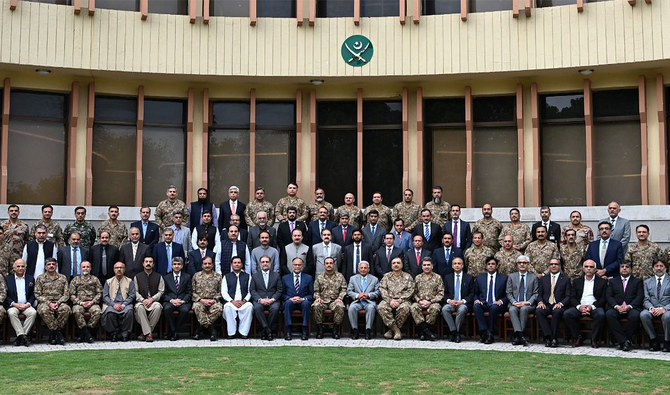
Pakistan’s army chief General Asim Munir (center in first row) poses for group picture with the participants of Green Pakistan conference in Rawalpindi, Pakistan on April 26, 2024. (ISPR)
Short Url
Updated 26 April 2024
Follow

Army chief stresses economic stability as key to national sovereignty at Green Pakistan conference

  • General Asim Munir says army will continue to support the government with economic development of Pakistan
  • He tells the gathering the military will provide comprehensive national security, work for Pakistan’s collective good

ISLAMABAD: Pakistan’s army chief General Asim Munir emphasized the importance of economic stability for a country to achieve full sovereignty while addressing the Green Pakistan Initiative conference on Friday, adding that his institution would continue to support the government in these efforts.

The initiative was launched as a response to the severe climate change impacts that Pakistan has faced over the years, including droughts, catastrophic floods, and extreme heatwaves. The program aims not only to mitigate the effects of erratic weather patterns by improving forest cover and restoring the ecosystem but also enhance the country’s resilience against future climatic shocks.

Pakistan has witnessed a growing awareness about the nexus between environmental issues and national security, prompting various sectors, including the military, to contribute to such green efforts.

“Pakistan is a blessed land with an industrious and resilient nation which needs to come together for national development,” the military’s media wing, ISPR, quoted the army chief in a statement circulated after the conference.

“Pakistan Army will continue to provide all possible support for the economic development of Pakistan,” he continued while pointing out the efforts of his institution to provide comprehensive national security and work for the collective good of the nation.

The state-owned PTV News reported the army chief warned all those who were trying to stop the country from progressing that their efforts would be wasted.

“In today’s era, the concept of complete sovereignty is not possible without economic stability,” he added.

Senior members of Pakistan’s federal cabinet were also present at the conference.

The participants reviewed the progress made under the initiative, expressing satisfaction that the country had achieved significant milestones under the program by establishing model farms, launching water management schemes and enhancing agricultural productivity.


Pakistan flags funding strain, host state cooperation gaps in UN peacekeeping

Updated 7 sec ago
Follow

Pakistan flags funding strain, host state cooperation gaps in UN peacekeeping

  • Pakistan says blue helmets remain the most visible symbol of UN commitment to peace
  • The country urges member states to pay contributions on time to sustain UN missions

ISLAMABAD: Pakistan on Friday raised concerns over mounting financial pressures on United Nations peacekeeping operations along with a lack of cooperation from some host countries, warning that the challenges risk undermining the effectiveness and safety of missions worldwide.

Pakistan’s top diplomat at the UN flagged the issues while speaking at a UN Security Council briefing on peacekeeping police components.

Pakistan is one of the world’s top troop-contributing countries and has deployed more than 235,000 peacekeepers to 48 UN missions across four continents over the past eight decades.

A total of 182 of its peacekeepers have also lost their lives while serving under the UN flag.

“We are concerned at the current challenges faced by the United Nations peacekeeping, both financial as well as those arising from lack of host state cooperation,” Ambassador Asim Iftikhar Ahmad told the council. “Pakistan underscores the importance of full cooperation by host States to enable timely deployment of peacekeepers including police components where authorized by the Security Council.”

He noted that UN missions were operating under acute financial stress, leading to capacity reductions that directly affected mandate delivery and the safety of peacekeepers, while UN police units continued to face gaps between authorized strength and actual deployments.

Ahmad urged UN member states to pay their assessed contributions in full and on time to ensure peacekeeping missions remain operationally capable.

“Blue helmets are the most visible symbol of the United Nations commitment to peace and stability,” he said. “Peacekeeping brings relevance and legitimacy to this organization by making a tangible difference in people’s lives.”

Pakistan has contributed both military and police personnel to UN operations, deploying more than 50 formed police units to missions including Haiti, Darfur, Timor-Leste and Côte d’Ivoire, according to Pakistan’s UN mission.