



JEDDAH: More than 280 million people worldwide suffered from acute hunger last year in a food security crisis driven by conflicts in Gaza and Sudan, UN agencies and development groups said on Wednesday.
Economic shocks also added to the number of victims, which grew by 24 million compared with 2022, according to a report by the Food Security Information Network. The number of nations with food crises that are monitored has also been expanded.
The report, which called the global outlook for this year “bleak,” is produced for an international alliance of UN agencies, the EU and governmental and non-governmental bodies.
Máximo Torero, chief economist for the UN’s Food and Agriculture Organization, said 705,000 people in five countries are at Phase 5, the highest level, on a scale of hunger determined by international experts — the highest number since the global report began in 2016 and quadruple the number that year.
Food insecurity is defined as when populations face food deprivation that threatens lives or livelihoods, regardless of the causes or length of time. More geographical areas experienced “new or intensified shocks” and there was a “marked deterioration in key food crisis contexts such as Sudan and the Gaza Strip,” said Fleur Wouterse, a senior official at the UN’s Food and Agriculture Organization.
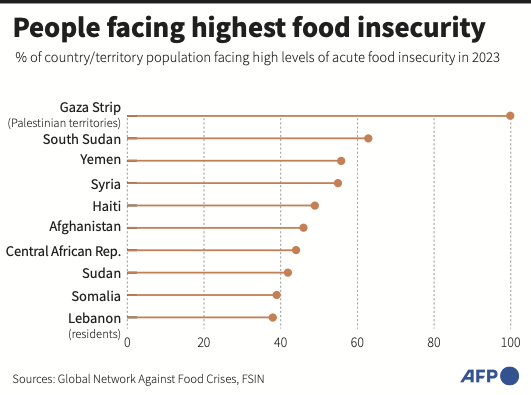
Over 80 percent of those facing imminent famine — 577,000 people — were in Gaza, he said. South Sudan, Burkina Faso, Somalia and Mali each host many thousands also facing catastrophic hunger.
According to the report’s future outlook, around 1.1 million people in Gaza, where the Israel-Hamas war is now in its seventh month, and 79,000 in South Sudan are projected to be in Phase 5 and facing famine by July.
It said conflict will also continue to drive food insecurity in Haiti, where gangs control large portions of the capital.
Additionally, while the El Nino phenomenon peaked in early 2024, “its full impact on food security – including flooding and poor rain in parts of east Africa and drought in southern Africa, especially Malawi, Zambia and Zimbabwe – are like to manifest throughout the year.”
Since the first report by the Global Food Crisis Network covering 2016, the number of food-insecure people has risen from 108 million to 282 million, Wouterse said. The share of the population affected within the areas concerned had doubled from 11 percent to 22 percent, she said.
UN Secretary-General Antonio Guterres called the report “a roll call of human failings,” and that “in a world of plenty, children are starving to death.”
“The conflicts erupting over the past 12 months compound a dire global situation,” he wrote in the report’s foreword.
Guterres highlighted the conflict in the Gaza Strip, as the enclave holds the highest number of people facing catastrophic hunger. There is also the year-old conflict in Sudan, which has created the world’s largest internal displacement crisis “with atrocious impacts on hunger and nutrition,” he added.
According to the report, over 36 million people in 39 countries and territories are facing an acute hunger emergency, a step below the famine level in Phase 4, with more than a third in Sudan and Afghanistan. It’s an increase of a million people from 2022, the report said.
Arif Husain, the UN World Food Program’s chief economist, said every year since 2016 the numbers of people acutely food insecure have gone up, and they are now more than double the numbers before the COVID-19 pandemic.
While the report looks at 59 countries, he said the target is to get data from 73 countries where there are people who are acutely food insecure.
Secretary-General Guterres called for an urgent response to the report’s findings that addresses the underlying causes of acute hunger and malnutrition while transforming the systems that supply food. Funding is also not keeping pace with the needs, he stressed.
“We must have the funding, and we also must have the access,” WFP’s Husain said, stressing that both “go hand-in-hand” and are essential to tackle acute food insecurity.
The report is the flagship publication of the Food Security Information Network and is based on a collaboration of 16 partners including UN agencies, regional and multinational bodies, the European Union, the US Agency for International Development, technical organizations and others.
(With Agencies)


