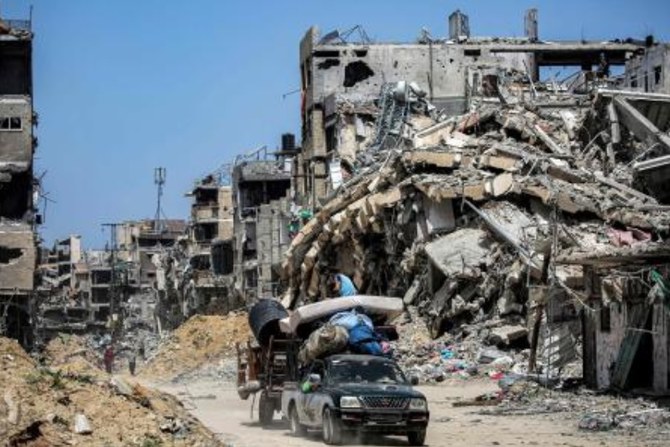
CAIRO: Egypt has condemned the repeated Israeli violations of international law and international humanitarian law in the Gaza Strip.
The Egyptian Ministry of Foreign Affairs said: “It is regrettable and shameful that violations of international law and humanitarian values continue in such a flagrant manner in the 21st century, in full view and hearing of all countries, international organizations, and the Security Council.”
This came during statements made by ministry spokesman Ahmed Abu Zeid regarding the discovery of mass graves in the Nasser Medical Complex in Khan Yunis in the southern Gaza Strip.
Egypt said it condemned violations of international law including the targeting of civilians, displaced persons, and medical teams by Israeli forces.
Abu Zeid reiterated the need for immediate intervention by the international community to stop such violations and to conduct the necessary investigations to hold perpetrators accountable.
He added that the killing, destruction, and violence witnessed in the West Bank over the past few weeks is no less dangerous, further aggravates the crisis, and threatens to escalate tensions across all occupied Palestinian territories.
He called for an immediate halt to the violence and attacks by settlers, protected by Israeli forces, against Palestinian civilians, their property, and homes in the West Bank.
The bodies of over 200 Palestinians, including patients, have been uncovered so far in mass graves at the Nasser Medical Complex in Gaza’s Khan Younis since Saturday, according to media reports.

Egypt condemns Israeli human rights violations in Gaza Strip
Short Url
https://arab.news/z4krz
Egypt condemns Israeli human rights violations in Gaza Strip
- Egypt said it condemned violations of international law including the targeting of civilians
- Abu Zeid reiterated the need for immediate intervention by the international community to stop such violations
Israel to take more West Bank powers and relax settler land buys, media say
JERUSALEM: Israel’s security cabinet approved a series of steps on Sunday that would make it easier for settlers in the occupied West Bank to buy land while granting Israeli authorities more enforcement powers over Palestinians, Israeli media reported.
The West Bank is among the territories that the Palestinians seek for a future independent state. Much of it is under Israeli military control, with limited Palestinian self-rule in some areas run by the Western-backed Palestinian Authority (PA).
Citing statements by Finance Minister Bezalel Smotrich and Defense Minister Israel Katz, Israeli news sites Ynet and Haaretz said the measures included scrapping decades-old regulations that prevent Jewish private citizens buying land in the West Bank.
They were also reported to include allowing Israeli authorities to administer some religious sites, and expand supervision and enforcement in areas under PA administration in matters of environmental hazards, water offenses and damage to archaeological sites.
Palestinian President Mahmoud Abbas said the new measures were dangerous, illegal and tantamount to de-facto annexation.
The Israeli ministers did not immediately respond to requests for comment.
The new measures come three days before Prime Minister Benjamin Netanyahu is scheduled to meet in Washington with US President Donald Trump.
In his statement, Abbas urged Trump and the UN Security Council to intervene.
Trump has ruled out Israeli annexation of the West Bank but his administration has not sought to curb Israel’s accelerated settlement building, which the Palestinians say denies them a potential state by eating away at its territory.
Netanyahu, who is facing an election later this year, deems the establishment of any Palestinian state a security threat.
His ruling coalition includes many pro-settler members who want Israel to annex the West Bank, land captured in the 1967 Middle East war to which Israel cites biblical and historical ties.
The United Nations’ highest court said in a non-binding advisory opinion in 2024 that Israel’s occupation of Palestinian territories and settlements there is illegal and should be ended as soon as possible. Israel disputes this view.
The West Bank is among the territories that the Palestinians seek for a future independent state. Much of it is under Israeli military control, with limited Palestinian self-rule in some areas run by the Western-backed Palestinian Authority (PA).
Citing statements by Finance Minister Bezalel Smotrich and Defense Minister Israel Katz, Israeli news sites Ynet and Haaretz said the measures included scrapping decades-old regulations that prevent Jewish private citizens buying land in the West Bank.
They were also reported to include allowing Israeli authorities to administer some religious sites, and expand supervision and enforcement in areas under PA administration in matters of environmental hazards, water offenses and damage to archaeological sites.
Palestinian President Mahmoud Abbas said the new measures were dangerous, illegal and tantamount to de-facto annexation.
The Israeli ministers did not immediately respond to requests for comment.
The new measures come three days before Prime Minister Benjamin Netanyahu is scheduled to meet in Washington with US President Donald Trump.
In his statement, Abbas urged Trump and the UN Security Council to intervene.
Trump has ruled out Israeli annexation of the West Bank but his administration has not sought to curb Israel’s accelerated settlement building, which the Palestinians say denies them a potential state by eating away at its territory.
Netanyahu, who is facing an election later this year, deems the establishment of any Palestinian state a security threat.
His ruling coalition includes many pro-settler members who want Israel to annex the West Bank, land captured in the 1967 Middle East war to which Israel cites biblical and historical ties.
The United Nations’ highest court said in a non-binding advisory opinion in 2024 that Israel’s occupation of Palestinian territories and settlements there is illegal and should be ended as soon as possible. Israel disputes this view.
© 2026 SAUDI RESEARCH & PUBLISHING COMPANY, All Rights Reserved And subject to Terms of Use Agreement.


