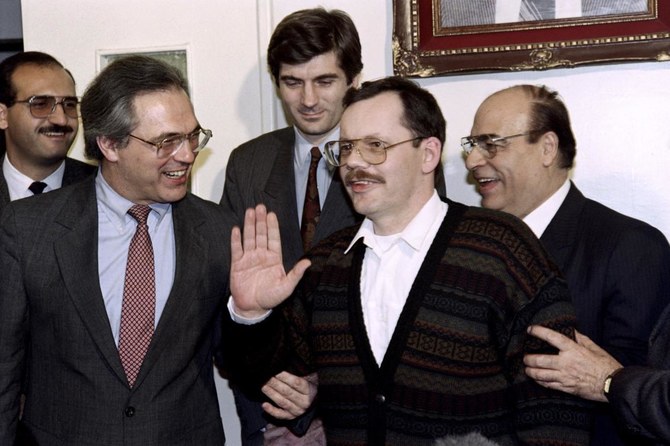
Terry Anderson, US journalist held hostage nearly 7 years in Lebanon, dead at 76

During captivity, both his father and brother would die of cancer and he would not see his daughter Sulome until she was six years old. (AFP/File)
Short Url
Updated 22 April 2024
Follow

Terry Anderson, US journalist held hostage nearly 7 years in Lebanon, dead at 76

  • Former AP correspondent was abuducted by pro-Iran Shiite Muslim group as part of “continuing operations against Americans”

LONDON: Terry Anderson, a US journalist who was held captive by Islamist militants for almost seven years in Lebanon and came to symbolize the plight of Western hostages during the country’s 1975-1990 civil war, died on Sunday at age 76, his daughter said in a statement.
The former chief Middle East correspondent for The Associated Press, who was the longest held hostage of the scores of Westerners abducted in Lebanon, died at his home in Greenwood Lake, New York, said his daughter Sulome Anderson, who was born three months after he was seized. No cause of death was given.
Kept in barely-lit cells by mostly Shiite Muslim groups in what was known as The Hostage Crisis, and chained by his hands and feet and blindfolded much of the time, the former Marine later recalled that he “almost went insane” and that only his Roman Catholic faith prevented him from taking his life before he was freed in December 1991.
“Though my father’s life was marked by extreme suffering during his time as a hostage in captivity, he found a quiet, comfortable peace in recent years. I know he would choose to be remembered not by his very worst experience, but through his humanitarian work with the Vietnam Children’s Fund, the Committee to Protect Journalists, homeless veterans and many other incredible causes,” Sulome Anderson said.
The family will take some time to organize a memorial, she said.
Anderson’s ordeal began in Beirut on the morning of March 16, 1985, after he played a round of tennis. A green Mercedes sedan with curtains over the rear window pulled up, three gunmen jumped out and dragged Anderson, still dressed in shorts, into the car.
The pro-Iran Islamic Jihad group claimed responsibility for the kidnapping, saying it was part of “continuing operations against Americans.” The abductors demanded freedom for Shiite Muslims jailed in Kuwait for bomb attacks against the US and French embassies there.
It was the start of a nightmare for Anderson that would last six years and nine months during which he was stuck in cells under the rubble-strewn streets of Beirut and elsewhere, often badly fed and sleeping on a thin, dirty mattress on a concrete floor.
During captivity, both his father and brother would die of cancer and he would not see his daughter Sulome until she was six years old.
“What kept me going?” he asked aloud shortly after release. “My companions. I was lucky to have people with me most of the time. My faith, stubbornness. You do what you have to. You wake up every day, summon up the energy from somewhere. You think you haven’t got it and you get through the day and you do it. Day after day after day.”
Other hostages described Anderson as tough and active in captivity, learning French and Arabic and exercising regularly.
However, they also told of him banging his head against a wall until he bled in frustration at beatings, isolation, false hopes and the feeling of being neglected by the outside world.
“There is a limit of how long we can last and some of us are approaching the limit very badly,” Anderson said in a videotape released by his captors in December 1987.
Marcel Fontaine, a French diplomat who was released in May 1988 after three years of captivity, recalled the time cell mate Anderson thought freedom was near because he was allowed to see the sun and eat a hamburger.
In April 1987 Anderson was given a suit of clothes that his captors had made for him. “He wore it every day,” Fontaine said.
A week later, however, Anderson’s captors took the suit back, leaving him in despair and certain he was forgotten, Fontaine said.
Scores of journalist groups, governments and individuals over the years called for Anderson’s release and his Oct. 27 birthday became an unofficial US memorial day for hostages.
Anderson said he considered killing himself several times but rejected it. He relied heavily on his faith, which he said he had renewed six months before being kidnapped.
“I must have read the Bible 50 times from start to finish,” he said. “It was an enormous help to me.”
His sister, Peggy Say, who died in 2015, was his fiercest advocate during captivity.
She worked tirelessly for her brother’s freedom. She visited Arab and European capitals, lobbied the Pope, the Archbishop of Canterbury and every US official and politician available.
Under pressure from the media and the US hostages’ families, the Reagan administration negotiated a secret and illegal deal in the mid-1980s to facilitate arms sales to Iran in return for the release of American hostages. But the deal, known as the Iran–Contra affair, failed to gain freedom for any of the hostages.
Born Oct. 27, 1947, in Lorain, Ohio, Anderson grew up in Batavia, New York. He graduated from Iowa State University and spent six years in the Marine Corps, mostly as a journalist.
He worked for the AP in Detroit, Louisville, New York, Tokyo, Johannesburg and then Beirut, where he first went to cover the Israeli invasion in 1982.
In that war-torn city, he fell in love with Lebanese woman Madeleine Bassil, who was his fiance and pregnant with their daughter Sulome when he was snatched.
He is survived by his daughters Sulome and Gabrielle, his sister Judy and brother Jack, and by Bassil, whom Sulome Anderson called “his ex-wife and best friend.”
Anderson and fellow hostages developed a system of communication by tapping on walls between their cells. Always the journalist, Anderson passed on news of the outside world he had picked up during captivity to Church of England envoy Terry Waite, being held hostage in an adjacent room in September 1990 after years of solitary confinement.
“Then the world news: the Berlin Wall’s falling, communism’s demise in eastern Europe, free elections in the Soviet Union, work toward multiracial government in South Africa. All the incredible things that have happened since he was taken nearly three years ago. He thought I was crazy,” Anderson wrote in his 1993 book “Den of Lions.”
After his release, Anderson taught journalism at Columbia University in New York, Ohio University, the University of Kentucky and the University of Florida until he retired in 2015.
Among businesses he invested in were a horse ranch in Ohio, and a restaurant. He unsuccessfully ran for the Ohio state Senate as a Democrat in 2004 and sued Iran in federal court for his abduction, winning a multimillion-dollar settlement in 2002.


A look back at how Arab News marked its 50th anniversary

Updated 31 December 2025
Follow

A look back at how Arab News marked its 50th anniversary

  • In a year crowded with news, the paper still managed to innovate and leverage AI to become available in 50 languages
  • Golden Jubilee Gala, held at the Diplomatic Quarter in Riyadh, now available to watch on YouTube

RIYADH: In 2025, the global news agenda was crowded with headlines concerning wars, elections and rapid technological change.

Inside the newsroom of Arab News, the year carried additional weight: Saudi Arabia’s first English-language daily marked its 50th anniversary.

And with an industry going through turmoil worldwide, the challenge inside the newsroom was how to turn a midlife crisis into a midlife opportunity. 

For the newspaper’s team members, the milestone was less about nostalgia than about ensuring the publication could thrive in a rapidly changing and evolving media landscape.

“We did not want just to celebrate our past,” said Faisal J. Abbas, editor-in-chief of Arab News. “But more importantly, we were constantly thinking of how we can keep Arab News relevant for the next five decades.”

Faisal J. Abbas, editor-in-chief of Arab News. (Supplied)

The solution, he added, came down to two words: “Artificial intelligence.”

For the Arab News newsroom, AI was not a replacement for journalism but as a tool to extend it.

“It was like having three eyes at once: one on the past, one on the present, and one on the future,” said Noor Nugali, the newspaper’s deputy editor-in-chief.

Noor Nugali, deputy editor-in-chief of Arab News. (Supplied)

One of the first initiatives was the 50th anniversary commemorative edition, designed as a compact historical record of the region told through Arab News’ own reporting.

“It was meant to be like a mini history book, telling the history of the region using Arab News’ archive with a story from each year,” said Siraj Wahab, acting executive editor of the newspaper.

The issue, he added, traced events ranging from the outbreak of the Lebanese civil war in 1975 to the swearing-in of Donald Trump, while also paying homage to former editors-in-chief who shaped the newspaper’s direction over five decades.

The anniversary edition, however, was only one part of a broader strategy to signal Arab News’ focus on the future.

To that end, the paper partnered with Google to launch the region’s first AI-produced podcast using NotebookLM, an experimental tool that synthesizes reporting and archival material into audio storytelling.

The project marked a regional first in newsroom-led AI audio production.

The podcast was unveiled during a special 50th anniversary ceremony in mid-November, held on the sidelines of the Arab Media Forum, hosted by the Dubai Future Foundation. The event in the UAE’s commercial hub drew regional media leaders and officials.

Remarks at the event highlighted the project as an example of innovation in legacy media, positioning Arab News as a case study in digital reinvention rather than preservation alone.

“This is a great initiative, and I’m happy that it came from Arab News as a leading media platform, and I hope to see more such initiatives in the Arab world especially,” said Mona Al-Marri, director-general of the Government of Dubai Media Office, on the sidelines of the event.

“AI is the future, and no one should deny this. It will take over so many sectors. We have to be ready for it and be part of it and be ahead of anyone else in this interesting field.”

Behind the scenes, another long-form project was taking shape: a documentary chronicling Arab News’ origins and its transformation into a global, digital-first newsroom.

“While all this was happening, we were also working in-house on a documentary telling the origin story of Arab News and how it transformed under the current editor into a more global, more digital operation,” said Nugali.

The result was “Rewriting Arab News,” a documentary examining the paper’s digital transformation and its navigation of Saudi Arabia’s reforms between 2016 and 2018. The film charted editorial shifts, newsroom restructuring and the challenges of reporting during a period of rapid national change.

The documentary was screened at the Frontline Club in London, the European Union Embassy, Westminster University, and the World Media Congress in Bahrain. It later became available on the streaming platform Shahid and onboard Saudi Arabian Airlines.

The grand slam of the anniversary year was the Golden Jubilee of Arab News gala, held in late September in Riyadh’s Diplomatic Quarter. (AN photo)

It was also nominated for an Association for International Broadcasting award.

In early July, a special screening of the documentary took place at the EU Embassy in Riyadh. During the event, EU Ambassador to Saudi Arabia Christophe Farnaud described the film as an “embodiment” of the “incredible changes” that the Kingdom is undergoing.

“I particularly appreciate … the historical dimension, when (Arab News) was created in 1975 — that was also a project corresponding to the new role of the Kingdom,” Farnaud said. “Now the Kingdom has entered a new phase, a spectacular phase of transformation.”

Part of the documentary is narrated by Prince Turki Al-Faisal, the former Saudi ambassador to the US, who in the film delves into the paper’s origins.

Prince Turki Al-Faisal, the former Saudi ambassador to the US. (AN photo)

The grand slam of the anniversary year was the Golden Jubilee of Arab News gala, held in late September in Riyadh’s Diplomatic Quarter.

Hosted by the Dean of Diplomatic Corps in Saudi Arabia and Ambassador of Djibouti to Riyadh Dya-Eddine Said Bamakhrama, the evening featured a keynote address by Prince Turki, who spoke about Arab News’ founding under his father, the late King Faisal, and its original mission to present the Kingdom to the English-speaking world.

The Dean of Diplomatic Corps in Saudi Arabia and Ambassador of Djibouti to Riyadh Dya-Eddine Said Bamakhrama (far left). (AN photo)

Arab News was established in Jeddah in 1975 by brothers Hisham and Mohammed Ali Hafiz under the slogan to give Arabs a voice in English while documenting the major transformations taking place across the Middle East.

The two founders were honored with a special trophy presented by Prince Turki, Assistant Media Minister Abdullah Maghlouth, Editor-in-Chief Abbas, and family member and renowned columnist Talat Hafiz on behalf of the founders. 

During the gala, Abbas announced Arab News’ most ambitious expansion yet: the launch of the publication in 50 languages, unveiled later at the World Media Congress in Madrid in cooperation with Camb.AI.

The grand slam of the anniversary year was the Golden Jubilee of Arab News gala, held in late September in Riyadh’s Diplomatic Quarter. (AN photo)

The Madrid launch in October underscored Arab News’ aim to reposition itself not simply as a regional paper, but as a global platform for Saudi and Middle Eastern perspectives.

The event was attended by Princess Haifa bint Abdulaziz Al-Mogrin, the Saudi ambassador to Spain; Arab and Spanish diplomats; and senior editors and executives.

As the anniversary year concluded, Arab News released the full video of the Golden Jubilee Gala to the public for the first time, making the event accessible beyond the room in which it was held.

For a newspaper founded in an era of typewriters and wire copy, the message of its 50th year was clear: longevity alone is not enough. Relevance, the newsroom concluded, now depends on how well journalism adapts without losing sight of its past.