

Gunmen kill 7 customs officials in western Pakistan in two attacks

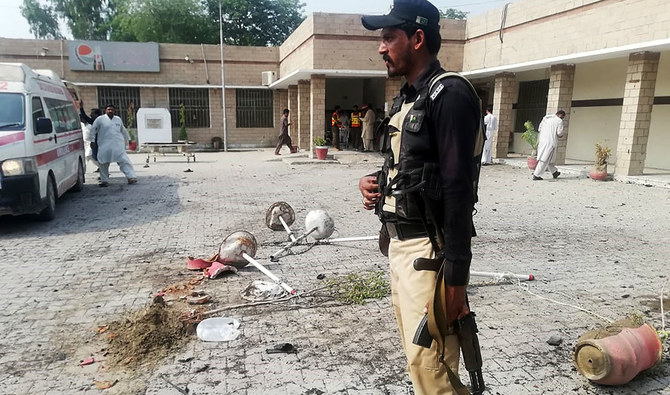
A Pakistani policeman stands guard at site of a suicide bomb attack a hospital entrance in Kotlan Saidan village on the outskirts of the northwestern city of Dera Ismail Khan on July 21, 2019. (AFP/file)
Short Url
Updated 21 April 2024
Follow

Gunmen kill 7 customs officials in western Pakistan in two attacks

  • No group has yet claimed responsibility for the two attacks since Thursday
  • A recent surge in attacks in Pakistan has soured its relations with Afghanistan 

DERA ISMAIL KHAN: Unknown gunmen killed two customs officers in western Pakistan, officials said on Sunday, following the killing of five other customs officials in the area in recent days.

No group has claimed responsibility for the two attacks since Thursday, which police said they were investigating.

Security in regions of Pakistan bordering Afghanistan has deteriorated in recent years. Attacks, some claimed by the Pakistani Taliban (TTP) militant group, have risen, mostly targeting police and security officials.

“Customs officials were present for checks... when unknown persons opened fire,” said the district deputy superintendent of police, Muhammad Adnan, adding that two people were injured and the area on a busy highway had been cordoned off.

“Three days ago, five officials, including an officer, of the customs department, were killed in a shooting in the same area and the attackers escaped,” he said.

The rise in attacks has escalated tensions between Pakistan and Afghanistan’s ruling Taliban administration.

Pakistan, saying militants have been using Afghan territory to launch attacks, has called on the Taliban to take action and carried out an airstrike last month on Afghan territory.

The Taliban have denied allowing the use of Afghan soil for militancy and said Pakistan’s security issues are a domestic issue for Islamabad.


Karachi plaza fire death toll reaches 28 as search continues for missing

Updated 6 sec ago
Follow

Karachi plaza fire death toll reaches 28 as search continues for missing

  • Demolition of burned building on hold until all victims accounted for, official says
  • Authorities shut adjacent mall, order fire safety compliance across Karachi city

KARACHI: Pakistani authorities on Wednesday said 28 bodies had been recovered from a shopping plaza devastated by a massive fire in Karachi last weekend, with dozens of people still unaccounted for, as officials warned the structure could not be demolished until search operations were completed.

The blaze broke out late Saturday at Gul Plaza, a multi-story commercial building in Karachi’s congested Saddar district, and burned for more than 24 hours before being brought under control. The fire gutted over 1,200 shops, triggered partial structural collapse and forced rescuers to navigate extreme heat, debris and instability inside the building.

Speaking to reporters on Wednesday, Deputy Commissioner of Karachi South Javed Nabi Khoso said rescue teams were continuing phased search and debris-removal operations under strict safety protocols, adding that demolition would only be permitted once all missing persons were traced.

“Until even one missing person is accounted for, the building cannot be demolished,” Khoso said “So far, 28 bodies have been recovered, of which 11 have been identified, while 17 remain unidentified. DNA samples have been taken from families and the bodies, and the identification process is ongoing.”

Khoso said authorities had initially received reports of 85 missing persons, of whom 39 had since been located, leaving 28 people still unaccounted for as search operations continued. He said heavy machinery had been deployed to remove large installations such as chillers to reduce load on the structure and allow safer access to critical areas.

“We are focusing on the floors where bodies were found, and then moving toward controlled debris removal,” he said, adding that extreme internal temperatures and structural damage were limiting how long rescue teams could remain inside the building.

Medical officials said the condition of many victims’ remains had made immediate identification impossible.

Police Surgeon Dr. Summaiya Syed said forensic teams were working to confirm identities through DNA analysis.

“As of now, we can confirm 20 deaths, including six identified and 14 unidentified,” she said earlier, noting that samples from 48 families had been collected to assist with identification, while processing of additional remains was continuing.

Officials have cautioned that figures could change as recovery operations progress.

SAFETY RISKS SPREAD TO ADJACENT BUILDINGS

The scale of the fire has raised broader safety concerns across Karachi’s commercial districts. Authorities said Rimpa Plaza, an adjacent shopping complex, had been declared unsafe after being damaged by falling debris during the blaze and was partially closed pending structural assessments.

Separately, the Sindh Building Control Authority (SBCA) has issued notices to building owners and developers across the city, giving them three days to address fire safety deficiencies highlighted in recent audit reports or face legal action under provincial laws.

In a letter to the Association of Builders and Developers (ABAD), the SBCA said enforcement would be stepped up following the Gul Plaza disaster, citing long-standing failures in fire exits, alarms, wiring and emergency access in commercial buildings.

Deadly fires are a recurring problem in Karachi, a city of more than 20 million people, where overcrowding, illegal construction, narrow access points and weak enforcement of safety regulations have repeatedly resulted in mass casualties and economic losses.

In November 2023, a shopping mall fire killed 10 people, while one of Pakistan’s deadliest industrial disasters occurred in 2012, when a blaze at a garment factory claimed at least 260 lives.

Provincial officials say inspections and enforcement will be intensified in the coming days, but safety advocates warn that lasting change will depend on sustained oversight beyond emergency directives.
