

Pakistan rejects US move to sanction firms for aiding its ballistic missile program 

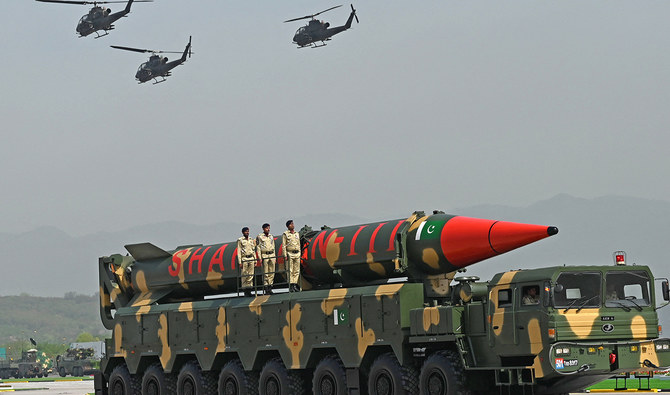
Pakistani military helicopters fly past a vehicle carrying a long-range ballistic Shaheen III missile during the military parade to mark Pakistan's National Day in Islamabad on March 25, 2021. (AFP/File)
Short Url
Updated 20 April 2024
Follow

Pakistan rejects US move to sanction firms for aiding its ballistic missile program 

  • US sanctions four international companies for supplying missile-applicable items to Pakistan’s ballistic missile program
  • Pakistan’s foreign office questions double standards of allowing advanced military technologies to some countries

ISLAMABAD: Pakistan’s foreign office spokesperson on Saturday rejected Washington’s move to impose sanctions on four international firms for providing missile-applicable items to its ballistic missile program, saying Islamabad is against the “political use” of export controls. 

In a press release issued late Friday, the US State Department announced sanctions against three Chinese companies and one Belarus-based firm on charges they supplied items to Pakistan’s ballistic missile program.

The companies listed by the US for sanctions are the China-based Xi’an Longde Technology Development Company Limited, Tianjin Creative Source International Trade Co. Ltd, Granpect Company Limited and Belarus-based Minsk Wheel Tractor Plant.

Pakistan’s foreign office spokesperson responded by saying that commercial entities have been sanctioned in the past on allegations of having links to Pakistan’s ballistic missile program “without sharing any evidence whatsoever.”

“Pakistan rejects political use of export controls,” the foreign office spokesperson said in a statement. It added that the same jurisdictions that claim to exercise non-proliferation controls have waived off licensing requirements for advanced military technologies for some countries.

“This is leading to arms build up; accentuating regional asymmetries, and undermining the objectives of non-proliferation and of regional and global peace and security,” it said. 

The statement said Islamabad had repeatedly pointed out that such items have legitimate civil commercial uses, urging Washington to avoid “arbitrary application of export controls.”

“There is need for discussions between concerned parties for an objective mechanism to ensure access to technology in pursuit of socio-economic development,” the spokesperson said.

“Pakistan has always been ready to discuss end-use and end-user verification mechanisms so that legitimate commercial users are not hurt by discriminatory application of export controls.”

The sanctions mean all property and interests in property of the companies in the US or in possession or control of American citizens are blocked and must be reported to the US Treasury Department’s Office of Foreign Assets Control (OFAC), the State Department has said.

They also mean that all transactions by American citizens, or those within (or transiting) the US that involve any property or interests in property of the companies, are prohibited unless authorized by a general or specific license issued by OFAC.


Air pollution cuts average Pakistani life expectancy by 3.9 years — report

Updated 5 sec ago
Follow

Air pollution cuts average Pakistani life expectancy by 3.9 years — report

  • Pakistan’s first city-level emissions mapping links smog to transport and industry
  • Lahore residents could gain up to 5.8 years of life with cleaner air, report says

ISLAMABAD: Air pollution is shortening the lives of millions of Pakistanis, reducing average life expectancy by almost four years and up to six years in smog-choked cities like Lahore, according to a new national assessment.

The study, titled Unveiling Pakistan’s Air Pollution and published by the Pakistan Air Quality Initiative (PAQI) this week, includes Pakistan’s first multi-sector, city-level emissions mapping, ending years of speculation over what drives the country’s chronic smog. 

Researchers identified transport, industry, brick kilns, power generation and crop burning as Pakistan’s largest contributors of PM2.5, which is hazardous fine particulate matter less than 2.5 micrometers wide that penetrates deep into the lungs and bloodstream, increasing the risk of heart disease, lung cancer and early death. The dominant sources varied by city, giving a data-based picture of pollution patterns for the first time.

The report calls particulate pollution the country’s most damaging environmental hazard. 

“Pollution reduces the life expectancy of an average Pakistani by 3.9 years,” the report states, noting the impact is more severe than food insecurity. 

“Particulate pollution is the greatest external threat to life expectancy in the country. While particulate pollution takes 3.3 years off the life expectancy of an average Pakistani resident, child and maternal malnutrition, and dietary risks reduce life expectancy by 2.4 and 2.1 years, respectively.”

The report findings suggest major health gains would follow even modest pollution cuts. 

“In Lahore, the country’s second most populous city, residents could gain 5.8 years of life expectancy,” it notes, if air quality met global safety standards.

Beyond health, the study frames smog as an economic and governance crisis. Researchers argue that Pakistan’s response has focused on optics like temporary shutdowns, anti-smog “sprays” and road-washing rather than long-term emissions control, vehicle regulation or industrial monitoring.

The assessment characterises pollution as an invisible national burden: 

“Poor air quality is Pakistan’s most universal tax, paid by every child and elder with every breath.”

Pakistan regularly ranks among the world’s most polluted countries, with Lahore, Karachi, Peshawar and Faisalabad repeatedly classified as high-toxicity zones during winter. The new mapping highlights how industrial output, diesel trucking, unregulated kiln firing, and seasonal stubble burning drive smog cycles, knowledge the authors say should guide enforceable policy rather than short-term bans.

The report concludes that reducing PM2.5 remains the single most powerful health intervention available to Pakistan, with improvements likely to deliver life expectancy gains faster than nutrition, sanitation or infectious-disease efforts.