

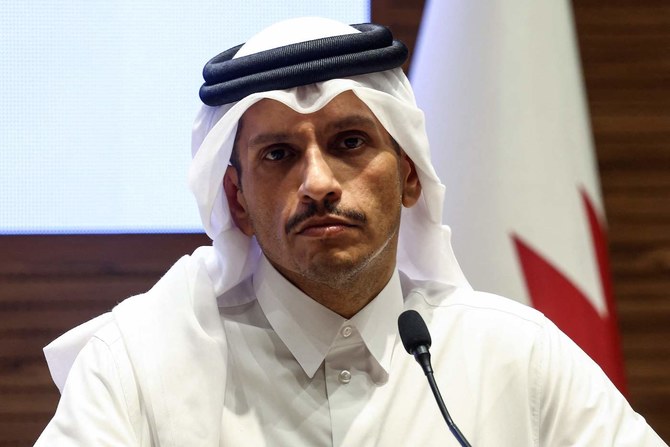
DOHA: Qatar is re-evaluating its role as mediator in ceasefire talks between Israel and Hamas, citing concerns that its efforts are being undermined by politicians seeking to score points, its prime minister said on Wednesday.
Qatari Prime Minister Sheikh Mohammed bin Abdulrahman Al Thani, who is also foreign minister, said there was a “misuse of this mediation for narrow political interests, and this necessitated Qatar to undertake a full evaluation of this role.”
Sheikh Mohammed did not identify any politicians by name.
Qatar’s embassy in Washington on Tuesday criticized comments made by US Democratic congressman Steny Hoyer, in which he called on the US to “reevaluate” its relationship with Qatar.
Hoyer said on Monday that Qatar must threaten Hamas with “repercussions” if the militant Palestinian group “continues to block progress toward releasing the hostages and establishing a temporary ceasefire.”
Some other US lawmakers have suggested in recent months that Qatar supports Hamas, an accusation rejected by the Gulf state, which hosts some 10,000 US troops, the largest US military presence in the Middle East.
Sheikh Mohammed underscored on Wednesday that the role of mediator has limits: “(Mediators) cannot provide things that the parties themselves refrain from (offering).”
Earlier on Wednesday Sheikh Mohammed said the talks on a Gaza ceasefire and a release of hostages were at a “delicate phase.”
“We are trying as much as possible to address this stumbling block,” he added, without giving further details.
Qatar’s premier also condemned what he described as a policy of “collective punishment” being pursued by Israel in its war in Gaza against Hamas as well as the latest escalation of violence in the Israeli-occupied West Bank.
The ceasefire discussions, mediated by Qatar and Egypt, are being held against the backdrop of a humanitarian disaster in Gaza, where Palestinians are suffering severe shortages of food, medicine and other essentials.
The war was triggered when Hamas attacked southern Israel from Gaza on Oct. 7, killing 1,200 people and taking 253 hostages into the enclave, according to Israeli tallies.
Israel has retaliated by pounding Gaza in an air and ground offensive which has killed almost 34,000 Palestinians, according to Gaza health authorities.
Qatar re-evaluating its role as mediator in Gaza ceasefire talks
https://arab.news/9bqur
Qatar re-evaluating its role as mediator in Gaza ceasefire talks
- Sheikh Mohammed underscored on Wednesday that the role of mediator has limits: “(Mediators) cannot provide things that the parties themselves refrain from (offering)”
- Qatari PM said talks on Gaza ceasefire and a release of hostages were at a “delicate phase”
Western Libya forces kill notorious migrant smuggler, security agency says
- The Security Threats Combating Agency raided the group’s hideout in response to the attack and killed its leader, Ahmed Al-Dabbashi
- Dabbashi had been under US sanctions since 2018
BENGHAZI: Western Libyan security forces said on Friday they had killed a notorious migrant smuggler in the coastal city of Sabratha after “criminal gangs” affiliated with him attacked one of their checkpoints overnight.
The Security Threats Combating Agency, a security agency under western Libya’s Prime Minister Abdulhamid Al-Dbeibah, said they raided the group’s hideout in response to the attack and killed its leader, Ahmed Al-Dabbashi, also known as “Al-Amu.”
Dabbashi’s brother was arrested and six members of the force were wounded in the fighting, the agency said in the statement on its Facebook page.
Dabbashi had been under US sanctions since 2018. Washington described him as the “leader of one of two powerful migrant smuggling organizations” based in Sabratha and said he had “used his organization to rob and enslave migrants before allowing them to leave for Italy.”
Human trafficking is rife in Libya, which has been divided between rival armed factions since a NATO-backed uprising toppled longtime leader Muammar Qaddafi in 2011.
The proliferation of smuggling gangs and the absence of a strong central authority have made the country one of the main staging points for migrants trying to cross the Mediterranean to reach Europe.
Dbeibah was installed through a UN-backed process in 2021, but significant parts of western Libya remain outside his control. Dbeibah’s Government of National Unity, or GNU, is not recognized by rival authorities in the east.
An armed alliance affiliated with an earlier UN-backed government in Tripoli – the Government of National Accord – had taken on Dabbashi’s forces in a three-week battle in 2017 that killed and wounded dozens and damaged residential areas and Sabratha’s Roman ruins.


