UN appeals for $2.8 billion for Gaza, West Bank aid

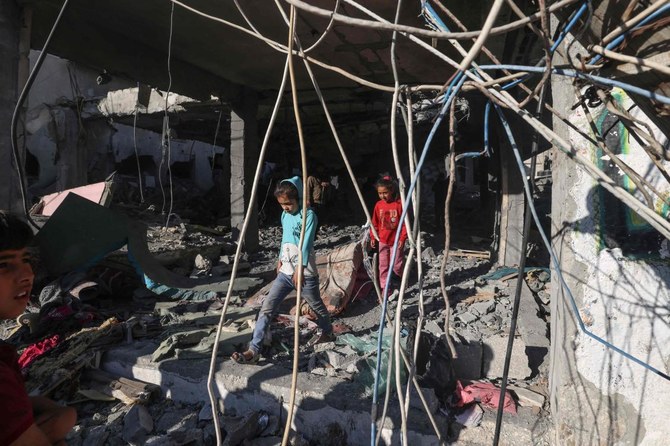
Palestinian children check a building destroyed by Israeli bombardment the previous night in Rafah the southern Gaza Strip on April 17, 2024. (AFP)
Short Url
Updated 18 April 2024
Follow

UN appeals for $2.8 billion for Gaza, West Bank aid

  • $782.1 million will be destined for food aid for 2.2 million people in Gaza

GENEVA: The United Nations appealed on Wednesday for $2.8 billion in funding to assist more than three million people in Gaza and the West Bank until the end of the year, to help ease food shortages and prevent looming famine in Gaza.
A flash appeal published by the UN Office for the Coordination of Humanitarian Affairs (OCHA) said that sum was needed to help 3.1 million people and “reduce human suffering and prevent further loss of life.”
A major chunk of funding — $782.1 million — will be destined for food aid for 2.2 million people in Gaza and 400,000 people in the West Bank, the appeal said.
More than six months of war have created critical food shortages among Gaza’s Palestinians that in some areas now exceed famine levels, according to the United Nations.
A senior UN aid official said on Tuesday that the United Nations was struggling to prevent famine in the Gaza Strip and while there had been some improvement in coordination with Israel, aid deliveries in the enclave still faced obstacles.
Israel aims to wipe out Hamas in Gaza after a deadly Oct. 7 attack on Israel by the Palestinian militant group, in which it killed some 1,200 people and took more than 250 people hostage, according to Israeli tallies.
Gaza health authorities say Israel has killed more than 33,000 people since, in its assault on the enclave.

The children in Israel’s prisons
Ongoing hostage-for-prisoners exchange opens the world’s eyes to arrests, interrogations, and even abuse of Palestinian children by Israeli authorities

Enter


keywords

UN-sanctioned migrant smuggler killed in western Libya

A boat used by migrants is seen near the western town of Sabratha, Libya March 19, 2019. (REUTERS)
Updated 4 sec ago
Follow

UN-sanctioned migrant smuggler killed in western Libya

  • In June 2018, the UN Security Council imposed sanctions on Al-Dabbashi, along with another five Libyan traffickers

CAIRO: A notorious militia leader in Libya, sanctioned by the UN for migrant trafficking across the Mediterranean Sea, was killed on Friday in a raid by security forces in the west of the country, according to Libyan authorities.
Ahmed Oumar Al-Fitouri Al-Dabbashi, nicknamed Ammu, was killed in the western city of Sabratha when security forces raided his hideout. The raid came in response to an attack on a security outpost by Al-Dabbashi’s militia, which left six members of the security forces severely wounded, according to a statement issued by the Security Threat Enforcement Agency, a security entity affiliated with Libya’s western government.
Al-Dabbashi, who was also sanctioned by the US Treasury for trafficking, was the leader of a powerful militia, the “Brigade of the Martyr Anas Al-Dabbashi,” in Sabratha, the biggest launching point in Libya for Europe-bound African migrants.
Al-Dabbashi’s brother Saleh Al-Dabbashi, another alleged trafficker, was arrested in the same raid, added the statement.
In June 2018, the UN Security Council imposed sanctions on Al-Dabbashi, along with another five Libyan traffickers. At the time, the UN report said that there was enough evidence that Al-Dabbashi’s militia controlled departure areas for migrants, camps, safe houses and boats.
Al-Dabbashi himself exposed migrants, including children, to “fatal circumstances” on land and at sea, and of threatening peace and stability in Libya and neighboring countries, according to the same report.
Al-Dabbashi was also sanctioned by the US Treasury for the same reason.
Libya has been a main transit point for migrants fleeing war and poverty in Africa and the Middle East. The country was plunged into chaos following a NATO-backed uprising that toppled and killed longtime autocrat Muammar Qaddafi in 2011.
The country has been fragmented for years between rival administrations based in the east and the west of Libya, each backed by various armed militias and foreign governments.