Just not cricket: Indian politicians bat for power

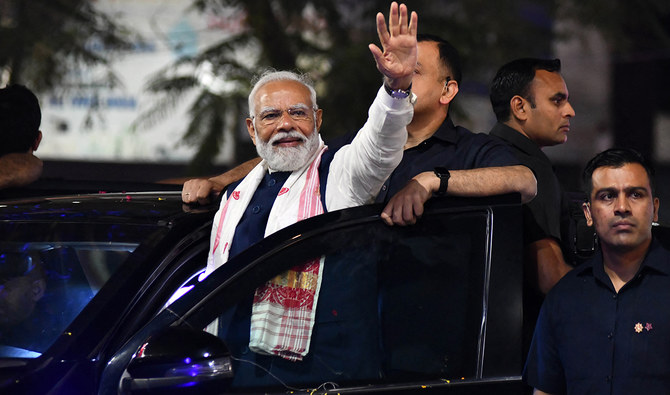
Indian Prime Minister and leader of the ruling Bharatiya Janata Party (BJP) Narendra Modi waves to supporters during a roadshow at an election campaign event in Guwahati on April 16, 2024, ahead of the country's upcoming general elections. (AFP)
Short Url
Updated 17 April 2024
Follow

Just not cricket: Indian politicians bat for power

  • Modi’s BJP is intricately tied to the powerful Board of Control for Cricket in India 
  • Critics say Modi has sought to co-opt cricket as tool to bowl out political opponents

NEW DELHI: Cricket is more than just a game in India: critics accuse ruling-party politicians and the sport’s closely linked mega-rich board of exploiting its huge popularity for electoral advantage.

India begins voting in six-week-long general elections on Friday, with Prime Minister Narendra Modi’s Hindu-nationalist Bharatiya Janata Party (BJP) widely expected to sweep to a third term in power.

Modi’s BJP is intricately tied to the powerful Board of Control for Cricket in India (BCCI), with commentators saying the ruling party has sought to co-opt the sport as a tool to bowl out political opponents.

Veteran cricket journalist Sharda Ugra said the sport is “used as a vehicle for a muscular nationalism.”

“Control is exercised not just through its presence of senior officials connected to the ruling party, but through the use of Indian cricket to further their political messaging,” she told AFP.

Modi’s government is far from the first to use cricket for political gain in India, but his populist BJP has tightened those links further than any before, added Ugra.

BCCI chief Jay Shah is the son of home affairs minister Amit Shah, Modi’s right-hand man and himself a former president of the Gujarat state cricket board.

Arun Dhumal, chairman of the money-spinning Indian Premier League, is the brother of sports minister Anurag Thakur, who is also an ex-BCCI head.

“The current BCCI is the first Indian cricketing administration which is under the control of a single political party, and not a general clutch of politicians,” said Ugra.

Gideon Haigh, cricket writer for The Australian newspaper, has called the BJP “shameless in its self-interest” for co-opting the sport.

“Cricket is just one of many institutions it has captured, although it is the one most meaningful to the most people,” Haigh told AFP. 

The BJP won state elections in Rajasthan in December, and last month a minister’s son took charge of the cricket board.

In New Delhi, the capital’s stadium was renamed in 2019 after a BJP stalwart, the late finance minister Arun Jaitley, whose son Rohan Jaitley heads the state cricket board.

For the previous 137 years, it had been called the Feroz Shah Kotla stadium, after a 14th-century Muslim sultan.

And when India hosted the ODI World Cup last year, Modi attended the final at the world’s biggest cricket stadium — which is named after him — in Ahmedabad.

A home victory would undoubtedly have further boosted national pride ahead of the election, but India lost in the decider.

Modi went into the dressing room, accompanied by a camera crew, to embrace the Indian team. “It happens,” he told them. “Keep smiling, the country is looking up to you.”

India’s delays or denials of visas for the tournament for players and fans from arch-rival Pakistan had raised some concerns.

Other players with Pakistani heritage — including Australia’s Usman Khawaja and England’s Shoaib Bashir — have also faced visa challenges during India tours.

The BCCI did not respond to a series of questions submitted by AFP.

Cricket is a lucrative business in the world’s most populous nation, home to 1.4 billion people.

By some counts, Indian cricket on average generates more revenue than Bollywood.

The IPL is the world’s richest cricket league and has added to the BCCI’s wealth, with the board selling the 2023-27 T20 tournament’s broadcast and digital rights for $6.2 billion.

Commentators say the BCCI’s wealth and reach enables it to pull strings at cricket’s world governing body, the International Cricket Council (ICC).

More than 90 percent of the sport’s billion-plus worldwide fans are in the Indian subcontinent, according to a 2018 ICC study.

In other countries, the ICC has been swift to suspend boards over political interference, including in Zimbabwe in 2019 and Sri Lanka last year.

ICC rules say cricket boards must manage their affairs “autonomously” and “ensure that there is no government (or other public or quasi-public body) interference in its governance.”

The ICC declined to comment on India’s role.

Modi opened his eponymous 132,000-seater ground in Ahmedabad in 2020 in a mega-rally for then-US president Donald Trump.

Haigh covered the 2023 India-Australia series and recalled how Modi toured the venue in a golf cart alongside his Australian counterpart Anthony Albanese when it hosted the fourth Test.

BJP members, government officials and school children were bussed in for the event, cheering as Modi lapped the venue.

The stadium rapidly emptied after the leaders left, even as play began.

“That the ICC — which purports to deplore political interference in cricket — studiously looked the other way, tells you all you need to know about its capture by the BCCI,” Haigh said.


EU leaders to reassess US ties despite Trump U-turn on Greenland

Updated 22 January 2026
Follow

EU leaders to reassess US ties despite Trump U-turn on Greenland

  • Diplomats stressed that, although Thursday’s emergency EU talks in Brussels would now lose some of their urgency, the longer-term issue of how to handle the relationship with the US remained

BRUSSELS: EU leaders will rethink their ties with the US at an emergency summit on Thursday after Donald Trump’s threat of tariffs and even military action to ​acquire Greenland badly shook confidence in the transatlantic relationship, diplomats said.
Trump abruptly stepped back on Wednesday from his threat of tariffs on eight European nations, ruled out using force to take Greenland, a semi-autonomous territory of NATO ally Denmark, and suggested a deal was in sight to end the dispute.
German Chancellor Friedrich Merz, welcoming Trump’s U-turn on Greenland, urged Europeans not to be too quick to write off the transatlantic partnership.
But EU governments remain wary of another change of mind by a mercurial president who is increasingly seen as a bully that Europe will have to stand up to, and they are focused on coming up with a longer-term plan on how to deal with the ‌United States under this ‌administration and possibly its successors too.
“Trump crossed the Rubicon. He might do ‌it ⁠again. ​There is no ‌going back to what it was. And leaders will discuss it,” one EU diplomat said, adding that the bloc needed to move away from its heavy reliance on the US in many areas.
“We need to try to keep him (Trump) close while working on becoming more independent from the US It is a process, probably a long one,” the diplomat said.
EU RELIANCE ON US
After decades of relying on the United States for defense within the NATO alliance, the EU lacks the needed intelligence, transport, missile defense and production capabilities to defend itself against a possible Russian attack. This gives the US substantial leverage.
The US ⁠is also Europe’s biggest trading partner, making the EU vulnerable to Trump’s policies of imposing tariffs to reduce Washington’s trade deficit in goods, and, as in ‌the case of Greenland, to achieve other goals.
“We need to discuss where ‍the red lines are, how we deal with this bully ‍across the Atlantic, where our strengths are,” a second EU diplomat said.
“Trump says no tariffs today, but does ‍that mean also no tariffs tomorrow, or will he again quickly change his mind? We need to discuss what to do then,” the second diplomat said.
The EU had been considering a package of retaliatory tariffs on 93 billion euros ($108.74 billion) on US imports or anti-coercive measures if Trump had gone ahead with his own tariffs, while knowing such a step would harm Europe’s economy as well ​as the United States.
WHAT’S THE GREENLAND DEAL?
Several diplomats noted there were still few details of the new plan for Greenland, agreed between Trump and NATO Secretary General Mark Rutte late on ⁠Wednesday on the sidelines of the World Economic Forum in Davos, Switzerland.
“Nothing much changed. We still need to see details of the Greenland deal. We are a bit fed up with all the bullying. And we need to act on a few things: more resiliency, unity, get our things together on internal market, competitiveness. And no more accepting tariff bullying,” a third diplomat said.
Rutte told Reuters in an interview in Davos on Thursday that under the framework deal he reached with Trump the Western allies would have to step up their presence in the Arctic.
He also said talks would continue between Denmark, Greenland and the US on specific issues.
Diplomats stressed that, although Thursday’s emergency EU talks in Brussels would now lose some of their urgency, the longer-term issue of how to handle the relationship with the US remained.
“The approach of a united front in solidarity with Denmark and Greenland while focusing on de-escalation and finding an off-ramp has worked,” a fourth EU diplomat said.
“At the ‌same time it would be good to reflect on the state of the relationship and how we want to shape this going forward, given the experiences of the past week (and year),” he said.