

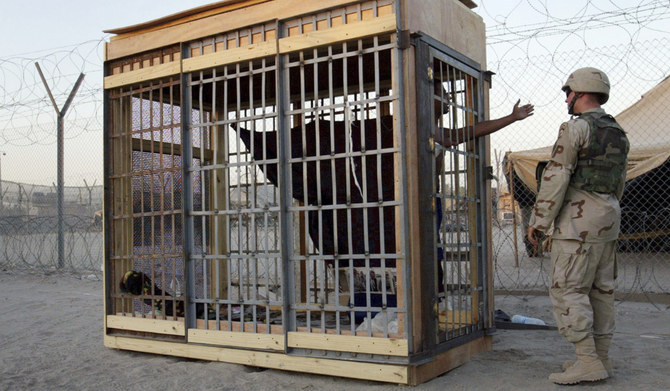

ALEXANDRIA, Virginia: An Army general who investigated the abuse of prisoners 20 years ago at Iraq’s infamous Abu Ghraib prison testified Tuesday that a civilian contractor instructed prison guards to “soften up” detainees for interrogations.
The retired general, Antonio Taguba, told jurors that the contractor, Steven Stefanowicz, even tried to intimidate the general as he investigated the Abu Ghraib abuses.
“He would lean on the table staring me down. He did not answer questions directly,” Taguba said. “He was trying to intimidate me.”
Taguba’s testimony was the strongest evidence yet that civilian employees of the Virginia-based military contractor CACI played a role in the abuse of Abu Ghraib inmates.
Three former inmates at the prison are suing CACI in federal court in Alexandria, alleging that the company contributed to the tortuous treatment they suffered. The trial, delayed by more than 15 years of legal wrangling, is the first time that Abu Ghraib inmates have been able to bring a civil case in front of a US jury.
The lawsuit alleges that CACI is liable for the three plaintiffs’ mistreatment because the company provided civilian interrogators to the Army who were assigned to Abu Ghraib and conspired with the military police who were serving as prison guards to torture the inmates.
In a report Taguba completed in 2004, he recommended that Stefanowicz be fired, reprimanded and lose his security clearance for “allowing and/or instructing” military police to engage in illegal and abusive tactics.
“He clearly knew his instructions equated to physical abuse,” Taguba’s report concluded.
In testimony Tuesday, Taguba said he personally questioned Stefanowicz for about an hour as part of his investigation.
“He was a very coy type of personality,” Taguba said of Stefanowicz, often referred to as “Big Steve” by Abu Ghraib personnel.
Taguba said his investigation was focused on military police, and his probe of civilian interrogators’ role was limited. But he felt obligated to delve into it, he said, because he received credible testimony from the military police that the civilians were playing an important role in what occurred.
The MPs told Taguba that they weren’t getting clear instructions from within their own military chain of command, and that Stefanowicz and other civilian personnel ended up filling the void. Taguba said the military chain of command was unclear, and that various commanders were not cooperating with each other, all of which contributed to a chaotic atmosphere at the prison.
Taguba said he was several weeks into his investigation before he even understood that civilians were carrying out interrogations at Abu Ghraib. He said he and his staff heard multiple references to CACI but initially misunderstood them, believing that people were saying “khaki” instead.
On cross-examination, Taguba acknowledged the limits of his investigation. A second report, completed by Maj. Gen. George Fay, looked more directly at the role of military intelligence and civilian contractors at Abu Ghraib.
Taguba also acknowledged that his report contained several errors, including misidentifying a CACI employee as an employee of another contractor, and another civilian contractor as a CACI employee.
CACI’s lawyers emphasized that Stefanowicz was never assigned to interrogate any of the three plaintiffs in the case.
As Taguba testified about Stefanowicz, a lawyer asked him if he was indeed intimidated by the CACI contractor.
“Not on your life,” Taguba responded.
The jury also heard Tuesday from one of the three plaintiffs in the case, Asa’ad Hamza Zuba’e, who testified remotely from Iraq through an Arabic interpreter. Zuba’e said he was kept naked, threatened with dogs, and forced to masturbate in front of prison guards.
CACI’s lawyers questioned his claims. Among other things, they questioned how he could have been threatened with dogs when government reports showed dogs had not yet been sent to Iraq at the time he said it happened.


