Yellen says Iran’s actions could cause global economic spillovers as White House vows new sanctions

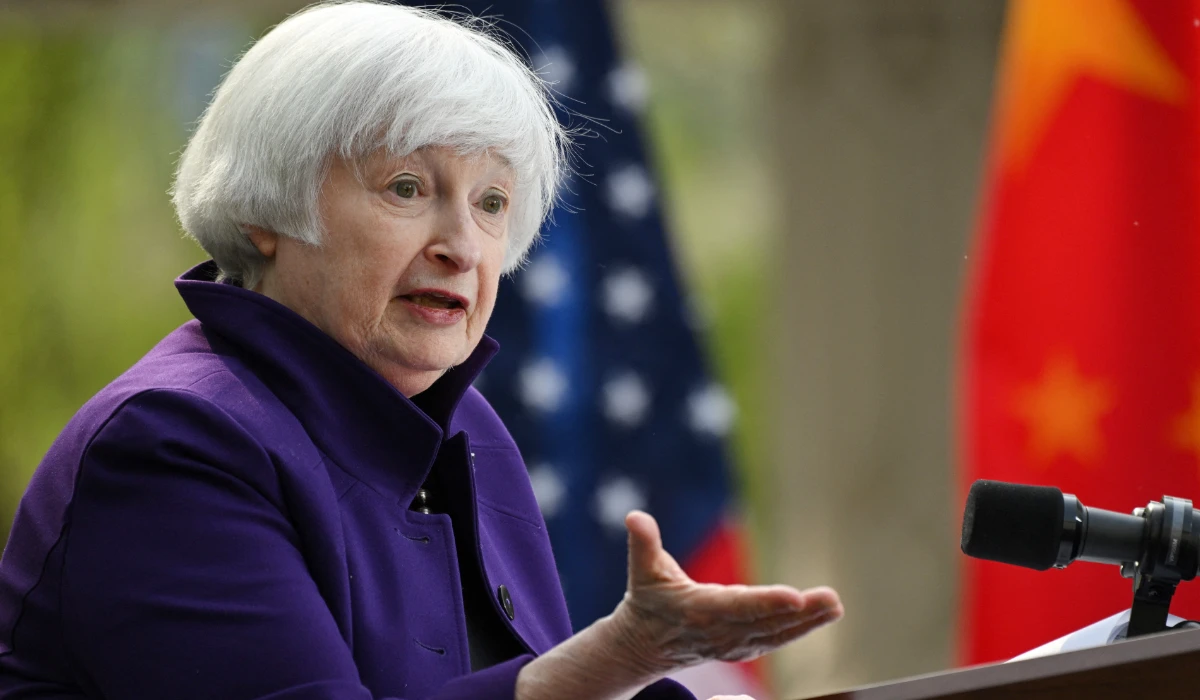
US Treasury Secretary Janet Yellen attends a press conference at US Ambassador’s residence in Beijing on April 8, 2024. (AFP)
Short Url
Updated 17 April 2024
Follow

Yellen says Iran’s actions could cause global economic spillovers as White House vows new sanctions

  • Israel has killed more than 33,000 Palestinians, according to Gaza’s Health Ministry
  • White House national security adviser Jake Sullivan also said Tuesday that coming US sanctions would target Iran’s missile and drone program and entities supporting the Islamic Revolutionary Guard Corps and Iran’s Defense Ministry

WASHINGTON: Treasury Secretary Janet Yellen warned Tuesday of potential global economic damage from rising tensions in the Middle East as the Biden administration said it was readying new sanctions in response to Iran’s malevolent activity in the region.
Yellen spoke out against Iran’s “malign and destabilizing activity” in remarks ahead of this week’s spring meetings of the International Monetary Fund and World Bank, saying Iran’s weekend missile and drone attack on Israel “underscores the importance of Treasury’s work to use our economic tools to counter Iran’s malign activity.”
She added: “From this weekend’s attack to the Houthi attacks in the Red Sea, Iran’s actions threaten the region’s stability and could cause economic spillovers.”
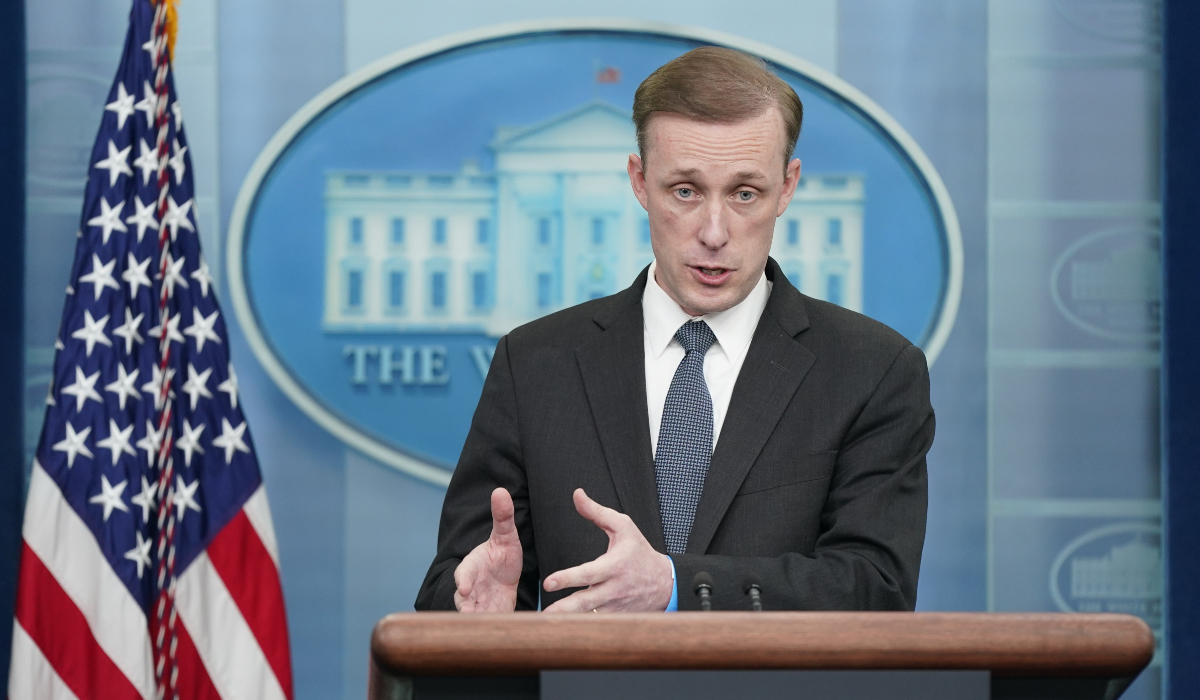


National security adviser Jake Sullivan speaks during a press briefing at the White House, in Washington. (AP file photo)

Iran’s attack on Israel early Sunday came in response to what it says was an Israeli strike on Iran’s consulate in Syria earlier this month. Israel’s military chief said Monday that his country will respond to the attack, while world leaders caution against retaliation, trying to avoid a spiral of violence.
As the IMF and its fellow lending agency, the World Bank, hold their spring meetings this week, high on the agenda are the fast-rising tensions between Iran and Israel and what escalation could spell for the global economy.
Meanwhile, White House national security adviser Jake Sullivan also said Tuesday that coming US sanctions would target Iran’s missile and drone program and entities supporting the Islamic Revolutionary Guard Corps and Iran’s Defense Ministry.
“We anticipate that our allies and partners will soon be following with their own sanctions,” Sullivan said in a statement. “In addition, we continue to work through the Department of Defense and US Central Command to further strengthen and expand the successful integration of air and missile defense and early warning systems across the Middle East to further erode the effectiveness of Iran’s missile and UAV capabilities.”
Israel and Iran have been on a collision course throughout Israel’s six-month war against Hamas militants in Gaza. The war erupted after two militant groups backed by Iran led an attack on Oct. 7 that killed 1,200 people in Israel and kidnapped 250 others. An Israeli offensive in Gaza has caused widespread devastation and killed over 33,000 people, according to local health officials.
“We’ve targeted over 500 individuals and entities connected to terrorism and terrorist financing by the Iranian regime and its proxies since the start of the Administration,” Yellen said, citing sanctions against Iran’s drone and missile programs, militant groups Hamas, the Houthis, Hezbollah, and other Iraqi militia groups.
Yellen said she expected the additional sanctions to be announced in the coming days.
The annual gathering will take place as other ongoing conflicts, including Russia’s invasion of Ukraine, threaten global financial stability.
Yellen in February offered her strongest public support yet for the idea of liquidating roughly $300 billion in frozen Russian Central Bank assets and using them for Ukraine’s long-term reconstruction.
She said Tuesday that the US is “continuing to work with our international partners to unlock the economic value of immobilized Russian sovereign assets and ensure that Russia pays for the damage it has caused.” Yellen added that she will meet with Group of Seven finance leaders Wednesday to continue discussions on the topic and will look at “a series of possibilities, ranging from actually seizing the assets to using them as collateral.”
Another major issue for this year’s meetings on the US side, Yellen said, will be ongoing conversations about Chinese industrial policy that poses a threat to US jobs and the global economy. She traveled to Guangzhou and Beijing earlier this month, to hold “difficult conversations” with counterparts over what she describes as China’s overcapacity in its wave of low-priced Chinese green tech exports that could overwhelm factories in the US and make it impossible to compete.
Yellen said she plans to meet later this week with her Chinese counterparts for a fourth meeting of the US-China Economic and Financial Working Groups, “to share information, identify potential areas of cooperation, and, when we disagree, frankly communicate concerns.”
US Treasury and China’s Ministry of Finance launched the economic working groups in an effort to ease tensions and deepen ties between the nations.

The children in Israel’s prisons
Ongoing hostage-for-prisoners exchange opens the world’s eyes to arrests, interrogations, and even abuse of Palestinian children by Israeli authorities

Enter


keywords

Trump says Zelensky ‘isn’t ready’ yet to accept US-authored proposal to end Russia-Ukraine war

Updated 4 sec ago
Follow

Trump says Zelensky ‘isn’t ready’ yet to accept US-authored proposal to end Russia-Ukraine war

  • Trump said he was “disappointed” and suggested that the Ukrainian leader is holding up the talks from moving forward
  • He also claimed Russia is “fine with it” even though Putin last week had said that aspects of Trump’s proposal were unworkable

KYIV, Ukraine: President Donald Trump on Sunday claimed Ukrainian President Volodymyr Zelensky “isn’t ready” to sign off on a US-authored peace proposal aimed at ending the Russia-Ukraine war.
Trump was critical of Zelensky after US and Ukrainian negotiators completed three days of talks on Saturday aimed at trying to narrow differences on the US administration’s proposal. But in an exchange with reporters on Sunday night, Trump suggested that the Ukrainian leader is holding up the talks from moving forward.
“I’m a little bit disappointed that President Zelensky hasn’t yet read the proposal, that was as of a few hours ago. His people love it, but he hasn’t,” Trump claimed in an exchange with reporters before taking part in the Kennedy Center Honors. The president added, “Russia is, I believe, fine with it, but I’m not sure that Zelensky’s fine with it. His people love it it. But he isn’t ready.”
To be certain, Russian President Vladimir Putin hasn’t publicly expressed approval for the White House plan. In fact, Putin last week had said that aspects of Trump’s proposal were unworkable, even though the original draft heavily favored Moscow.
Trump has had a hot-and-cold relationship with Zelensky since riding into a second White House term insisting that the war was a waste of US taxpayer money. Trump has also repeatedly urged the Ukrainians to cede land to Russia to bring an end to a now nearly four-year conflict he says has cost far too many lives.
Zelensky said Saturday he had a “substantive phone call” with the American officials engaged in the talks with a Ukrainian delegation in Florida. He said he had been given an update over the phone by US and Ukrainian officials at the talks.
“Ukraine is determined to keep working in good faith with the American side to genuinely achieve peace,” Zelensky wrote on social media.
Trump’s criticism of Zelensky came as Russia on Sunday welcomed the Trump administration’s new national security strategy in comments by the Kremlin spokesman published by Russia’s Tass news agency.

Dmitry Peskov said the updated strategic document, which spells out the administration’s core foreign policy interests, was largely in line with Moscow’s vision.
“There are statements there against confrontation and in favor of dialogue and building good relations,” he said, adding that Russia hopes this would lead to “further constructive cooperation with Washington on the Ukrainian settlement.”
The document released Friday by the White House said the US wants to improve its relationship with Russia after years of Moscow being treated as a global pariah and that ending the war is a core US interest to “reestablish strategic stability with Russia.”
Speaking on Saturday at the Reagan National Defense Forum, Trump’s outgoing Ukraine envoy, Keith Kellogg, said efforts to end the war were in “the last 10 meters.”
He said a deal depended on the two outstanding issues of “terrain, primarily the Donbas,” and the Zaporizhzhia Nuclear Power Plant.
Russia controls most of Donbas, its name for the Donetsk and neighboring Luhansk regions, which, along with two southern regions, it illegally annexed three years ago. The Zaporizhzhia Nuclear Power Plant is in an area that has been under Russian control since early in Moscow’s invasion of Ukraine and is not in service. It needs reliable power to cool its six shutdown reactors and spent fuel, to avoid any catastrophic nuclear incidents.
Kellogg, who is due to leave his post in January, was not present at the talks in Florida.
Separately, officials said the leaders of the United Kingdom, France and Germany would participate in a meeting with Zelensky in London on Monday.
As the three days of talks wrapped up, Russian missile, drone and shelling attacks overnight and Sunday killed at least four people in Ukraine.
A man was killed in a drone attack on Ukraine’s northern Chernihiv region Saturday night, local officials said, while a combined missile and drone attack on infrastructure in the central city of Kremenchuk caused power and water outages. Kremenchuk is home to one of Ukraine’s biggest oil refineries and is an industrial hub.
Kyiv and its Western allies say Russia is trying to cripple the Ukrainian power grid and deny civilians access to heat, light and running water for a fourth consecutive winter, in what Ukrainian officials call “weaponizing” the cold.
Three people were killed and 10 others wounded Sunday in shelling by Russian troops in Ukraine’s Kharkiv region, according to the regional prosecutor’s office.