

Indonesia denies reports of recognizing Israel, vows to stay at forefront defending Palestine

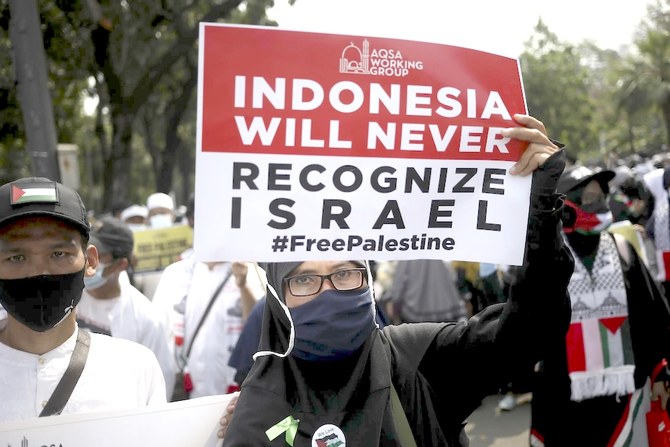
An Indonesian woman holds up a poster during a rally against Israel’s attacks on Gaza, outside the US embassy in Jakarta on May 21, 2021. (AP)
Short Url
Updated 12 April 2024
Follow

Indonesia denies reports of recognizing Israel, vows to stay at forefront defending Palestine

  • Establishing ties with Israel would be ‘political suicide’ for Indonesian leadership, analyst says
  • Israeli media reports claim Jakarta has begun OECD-brokered talks with Tel Aviv

JAKARTA: Jakarta has denied plans to establish diplomatic ties with Tel Aviv, following viral Israeli media reports claiming it was part of a deal to smooth Indonesia’s entry into the Organization for Economic Cooperation and Development.

Indonesia is the first Southeast Asian nation to apply for the membership of the 38-nation forum. Accession talks began in February, but according to local Israeli media were objected to by Tel Aviv over the lack of diplomatic ties with Jakarta.

Countries need unanimous approval from all OECD members, including Israel, to join the bloc.

Citing anonymous sources, the Israeli media reports claimed that Indonesia had started OECD-brokered talks with Israel, which in exchange for recognition would agree to the world’s most populous Muslim-majority nation joining the group.

However, the Indonesian Ministry of Foreign Affairs rejected the claims.

“There are no plans to open diplomatic ties with Israel, especially in the wake of Israel’s atrocities in Gaza. Indonesia’s stance has not changed, and we remain consistent in supporting Palestine’s independence within the framework of the two-state solution,” Lalu Muhamad Iqbal, the ministry’s spokesperson, told reporters late on Thursday.

“Indonesia will always be consistent and at the forefront of defending the rights of the Palestinian people.”

One of the staunchest supporters of Palestine, the Indonesian government has repeatedly called for an end to Israeli occupation of Palestinian territories and for a two-state solution based on pre-1967 borders.

Since the beginning of Israel’s deadly invasion of Gaza in October, Jakarta has also been vocal on the international stage, demanding an end to military support and weapons sales to Tel Aviv.

In January, Indonesian Foreign Minister Retno Marsudi called on the UN Security Council to make no exceptions in upholding international law, and to bring Israel to account over mass killing and atrocities.

Israeli ground and air attacks have in the past six months have killed at least 33,400 Palestinian citizens, almost half of them children. Over 70,000 have been injured, mutilated or disabled by the strikes, while thousands remain missing under the rubble.

The Israeli military has also levelled large parts of Gaza, destroyed most of its civilian and medical infrastructure, and blocked water, food and aid supplies to the territory, bringing its more than 2 million inhabitants to the brink of famine.

Since the beginning of the onslaught, mass public protests in support of Palestine have taken place frequently in Indonesia, where people see Palestinian independence as mandated by their own constitution, which calls for the abolition of colonialism.

“If the government takes the opposite step by recognizing the state of Israel and tolerating colonialism and oppression, that will cause political suicide, given that such a thing would lead to political delegitimization and loss of public trust,” Airlangga Pribadi Kusman, a political science lecturer at Airlangga University in Surabaya, told Arab News.

“The current and future Indonesian government should continue its policy of supporting Palestinian independence as has been the commitment of previous governments.”


African Union rejects ‘any recognition of Somaliland’ after Israel declaration

A man holds a flag of Somaliland in front of the Hargeisa War Memorial monument in Hargeisa on November 7, 2024. (AFP)
Updated 27 December 2025
Follow

African Union rejects ‘any recognition of Somaliland’ after Israel declaration

  • Egypt’s foreign ministry said its top diplomat had spoken with his counterparts from Turkiye, Somalia and Djibouti, who together condemned the move and emphasized “their full support for the unity, sovereignty and territorial integrity of Somalia”
  • Israel repeatedly hit targets in Yemen after the Gaza war broke out in October 2023, in response to Houthi attacks on Israel that the rebels said were in solidarity with Palestinians in the Gaza Strip

NAIROBI: The African Union on Friday said it “rejects any recognition of Somaliland” after Israel declared it viewed the breakaway Somali territory as a sovereign state.
In a statement issued by its head, Mahamoud Ali Youssouf, the AU called for African borders to be respected and said: “Any attempt to undermine the unity, sovereignty, and territorial integrity of Somalia... risks setting a dangerous precedent with far-reaching implications for peace and stability across the continent.”
The chief of the pan-African body, which counts Somalia as a member, said he “firmly rejects any initiative or action aimed at recognizing Somaliland as an independent entity” and stating that Somaliland “remains an integral part of the Federal Republic of Somalia.”

While, Somalia reacted angrily on Friday after Israel formally recognized its northern region of Somaliland as an “independent and sovereign state” — the first country to do so.
Somaliland, which declared independence from Somalia in 1991, has for decades pushed for international recognition, which has been the key priority for president Abdirahman Mohamed Abdullahi since he took office last year.
But a Somali foreign ministry statement warned that the decision was “deliberate attack” on its sovereignty that would undermine peace in the region. Several other countries also condemned Israel’s decision.
Israeli Prime Minister Benjamin Netanyahu’s office said he announced “the official recognition of the Republic of Somaliland as an independent and sovereign state,” making Israel the first country to do so.
“The declaration is in the spirit of the Abraham Accords,” Netanyahu’s office said, referring to several agreements between Israel and Arab countries brokered by US President Donald Trump during his first presidency to normalize ties with Israel.
It said Netanyahu had invited Abdullahi to visit.
Hailing Israel’s decision, Abdullahi said in a post on X that it marked the beginning of a “strategic partnership.”
“This is a historic moment as we warmly welcome” he said, affirming “Somaliland’s readiness to join the Abraham Accords,” he added.
In Hargeisa, the capital of Somaliland, crowds of people took to the streets to celebrate, many carrying the flag of the breakaway state, said sources.

- ‘Illegitimate actions’ -

Somalia’s foreign ministry said: “Illegitimate actions of this nature seriously undermine regional peace and stability, exacerbate political and security tensions, in the Horn of Africa, the Red Sea and Gulf of Aden, the Middle East and the wider region.”
Turkiye, a close ally of Somalia, also condemned the move.
“This initiative by Israel, which aligns with its expansionist policy... constitutes overt interference in Somalia’s domestic affairs,” it said in a foreign ministry statement.
Egypt’s foreign ministry said its top diplomat had spoken with his counterparts from Turkiye, Somalia and Djibouti, who together condemned the move and emphasized “their full support for the unity, sovereignty and territorial integrity of Somalia.”
In video showing Netanyahu speaking to Abdullahi by telephone, the Israeli leader said: “I want you to know that I am signing now as we speak Israel’s official recognition of the Somaliland,” adding that the new relationship would offer economic opportunities.
“I am very, very happy and I am very proud of this day and I want to wish you and the people of Somaliland the very, very best,” he said.
Netanyahu also said that he would communicate to Trump Abdullahi’s “willingness and desire to join the Abraham accords.”
A self-proclaimed republic, Somaliland enjoys a strategic position on the Gulf of Aden, has its own money, passports and army. But since its unilateral declaration of independence in 1991, it has grappled with decades of isolation.

- Strategic -

Analysts say matters of strategy were behind Israel’s drive to recognize Somaliland.
“Israel requires allies in the Red Sea region for many strategic reasons, among them the possibility of a future campaign against the Houthis,” said the Institute for National Security Studies in a paper last month, referring to Yemen’s Iran-backed rebels.
“Somaliland is an ideal candidate for such cooperation as it could offer Israel potential access to an operational area close to the conflict zone,” it said, adding there were also economic motives.
Israel repeatedly hit targets in Yemen after the Gaza war broke out in October 2023, in response to Houthi attacks on Israel that the rebels said were in solidarity with Palestinians in the Gaza Strip.
The Houthis have halted their attacks since a fragile truce began in Gaza in October.
Somaliland’s lack of international recognition has hampered access to foreign loans, aid and investment, and the territory remains deeply impoverished.
A deal between landlocked Ethiopia and Somaliland last year to lease a stretch of coastline for a port and military base enraged Somalia.
Israel has been trying to bolster relations with countries in the Middle East and Africa.
Historic agreements struck late in Trump’s first term in 2020 saw several countries including Muslim-majority United Arab Emirates and Morocco normalize relations with Israel, but wars that have stoked Arab anger, particularly in Gaza, have hampered recent efforts.