

This Eid, Pakistan’s designer ‘lawn wars’ cool off as inflation bites

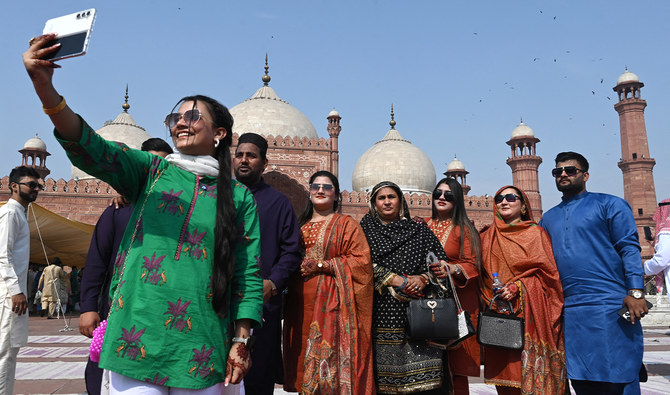
A Muslim woman takes a selfie with her family members after offering a special prayers on the occasion of Eid al-Fitr, which marks the end of the holy fasting month of Ramadan at the Badshahi Mosque in Lahore on April 10, 2024. (AFP/File)
Short Url
Updated 10 April 2024
Follow

This Eid, Pakistan’s designer ‘lawn wars’ cool off as inflation bites

  • Pakistani women prefer to buy dresses made of lightweight lawn, long seen as staple for summer clothes 
  • Branded lawn is major part of how Pakistani housewives, working women and young girls shop for clothes

ISLAMABAD: Noor Fatima, a first-year pre-med student in the Pakistani capital, had been on a quest to find the perfect Eid dress for days but there was one problem. 

The dress she liked cost Rs30,000 ($108), nearly double her budget.

Ahead of Eid each year, women spend hours going to clothing stores or surfing online catalogs in search of their holiday dresses. If Eid falls in the spring or summer months as it has this year, they prefer to buy dresses made of lightweight lawn, long seen as a staple for summer clothes in Pakistan.

The cloth, made of fine combed cotton, is itself ideal for Pakistani climate, and has over generations become the go-to material for traditional shalwar kameez, especially for women. While textile manufacturers like Gul Ahmed have been around since the early 1950s, it is only in the last two decades that branded lawn with round-the-year collections have become a major part of how Pakistanis, from housewives and working women to teenagers and school girls, shop for clothes.

As Eid arrives, the “lawn wars” get more intense as brands release stitched and unstitched collections, billboards, television commercials, flyers, print advertisements and social media bring customers “the most coveted lawn” and online platforms get flooded with images of models, local and international, wearing lawn dresses in exotic locations. Social media is also rife with videos of women fighting over pieces at exhibitions and clothing stores, with the altercations oftening turning physical. 

But this year, the advertising and the marketing has not been able to hide the reality that designer lawn is becoming increasingly unaffordable for most people in a country with double digit inflation, with many women surveyed by Arab News saying the price tags this Eid had left them sour. 

A general survey of designers shows that dresses sold at Rs9000 ($32.42) last year are now starting at Rs16,000 ($57.64) and going upwards of Rs50,000 ($180).

“Last year, [clothes] were expensive but not as expensive compared to this year,” Fatima told Arab News last week as she shopped for Eid dresses in Islamabad’s F-10 shopping area. 

Sumera Tauseef, a principal at a private school, called out lawn designers, saying their prices were not justified. 

“Prices have gone really high,” she said, complaining that designers were buying fabric for cheap but selling pret at steep prices and earning exorbitant profits. 

“Things that cost Rs18,000 ($64.66) to Rs19,000 ($68.25) in previous years, right now cost Rs30-40,000 ($107.76 - $143.68).”

Many customers said the higher prices did not necessarily mean better quality. 

“This time the quality is not there, the designs are very mediocre, and the price is definitely not justified ... So, it has put me in a pickle. It’s been quite a mess this year for everyone,” Sherina Noor, a marketing consultant in Islamabad, said.

“The dresses that I got stitched are way better than theirs [ready to wear] and that too made at a lower cost,” said Mahrukh Sattar, a government officer. “In Pakistan, where people’s affordability is falling, their [designer wear] prices are getting double, triple.”

Imran Khan, a salesman at a multi-brand store, said higher prices of designer clothes had hit demand, with only a limited number of customers now able to afford luxury lawn.

“Last year, Zara Shahjahan, Zaha, and Elan [dress] prices were from Rs9,000 to Rs11,000,” he said, listing a few top brands. 

“But this year, their prices have gone to Rs16,000 ($57.47), Rs17,000 (Rs61.06). We are running slow because most customers cannot afford it.”


Pakistan, Iraq agree on tighter coordination over pilgrims under new regulated travel system

Updated 4 sec ago
Follow

Pakistan, Iraq agree on tighter coordination over pilgrims under new regulated travel system

  • New system requires all Iraq-Iran pilgrimages to be organized by licensed groups under state oversight
  • Long-running “Salar” model relied on informal caravan leaders, leading to overstays and missing pilgrims

ISLAMABAD: Pakistan and Iraq this week agreed to closely coordinate on the management and security of Pakistani pilgrims, as Islamabad rolls out a new, tightly regulated travel system aimed at preventing overstays, undocumented migration and security breaches during religious visits to Iraq and Iran.

The understanding was reached during a meeting between Pakistan’s Interior and Narcotics Control Minister Mohsin Naqvi and Iraq’s Interior Minister General Abdul Amir Al-Shammari on Thursday evening, where both sides discussed measures to facilitate pilgrims while strengthening oversight, Pakistan’s interior ministry said.

The agreement comes as Pakistan dismantles its decades-old pilgrim travel model and replaces it with a centralized, licensed system after authorities confirmed that tens of thousands of Pakistani pilgrims had overstayed or gone missing abroad over the past decade, triggering concerns from host governments.

“You have, for the first time during your tenure, taken effective measures to organize pilgrim groups, which are commendable,” Al-Shammari told Naqvi, according to Pakistan’s interior ministry.

“All pilgrims included in the list provided by Pakistan’s Ministry of Interior will be allowed to enter Iraq,” he added, making clear that only travelers cleared under the new system would be permitted.

Naqvi said Pakistan would strictly enforce return timelines under the revised framework.

“Pilgrims traveling to Iraq will not be allowed to stay beyond the designated period,” he said, adding that relevant authorities in both countries would remain in close coordination.

Both interior ministers also agreed to strengthen information-sharing and joint mechanisms on security cooperation, counterterrorism and the prevention of human smuggling, officials said.

“The safety, dignity, and facilitation of Pakistani pilgrims is the top priority of the Government of Pakistan,” Naqvi said.

Al-Shammari said he would visit Pakistan soon to finalize a joint roadmap to further improve pilgrim facilitation, security coordination and broader bilateral cooperation, according to the interior ministry.

Pakistan’s government has overhauled its pilgrim travel regime this year, abolishing the long-running “Salar” system under which informal caravan leaders managed pilgrimages. The move followed official confirmation that around 40,000 Pakistani pilgrims had overstayed or disappeared in Iran, Iraq and Syria over the past ten years.

Under the new Ziyarat Management Policy, only licensed Ziyarat Group Organizers (ZGOs) are allowed to arrange pilgrimages, with companies held directly responsible for ensuring pilgrims return on time. Authorities have completed security clearance for 585 companies seeking registration, while scrutiny of applications remains ongoing.

Islamabad has also barred overland travel for major pilgrimages, including Arbaeen, citing security risks in Pakistan’s southwestern Balochistan province, meaning all travel to Iraq and Iran is now restricted to regulated air routes.

Tens of thousands of Pakistani pilgrims travel each year to Iraq and Iran to visit some of the most revered shrines in Shia Islam, including the mausoleums of Imam Ali in Najaf and Imam Hussain in Karbala in Iraq, and major religious sites in Mashhad and Qom in Iran. Pilgrimages peak during religious occasions such as Arbaeen, when millions of worshippers converge on Karbala from across the region. The scale of travel, often involving long stays and cross-border movements, has long posed logistical, security and migration-management challenges for Pakistani authorities and host governments alike.