

Qatar, Pakistan resolve to boost strategic, economic cooperation at Doha talks

Prime Minister Shehbaz Sharif (fifth right) meets Qatari counterpart Sheikh Mohammed bin Abdulrahman bin Jassim Al Thani (fifth left) in Doha, Qatar, on February 24, 2026. (PID)
Short Url
Updated 24 February 2026
Follow

Qatar, Pakistan resolve to boost strategic, economic cooperation at Doha talks

  • Both countries urge dialogue on Afghanistan amid renewed border tensions between Islamabad and Kabul
  • Discussions focus on bilateral trade and investment, energy, defense, manpower and labor and culture

ISLAMABAD: Pakistan and Qatar on Tuesday agreed to deepen their strategic and economic cooperation during high-level talks between Prime Minister Shehbaz Sharif and his Qatari counterpart Sheikh Mohammed bin Abdulrahman bin Jassim Al Thani, Sharif’s office said.

Sharif visited Qatar along with a high-level delegation on the invitation of Qatari emir Sheikh Tamim bin Hamad Al Thani. The Pakistani premier also held meetings with Qatar’s trade and defense ministers to discuss cooperation in various domains.

The visit came at a time when Pakistan is seeking closer economic engagement with Gulf partners amid its broader push to stabilize the economy and attract investment, while maintaining security and defense cooperation with key regional states.

During their meeting in Doha, PM Sharif and Qatar’s Sheikh Mohammed discussed bilateral relations and exchanged views on regional and international developments, according to the Pakistan prime minister’s office.

“They reaffirmed the strong brotherly relations between Pakistan and Qatar and expressed satisfaction at the growing momentum in political, economic and institutional ties,” Sharif’s office said.

“Discussions focused on enhancing cooperation in the fields of trade and investment, energy, defense, manpower and labor and culture, with both sides stressing the importance of their task force to accelerate cooperation in all these areas.”

Pakistan and Qatar maintain strong trade and investment ties. In 2022, the office of Qatar’s emir said the Qatar Investment Authority planned to invest $3 billion in Pakistan, targeting sectors including transport, aviation, education, health, media, technology and labor.

Nearly 300,000 Pakistanis live and work in Qatar, according to Pakistan’s foreign office, with many employed in health, education, engineering and public services, as well as construction and transport. The two countries engage through forums such as the Bilateral Political Consultations and the Joint Ministerial Commission.

Sharif said he had productive discussions with Qatar’s emir, Sheikh Tamim bin Hamad Al Thani, on how the two sides could transform their brotherly ties into mutually beneficial economic relationships. 

“We also took stock of the regional situation,” he said on X. “Pakistan and Qatar will continue to work together for peace and stability in the region and beyond.”
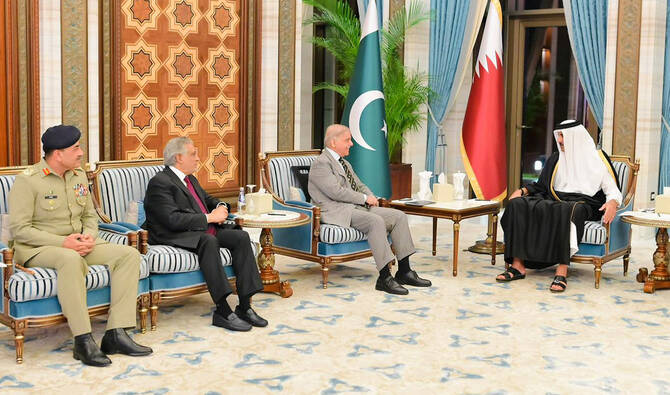


Prime Minister Shehbaz Sharif (second right) meets the Qatari Emir Qatar’s emir Sheikh Tamim bin Hamad Al Thani (left) in Doha, Qatar, on February 24, 2026. (PID)

DIALOGUE WITH AFGHANISTAN

Earlier, Sharif and Qatar’s Deputy PM Sheikh Saoud Al-Thani discussed the situation in Afghanistan and called for dialogue to support regional stability.

The meeting took place amid renewed tensions after Islamabad carried out airstrikes last week on what it described as Tehreek-e-Taliban Pakistan (TTP) targets inside Afghanistan. Kabul said the strikes killed civilians and vowed to respond to what it called a violation of its sovereignty.

“Regional developments were also discussed, in particular the situation in Iran and Afghanistan,” Sharif’s office said in a statement. “Both sides emphasized the importance of dialogue, de-escalation and collective efforts to promote peace and stability in the region.”

This was the second time in less than six months that Pakistan conducted airstrikes in Afghanistan. The last strikes triggered heavy, weeklong clashes between the neighbors along their border before Qatar and Turkiye mediated a ceasefire between them in Oct. last year.

Separately, Sharif held meetings with Qatar’s State Minister for Trade Dr. Ahmed bin Mohammed Al-Sayed and a delegation of the Qatar Businessmen Association (QBA), highlighting Pakistan’s investment-friendly reforms.

He invited QBA members to explore opportunities in infrastructure, logistics, energy, agriculture, technology and export-oriented manufacturing, his office said.

On International Women’s Day, activist Abia Akram urges women with disabilities not to hide

Updated 6 sec ago
Follow

On International Women’s Day, activist Abia Akram urges women with disabilities not to hide

  • With over two decades of advocacy, Akram says disability is her identity to be celebrated
  • Women with disabilities face four times higher GBV risk, often overlooked by rights movements

ISLAMABAD: On this International Women’s Day, Abia Akram has a message for young women with disabilities: do not hide.

Born with a physical mobility impairment, the 40-year-old Pakistani activist has spent more than two decades advocating for the rights of women with disabilities while working with governments and international organizations to push for greater inclusion and a rights-based approach to disability.

For Akram, International Women’s Day is also an opportunity to challenge stigma and encourage women with disabilities to speak openly about their identities and experiences.

“I would say disability is nothing to worry about, and it’s not an issue that we need to address,” she said. “It’s just a thing to celebrate it, with all its diversity and impact. There’s no need to worry about disability, just enjoy life with it.”

Akram’s advocacy journey began in 1997, when public perceptions of disability in the region were often shaped by stereotypes representing two extremes.

“They are very close to Allah, so we have to respect them,” she said, recalling one such view. “Or on the other extreme, people were thinking they are a punishment.”

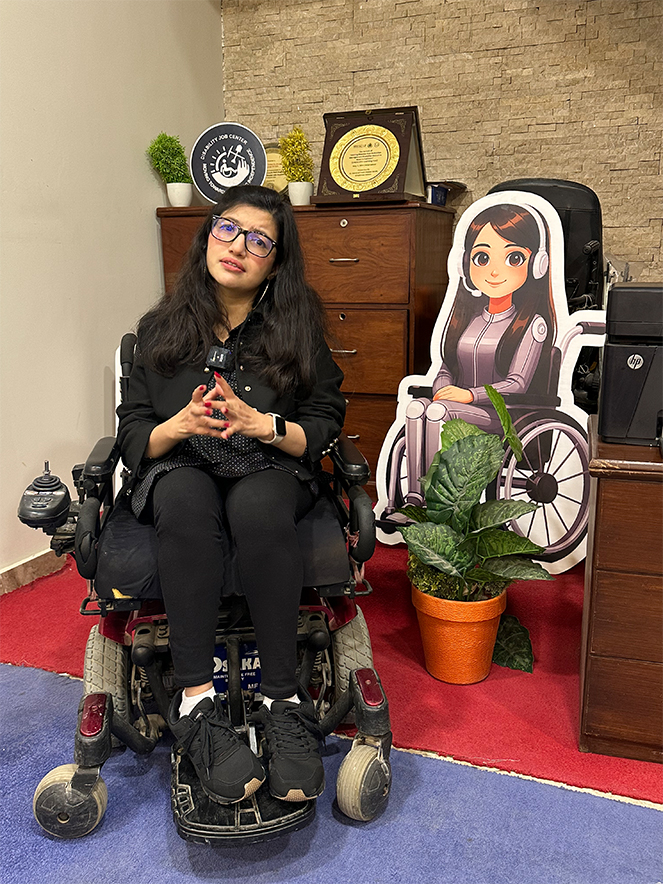
Activist Abia Akram speak to Arab News in Islamabad, Pakistan, on March 7, 2026. (AN photo)

As a woman from a developing country without a “strong background,” she said the fight for recognition and rights came with its own challenges.

In 2009, she founded the National Forum of Women with Disabilities, an initiative that helped bring attention to the challenges faced by women and girls with disabilities who were often overlooked even within their own families.

“Many parents used to pray that their daughters die before them, because there was no support system available,” she said.

Her own experience, however, was different. She credits her parents for encouraging her education and independence from an early age.

“My parents were really supportive because they were telling me like education is the most important thing. If you are qualified, if you are educated, then you have the world to contribute to.”

Today, Akram’s work extends beyond Pakistan. She serves as chair of the Global Forum on the Leadership of Women with Disabilities and is a trustee for Sightsavers, working with organizations including the UK’s Foreign, Commonwealth &

Development Office (FCDO) and humanitarian groups to promote a shift from a medical model of disability to a rights-based approach.

She is also currently chair of the Aging Disability Diversity Task Force, chief executive of the National Forum of Women with Disabilities and an executive member of the Commonwealth Disability Forum.

Akram says women with disabilities often face multiple layers of discrimination — within their families, in education, in employment and in public life.

According to advocacy data she cited, women with disabilities experience four times greater gender-based violence (GBV) and sexual harassment than women without disabilities.

Her work includes training programs that address systemic barriers and collaboration with government institutions such as Pakistan’s National Assembly, the Ministry of Human Rights and the National Commission on the Status of Women.

In recent years, Akram has also focused on using technology to address these challenges.

Last month at the Zero Project Conference in Vienna, she received a global award for “Noor AI,” an accessible mobile application designed to assist women with disabilities who are survivors of gender-based violence.

Akram argues that the difficulties often associated with disability arise not from individuals themselves but from environments that fail to accommodate different needs.

She illustrates the point with an analogy comparing wheelchairs to cars.

“Are you using a wheelchair? But you came in a car, which has the wheels and the chair. So, you are also using the wheelchair, but you park your wheelchair outside and mine is inside,” she said.

“It’s just about the diversity, accepting the diversity, not fixing the person.”

In Pakistan, she says there has been legislative progress in protecting the rights of persons with disabilities, pointing to the Rights of Persons with Disabilities Act 2020 in Islamabad and similar laws in Sindh and Balochistan.

However, she believes more work is needed in regions such as Azad Jammu and Kashmir and Khyber Pakhtunkhwa to strengthen legal protections and implementation.

Despite receiving international recognition, including the Zero Project Award and the Human Rights Award, Akram says such honors mainly reinforce her sense of responsibility.

She remains particularly focused on addressing what she describes as “double discrimination,” where women with disabilities are sometimes overlooked both within mainstream women’s movements and within male-dominated disability advocacy spaces.

As the world marks International Women’s Day, Akram says the goal must remain justice, empowerment and equality that includes everyone.

“Disability is my identity and I’m very proud of it. It’s about how we take that identity in a positive way, in a dignified way,” she said.

“It’s not about just celebrating, but also taking that positive initiative, the commitment, like how we can change the life of other people.”