

Pakistan’s delicate Eid bangles go from furnace to forearms

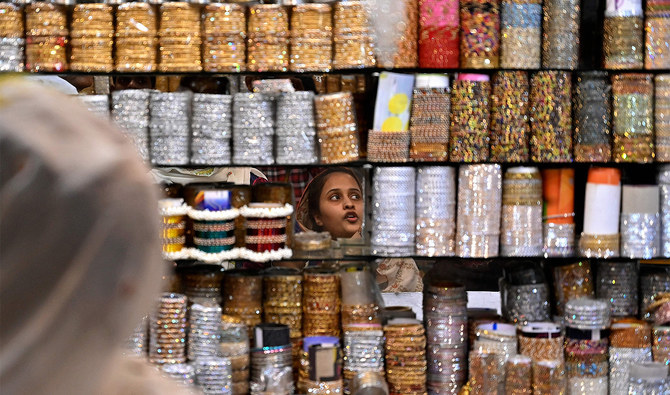
In this picture taken on March 31, 2024, a customer looks at bangles displayed in a shop in Hyderabad. (AFP)
Short Url
Updated 08 April 2024
Follow

Pakistan’s delicate Eid bangles go from furnace to forearms

  • Intricately decorated bangles are staple fashion accessory for Pakistani women on Eid Al-Fitr 
  • Over a dozen people can be involved in making a bangle, from factories to designers who decorate them

HYDERABAD, Pakistan: Layers of intricately decorated bangles are a staple fashion accessory for women in Pakistan, a carefully considered part of their Islamic Eid-al-Fitr celebrations.

More than a dozen people can be involved in the making of a single bangle, from sweltering factories to the homes of designers who skillfully decorate them by hand.

“Whatever the fashion trends, when we attend any event and wear any outfit it feels incomplete without bangles,” said 42-year-old Talat Zahid, who uses beads, stitching and embroidery to embellish bangles.

“Even if you don’t wear jewelry but wear bangles or a bracelet with your outfit, the outfit looks complete.”


In this picture taken on March 31, 2024, a customer looks at bangles displayed in a shop in Hyderabad. (AFP)

In the lead-up to this week’s Eid-al-Fitr festivities that mark the end of Ramadan, market stalls are adorned with a glittering array of colorful bangles, each turned over and inspected for their beauty and imperfections by women who haggle for a good price.

They are often sold by the dozen, starting at around Rs150 (about 50 cents) and rising to Rs1,000 ($3.60) as stones and silk are added.

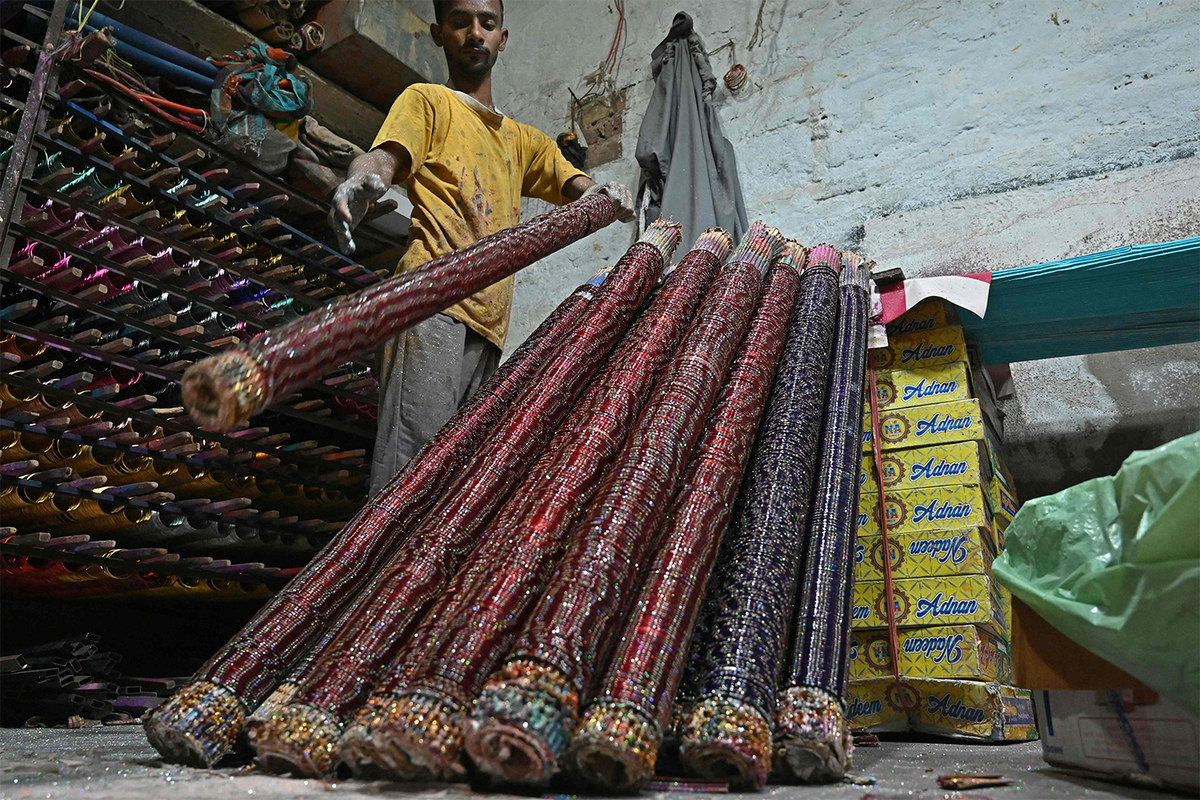
Hyderabad is home to the delicate “churi” glass bangle, where a single furnace can produce up to 100 bangles an hour from molten glass wire shaped around an iron rod.

The work is arduous and frustrating — laborers are exposed to oppressive temperatures in unregulated factories prone to frequent power cuts, while the fragile glass threads can snap easily.

“The work is done without a fan. If we turn on the fan the fire is extinguished. So the heat intensity is high. As it becomes hotter our work slows down,” said 24-year-old Sameer, who followed his father into the industry and earns less than the minimum wage of 32,000 rupees ($115) a month.
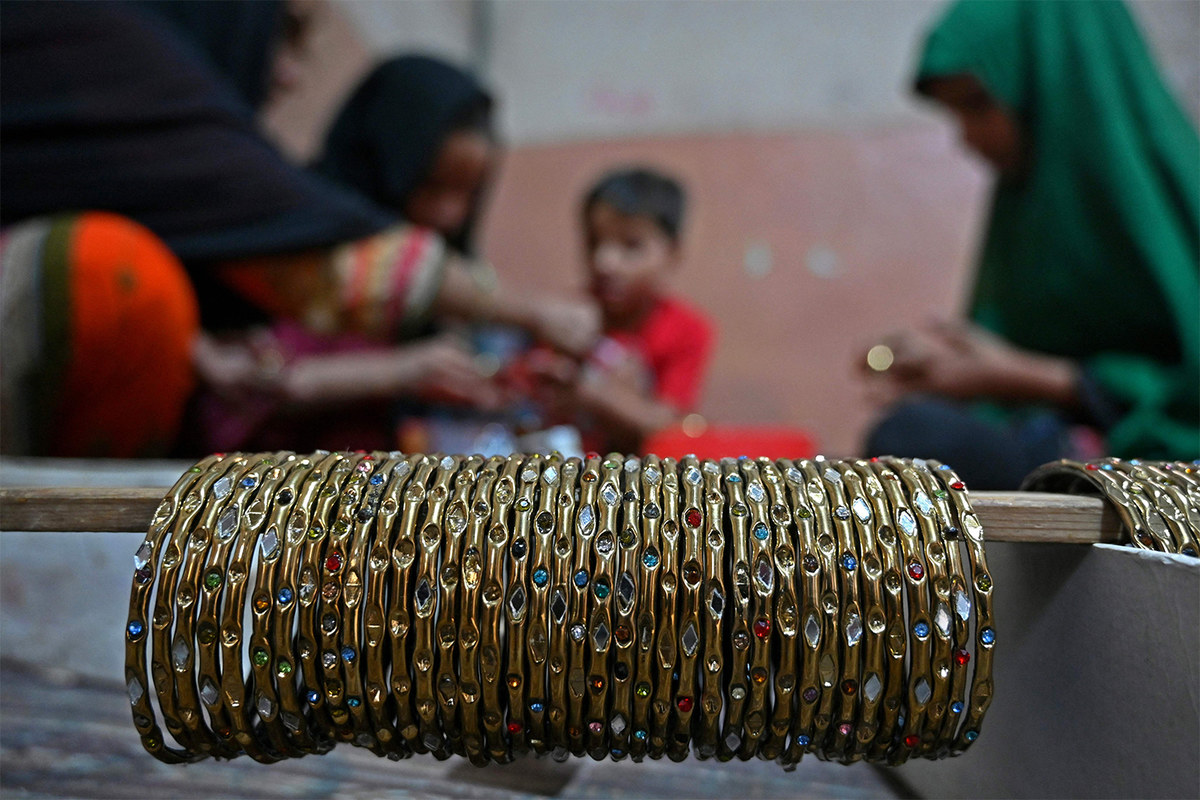


In this picture taken on March 31, 2024, worker Saima Bibi (L) along with her children, adds decorative elements to glass bangles at a home workshop in Hyderabad. (AFP)

After the partition of British-ruled India in 1947, migrating Muslims who had produced bangles in the Indian city of Firozabad took their trade to Hyderabad — where hundreds of thousands of people rely on the industry.

But soaring gas prices after the government slashed subsidies have forced many factories to close or to operate at reduced hours.

“The speed at which the government has increased the gas prices and taxes, (means) the work in this area has started to shrink instead of expand,” said 50-year-old factory owner Muhammad Nafees.

Most bangles leave the factory as plain loops, sent off to be embellished to different degrees by women who work from home, before they’re finally passed on to traders to be sold in markets.

The production is often a family affair.

Saima Bibi, 25, works from home, carefully adding stones to bangles with the help of her three children when they return from school, while her husband works at the furnaces.

“They go through a lot of hands to be prepared,” she said.


Pakistan forces retake Balochistan town using drones, helicopters as violence toll rises

Updated 6 sec ago
Follow

Pakistan forces retake Balochistan town using drones, helicopters as violence toll rises

  • Security forces say 197 BLA militants killed after coordinated attacks across the province
  • Police say additional troops were sent to the remote town of Nushki amid rising violence

QUETTA: Pakistan’s security forces used drones and helicopters to wrest control of a southwestern town from separatist insurgents after a three-day ​battle, police said on Wednesday, as the death toll in the weekend’s violence rose to 58.

Saturday’s wave of coordinated attacks by the separatist Baloch Liberation Army brought Pakistan’s largest province to a near standstill as security forces exchanged fire with insurgents in more than a dozen places, killing 197 militants.

“I thought the roof and walls of my house were going to blow up,” said Robina Ali, a housewife living near the main administrative building in the fortified provincial capital of Quetta, where a powerful morning blast rocked the area.

Fighters of the BLA, the region’s strongest insurgent group, stormed schools, banks, markets and ‌security installations across Balochistan ‌in one of their largest operations ever, killing more than 22 ‌security ⁠officials ​and 36 ‌civilians.

Police officials gave details of the situation on condition of anonymity as they were not authorized to speak to the media.

In the desert town of Nushki, home to about 50,000, the insurgents seized control of the police station and other security installations, triggering a three-day standoff.

Police said seven officers were killed in the fighting before they regained control of the town late on Monday, while operations against the BLA continue elsewhere in the province.

“More troops were sent to Nushki,” said one security official. “Helicopters and drones were used against the militants.”

Pakistan’s ⁠interior ministry did not immediately respond to a Reuters request for comment.

LATE NIGHT ATTACKS

Pakistan’s largest and poorest province, mineral-rich Balochistan borders Iran and ‌Afghanistan and is home to Beijing’s investment in the Gwadar deep-water ‍port and other projects.

It has grappled with a ‍decades-long insurgency led by ethnic Baloch separatists seeking greater autonomy and a larger share of its natural ‍resources.

The BLA, which has urged people of the province to support the movement, said on Tuesday it had killed 280 soldiers during its Operation “Herof,” Black Storm, but gave no evidence.

Security officials said the weekend attacks began at 4 a.m. on Saturday with suicide blasts in Nushki and the fishing port of Pasni and gun and grenade ​attacks in 11 more places, including Quetta.

The insurgents seized at least six district administration offices during the siege and had advanced at one point to within 1 km (3,300 ft) ⁠of the provincial chief minister’s office in Quetta, the police officials said.

EVOLVING INSURGENCY

Pakistan has blamed India for the attacks, without furnishing evidence for charges that could escalate hostilities between the nuclear-powered neighbors who fought their worst armed conflict in decades in May.

India’s foreign ministry has rejected the charges, saying Islamabad should instead tackle the “long-standing demands of its people in the region.”

Retired Lt. General Amir Riaz, who led the military in Balochistan from 2015 to 2017, said the insurgency had evolved over the last decade.

He added that it gained strength as the BLA received Indian support and used Afghanistan as a staging ground for its attacks, a charge the Taliban government has denied.

Riaz said the conflict would oscillate between stalemate and periods of heightened violence.

“It has escalated. The response will be decisive, leading to serious capacity degradation of BLA,” he said, denying that the Pakistani military ‌has used excessive force in Balochistan.

“However, ultimately the issues are only resolved through political process and governance.”