

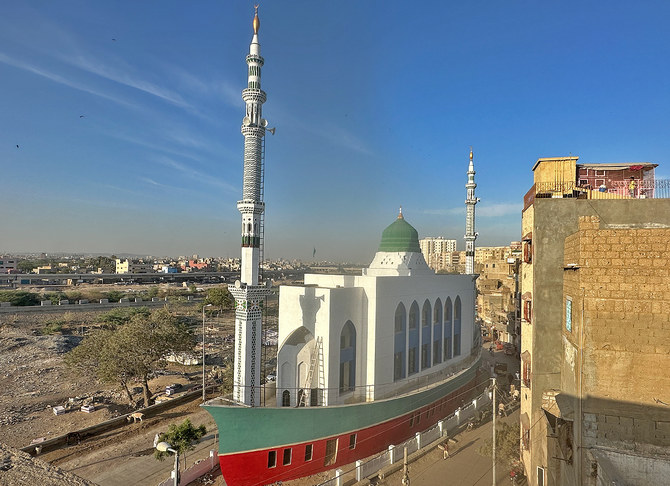
Karachi’s ‘Kishti Wali Masjid’ adds charm for worshippers with unique boat-like shape

The picture taken on March 28, 2024 shows boat-like shape in Karachi, Pakistan. (AN photo)
Short Url
Updated 01 April 2024
Follow

Karachi’s ‘Kishti Wali Masjid’ adds charm for worshippers with unique boat-like shape

  • Mosque originally built in British era by Muslim laborers, demolished multiple times due to road and development works
  • To avoid future demolition, community members and architect suggested turning building into landmark with unique boat shape 

KARACHI: If you see the structure from afar, it looks like a giant boat anchored in the middle of the busy road in Pakistan’s southern port city of Karachi.

But once you move closer and two large minarets and a green-colored dome appear in sight, it becomes clear that this is a mosque. 

This is the historic Kutchi Jama Masjid, or ‘Kishti Wali Masjid,’ in Karachi’s Dhobi Ghat area, which has become a popular landmark and beloved space for worshippers to visit for prayers and community. 

The mosque traces its origins to some 130 years ago, when British forces mobilized Muslim laborers to fortify the banks of the Lyari river. The workers erected a makeshift mosque on the site, according to Gul Muhammad Attari, the current president of the Kutchi Jama Masjid. 

Decades later, when members of the Kutchi Memon community migrated to Karachi in the 1920s, they constructed a concrete mosque in the same place with four minarets. 

Since then, the building has been demolished and reconstructed multiple times due to road building and expansion works as well as development projects in the area. In 2005, to save the mosque from future demolitions, the Kutchi community came up with the idea of turning the mosque into a landmark — a space that was a mosque but also had cultural and tourist value. 

The design came from Abdul Qadir, an architect from the Kutchi community, and the mosque was built over seven years. In its present form, it has three floors and can accommodate up to 1,000 worshippers.

“When people see this mosque from afar, they are amazed that there is a boat standing in the middle of the road,” Attari told Arab News. 

“When they come closer and see the dome and minarets, they are pleasantly surprised that, ‘Wow, this is a mosque, Mashallah!’ They are really happily surprised.”

“WORLD FAMOUS”

The boat had almost been moved from its coveted spot on the edge of the river once. 

Attari recalled a proposal by then mayor of Karachi Dr. Farooq Sattar in the 1980s to relocate the mosque closer to the river to make space for a dual carriageway, but residents of the area said they would give up the space of their houses rather than let the building be moved. 

“If people hadn’t sacrificed their homes, it wouldn’t have taken the shape of a boat like this later,” Attari said.

Noor Muhammad, a community elder and a regular worshiper at the mosque for the last five decades, said its design had garnered worldwide fame to the extent that many were now unfamiliar with its original name.

“People don’t know, most of them don’t know what the name of the mosque is,” he told Arab News, saying worshippers only identified it as the boat-shaped mosque and came from far and wide to witness the “architectural marvel.”

“People come from Islamabad, people come from Lahore, and say ‘We have come just to see this mosque’,” Muhammad said. 

“When that mosque was [last] demolished, people thought they wouldn’t find the tranquillity of the original mosque again,” Attari added. 

“But now, Mashallah, when this mosque was built, it became so famous worldwide that people now come here and pray and feel proud that they are praying in the ‘Kishti Wali Masjid’.”


Pakistan minister calls for integrating ocean awareness into education to preserve ecosystems

Updated 5 sec ago
Follow

Pakistan minister calls for integrating ocean awareness into education to preserve ecosystems

  • Pakistan’s maritime sector posted a record $360 million profit in 2025 following a year of sweeping reforms
  • Junaid Anwar Chaudhry says education equips youth to make informed decisions, contribute to blue economy

KARACHI: Pakistan’s Maritime Affairs Junaid Anwar Chaudhry has urged integrating ocean awareness into formal education systems and empowering youth as active partners in order to preserve marine ecosystems, his ministry said on Saturday.

Chaudhry said this at a meeting with Minister of State for Education and Professional Training, Wajiha Qamar, who called on him and discussed strategies for enhancing marine education, literacy, and youth engagement in sustainable ocean management.

Pakistan’s maritime sector posted a record Rs100 billion ($360 million) profit in 2025 following a year of sweeping reforms aimed at improving port efficiency, cost-cutting, and safeguarding marine ecosystems to boost the blue economy.

“Understanding our oceans is no longer optional, it is essential for climate resilience, sustainable development, and the long-term health of our maritime resources,” Chaudhry said, highlighting the critical role of marine literacy.

The minister said education equips youth to make informed decisions and actively contribute to marine conservation and the blue economy, urging inclusion of marine ecosystems, conservation and human-ocean interactions into curricula, teacher training and global citizenship programs.

“Initiatives like ‘Ocean Literacy for All’ can mainstream these elements in national policies, school programs, and community workshops to build proactive citizenship on marine challenges,” he added.

Ocean Literacy for All is a UNESCO Intergovernmental Oceanographic Commission–coordinated global initiative under the UN Ocean Decade (2021–2030) that promotes ocean awareness, education, and conservation.

Chaudhry announced reforms in maritime education, including granting degree-awarding status to the Pakistan Marine Academy, and the establishment of the Maritime Educational Endowment Fund (MEEF) to provide scholarships for deserving children from coastal communities.

“The scholarship program promotes inclusive development by enabling access to quality education for youth from over 70 coastal and fishing communities, particularly in Sindh and Balochistan,” he said.

The discussions underscored raising awareness about oceans, coastal ecosystems and marine resources, according to the Pakistani maritime affairs ministry. Both ministers stressed the need to integrate climate and marine education from classrooms

to community programs, addressing risks like rising sea temperatures, coastal erosion, biodiversity loss and pollution.

“Incorporating marine science and ocean literacy into curricula can help students connect local challenges with global trends,” Qamar said, underscoring education’s transformative power in building social resilience.

The meeting explored translating complex marine science into accessible public knowledge through sustained, solution-oriented awareness campaigns, according to the maritime affairs ministry.

With coastline facing pressures from climate change, pollution, and overexploitation, the ministers called for a coordinated approach blending formal education, informal learning and youth-led advocacy.

“A joint effort by the Ministries of Maritime Affairs and Education can cultivate an ocean-literate generation, transforming vulnerability into resilience and ensuring the long-term sustainability of coastal and marine ecosystems,” Chaudhry said.