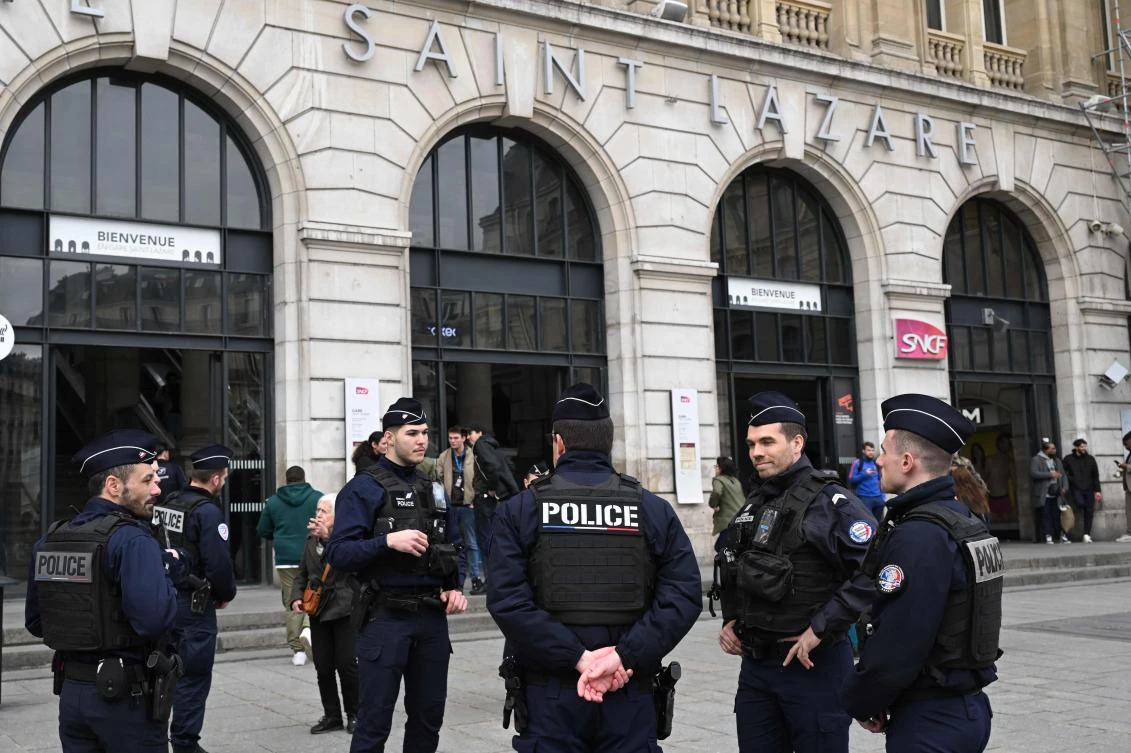
PARIS: France says it has asked 46 countries if they would be willing to supply more than 2,000 police officers to help secure the Paris Olympics this summer, as organizers finalize security planning for the French capital’s first Games in a century while on heightened alert against potential attacks.
The Interior Ministry said Friday that the request for foreign security assistance was made in January, seeking nearly 2,185 reinforcements. The officers are sought to help with Games security and “the spectator experience” and to “strengthen international cooperation,” the ministry said.
“This is a classic approach of host countries for the organization of major international events,” the ministry added.
It noted that France sent 200 of its gendarmes to soccer’s World Cup in Qatar in 2022 and also welcomed 160 officers from other European security forces for the Rugby World Cup that France hosted last year.
Separately, the French Defense Ministry has also asked foreign nations for “small numbers” of military personnel who could help with “very specific” tasks at the Games, including sniffer dog teams, said Col. Pierre Gaudillière, spokesman for the army general staff.
Poland’s defense minister said his country will be sending soldiers to the Paris Games. The Polish armed forces delegation will include dog handlers and “its main goal will be to undertake activities related to the detection of explosives and counteracting terrorist phenomena.” the minister, Władysław Kosiniak-Kamysz, posted on X.
Security is the biggest challenge for Paris Games organizers in a city that has been repeatedly hit by deadly attacks by Islamic extremists and which is expecting as many as 15 million visitors for the July 26-Aug. 11 Games and Paralympics that follow.
Security concerns are notably high for the opening ceremony, which will involve boats along the Seine River and huge crowds watching from the embankments.
France’s government increased its security alert posture to the highest level in the wake of the recent deadly attack at a Russian concert hall and Daesh’s claim of responsibility.
French Prime Minister Gabriel Attal announced the decision in a post on X, saying authorities were “taking into account Daesh’s claim of responsibility for the (Moscow) attack and the threats weighing on our country.″
France asks for foreign police and military help with massive Paris Olympics security challenge
https://arab.news/jz2mb
France asks for foreign police and military help with massive Paris Olympics security challenge
- The Interior Ministry said Friday that the request for foreign security assistance was made in January, seeking nearly 2,185 reinforcements
- The officers are sought to help with Games security and “the spectator experience” and to “strengthen international cooperation,” the ministry said
US allies, foes alarmed by capture of Venezuela’s Maduro
- Countries such as Russia and China, which had ties with Maduro’s government, were quick to condemn the operation but alarm also shared by France and EU
- UN Secretary-General Antonio Guterres was “deeply alarmed” by the US strikes
PARIS: The US military operation that led to the seizure of Venezuelan President Nicolas Maduro on Saturday sparked alarm across the international community, with allies and foes of Washington and Caracas expressing disquiet.
US President Donald Trump said Maduro and his wife would be taken to New York to face federal charges after military strikes and an operation which he described as looking like a “television show.”
The Venezuelan government decried what it termed a “extremely serious military aggression” by Washington and declared a state of emergency.
Countries such as Russia and Iran, which had longstanding ties with Maduro’s government, were quick to condemn the operation but their alarm was also shared by Washington’s allies including France and the EU.
Here is a rundown of the main reaction.
Russia
Russia demanded the US leadership “reconsider its position and release the legally elected president of the sovereign country and his wife.”
China
Beijing said “China is deeply shocked and strongly condemns the US’s blatant use of force against a sovereign state and its action against its president.”
Iran
Iran, which Trump bombed last year, said it “strongly condemns the US military attack on Venezuela and a flagrant violation of the country’s national sovereignty and territorial integrity.”
Mexico
Mexico, which Trump has also threatened with military force over drug trafficking, strongly condemned the US military action in Venezuela, saying it “seriously jeopardizes regional stability.”
Colombia
Colombian President Gustavo Petro — whose country neighbors Venezuela — called the US action an “assault on the sovereignty” of Latin America which would lead to a humanitarian crisis.
Brazil
Brazilian President Luiz Inacio Lula da Silva slammed the US attacks as a “serious affront” to Venezuela’s sovereignty.
Cuba
Cuba, a strong ally of Venezuela, denounced “state terrorism against the brave Venezuelan people.”
Spain
Spain offered to mediate in the crisis to find a way to a peaceful solution, while calling for “de-escalation and restraint.”
France
France condemned the US operation, saying it undermined international law and no solution to Venezuela’s crisis can be imposed from the outside.
EU
The EU more generally expressed concern at the developments and urged respect for international law, even as it noted that Maduro “lacks legitimacy.”
EU candidate country North Macedonia, along with fellow Balkan nations Albania and Kosovo, backed Washington, however.
“We stand with the United States and the Venezuelan people for freedom and democracy,” North Macedonia FM Timco Mucunski said on X.
Britain
British Prime Minister Keir Starmer said all countries should “uphold international law” and added that “the UK was not involved in any way in this operation” as he urged patience in order to “establish the facts.”
Italy
In a rare expression of support for the US operation by a major European country, far-right Italian Prime Minister Giorgia Meloni — a Trump ally — argued the US military action in Venezuela was “legitimate” and “defensive.”
Israel
Israel also hailed the operation, saying Washington acted as the “leader of the free world.”
Ukraine
Ukraine — dependent on US support in its war against invading Russia — did not address the legality of a big country like America using military force against a much smaller one like Venezuela.
Foreign minister Andriy Sybiga instead focused on Maduro’s lack of legitimacy and the Venezuelan government’s repression, while backing “democracy, human rights, and the interests of Venezuelans.”
South Africa
South Africa, which Trump accuses of alleged discrimination — and even “genocide” — of minority white Afrikaners, said: “Unlawful, unilateral force of this nature undermines the stability of the international order and the principle of equality among nations.”
UN
UN Secretary-General Antonio Guterres was “deeply alarmed” by the US strikes, with his spokesman quoting him as saying it could “constitute a dangerous precedent.”