MUMBAI/WASHINGTON: India strongly objected on Wednesday to US remarks about its “internal affairs” after the arrest of Delhi’s chief minister, a government rival, and the freezing of opposition Congress party bank accounts ahead of an election.
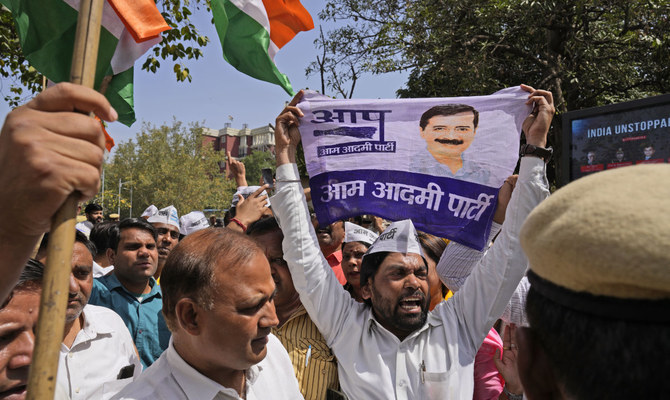
Arvind Kejriwal, whose Aam Aadmi Party (AAP) governs the national capital territory and the northern state of Punjab, was arrested last week by the federal financial crime-fighting agency on corruption charges, weeks before Indians head to the polls from April 19.
AAP, all of whose main leaders are now imprisoned in connection with the case, says Kejriwal has been “falsely arrested” in a “fabricated case.”
It has an electoral alliance with the Congress party and others who aim to challenge Prime Minister Narendra Modi’s ruling Hindu nationalist Bharatiya Janata Party.
On Wednesday, India summoned the acting US deputy chief of mission in New Delhi following a State Department comment on Monday that it was closely following reports of Kejriwal’s arrest and that it encouraged a fair legal process.
“India’s legal processes are based on an independent judiciary which is committed to objective and timely outcomes. Casting aspersions on that is unwarranted,” the Indian foreign ministry said in a statement.
“In diplomacy, states are expected to be respectful of the sovereignty and internal affairs of others. This responsibility is even more so in case of fellow democracies. It could otherwise end up setting unhealthy precedents,” it said.
India and the US enjoy close ties and Washington has increasingly come to see New Delhi as an important partner in its effort to push back against China’s growing power worldwide.
When asked about the summoning of the diplomat, a US State Department spokesperson said he would not discuss private conversations but reiterated that Washington encouraged a “fair, transparent and timely” legal process for Kejriwal and for the Congress party.
The Congress party said last week its bank accounts had been frozen over an income tax case. It called the action politically motivated.
The federal government and Modi’s party deny political interference.
Kejriwal’s arrest after the announcement of elections has angered the opposition alliance challenging Modi and drawn international attention.
The US comments on Kejriwal followed those by Germany, which said Berlin assumes and expects that the standards relating to independence of judiciary and basic democratic principles will also be applied in this case.
In response, New Delhi summoned a German envoy to protest against the remarks.


![]()

India objects to US remarks on opposition figure Kejriwal’s arrest
Short Url
https://arab.news/vjxr8
India objects to US remarks on opposition figure Kejriwal’s arrest
- Kejriwal’s arrest after the announcement of elections has angered the opposition alliance challenging Modi and drawn international attention


Latest updates


© 2026 SAUDI RESEARCH & PUBLISHING COMPANY, All Rights Reserved And subject to Terms of Use Agreement.