Salman Rushdie: AI only poses threat to unoriginal writers

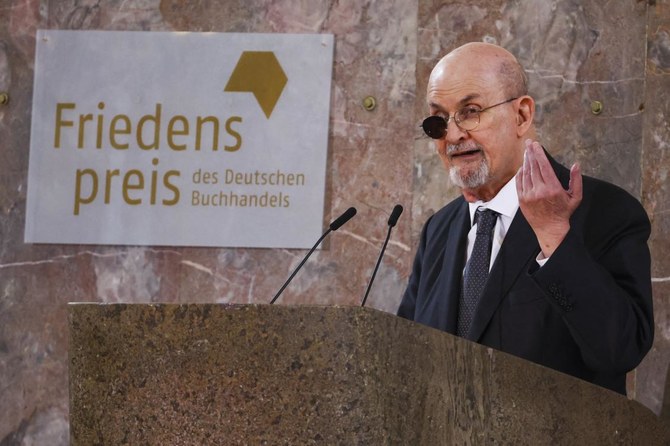
Rushdie said that generative AI writing tools could be a threat to more formulaic writers, however. (AFP/File)
Short Url
Updated 22 March 2024
Follow

Salman Rushdie: AI only poses threat to unoriginal writers

  • Technology lacks originality and humor to pose seriuous challenge, author said

PARIS: Artificial intelligence tools may pose a threat to writers of thrillers and science fiction, but lack the originality and humor to challenge serious novelists, Salman Rushdie wrote in a French journal published Thursday.
In an article translated into French for literary journal La Nouvelle Revue Francaise (NRF), Rushdie said he tested ChatGPT by asking it to write 200 words in his style.
He describes the results as “a bunch of nonsense.”
“No reader who had read a single page of mine could think I was the author. Rather reassuring,” he said, according to a translation of the article by AFP.
The Booker Prize-winning author of “The Satanic Verses” and “Midnight’s Children” said that generative AI writing tools could be a threat to more formulaic writers, however.
“The trouble is that these creatures learn very quickly,” he said, adding that this could be worrying for writers of genre literature like thrillers and science fiction, where originality is less important.
The threat could be particularly acute for film and TV writers.
“Given that Hollywood is constantly creating new versions of the same film, artificial intelligence could be used to draft screenplays,” he said.
His judgment of ChatGPT’s skills was harsh, finding it had “no originality” and was seemingly “completely devoid of any sense of humor.”
Rushdie spent many years in hiding after a death threat was issued by Iran in 1989 over the “The Satanic Verses,” which was claimed to be anti-Islamic.
He lost the use of an eye after being stabbed in August 2022 during a literary conference in the New York area by an US citizen of Lebanese origin.


Trending: BBC report suggests sexual abuse and torture in UAE-run Yemeni prisons

Updated 02 February 2026
Follow

Trending: BBC report suggests sexual abuse and torture in UAE-run Yemeni prisons

  • The investigation was produced by British-Yemeni BBC journalist Nawal Al-Maghafi

LONDON: A recent BBC video report diving into what it says was UAE-run prison in Yemen has drawn widespread attention online and raised fresh questions about the role of the emirates in the war-torn country.

The report, published earlier this month and recently subtitled in Arabic and shared on social media, alleged that the prison — located inside a former UAE military base — was used to detain and torture detainees during interrogations, including using sexual abuse as a method.

The investigation was produced by British-Yemeni BBC journalist Nawal Al-Maghafi, who toured the site, looking into cells and what appear to be interrogation rooms.

Al-Maghafi said the Yemeni government invited the BBC team to document the facilities for the first time.

A former detainee, speaking anonymously, described severe abuse by UAE soldiers: “When we were interrogated, it was the worst. They even sexually abused us and say they will bring in the doctor. The ‘so-called’ doctor was an Emirati soldier. He beat us and ordered the soldiers to beat us too. I tried to kill myself multiple times to make it end.”

Yemeni information minister, Moammar al Eryani also appears in the report, clarifying that his government was unable to verify what occurred within sites that were under Emirati control.

“We weren’t able to access locations that were under UAE control until now,” he said, adding that “When we liberated it (Southern Yemen), we discovered these prisons, even though we were told by many victims that these prisons exist, but we didn't believe it was true.”

The BBC says it approached the UAE government for comment, however Abu Dhabi did not respond to its inquiries.

Allegations of secret detention sites in southern Yemen are not new. The BBC report echoes earlier reporting by the Associated Press (AP), which cited hundreds of men detained during counterterrorism operations that disappeared into a network of secret prisons where abuse was routine and torture severe.

In a 2017 investigation, the AP documented at least 18 alleged clandestine detention sites — inside military bases, ports, an airport, private villas and even a nightclub — either run by the UAE or Yemeni forces trained and backed by Abu Dhabi.

The report cited accounts from former detainees, relatives, civil rights lawyers and Yemeni military officials.

Following the investigation, Yemen’s then-interior minister called on the UAE to shut down the facilities or hand them over, and said that detainees were freed in the weeks following the allegations.

The renewed attention comes amid online speculation about strains between Saudi Arabia and the UAE over Yemen.