

Baloch militant bombers killed in raid on key China-backed port in Pakistan

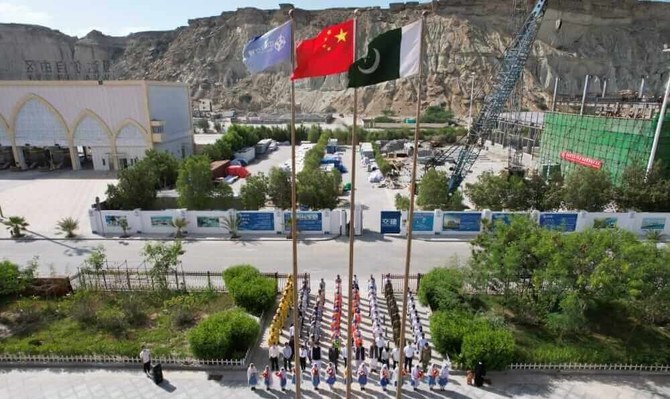
The deep-water port is key to the China-Pakistan Economic Corridor (CPEC) that also encompasses roads and energy projects and is part of Xi Jinping’s Belt and Road Initiative. (Gwadar Port Authority)
Short Url
Updated 20 March 2024
Follow

Baloch militant bombers killed in raid on key China-backed port in Pakistan

  • Baloch separatists armed with guns and bombs attacked the strategic port, key to the multi-billion dollar China-Pakistan Economic Corridor
  • Baloch Liberation Army (BLA), the most prominent of several separatist groups in Balochistan, claimed responsibility for the assault

QETTA: Pakistani security forces on Wednesday killed eight Baloch Liberation Army militants who stormed a complex outside the strategic port of Gwadar.
Armed with guns and bombs, the militants attacked the complex that houses offices of government departments, intelligence agencies and paramilitary forces. They detonated a number of bombs before opening fire, said Saeed Ahmed Umrani, a government commissioner.
Provincial Chief Minister Sarfraz Bugti said all eight attackers had been killed by security forces. “The message is loud and clear,” he said. “Whosoever chooses to use violence will see no mercy from the state.”
China has invested heavily in the mineral-rich southwestern province of Balochistan, including developing Gwadar, despite a decades-long separatist insurgency. The deep-water port in the Gulf of Oman near the strategically important Strat of Hormuz is key to the China-Pakistan Economic Corridor, which also encompasses roads and energy projects and is part of Chinese President Xi Jinping's Belt and Road Initiative.
The Baloch Liberation Army, the most prominent of several separatist groups in Balochistan, has previously been involved in attacks on Pakistani and Chinese interests in the region and elsewhere.

Chinese targets have also come under attack by other Baloch militant groups in Pakistan, who have been fighting for decades for a larger share in the regional wealth of mines and minerals that they say is being denied by central government in Islamabad.

Belt and Road projects in Pakistan have been plagued by security concerns. In 2021, a bus carrying engineers to a construction site near a dam in northwestern Pakistan was hit by a bomb, killing 13 people including nine Chinese workers.


EU parliament approves 90-bn-euro loan for Ukraine amid US cuts

Updated 5 sec ago
Follow

EU parliament approves 90-bn-euro loan for Ukraine amid US cuts

  • awmakers voted by 458 to 140 in favor of the loan, intended to cover two-thirds of Ukraine’s financial needs for 2026 and 2027

The EU parliament on Wednesday approved a 90-billion-euro loan for Ukraine, providing a financial lifeline to cash-strapped Kyiv four years into Russia’s invasion.
Lawmakers voted by 458 to 140 in favor of the loan, intended to cover two-thirds of Ukraine’s financial needs for 2026 and 2027 and backed by the EU’s common budget — after plans to tap frozen Russian central bank assets fell by the wayside.

Military aid to Ukraine hit its lowest level in 2025 as the US pulled funding, leaving Europe almost alone in footing the bill and averting a complete collapse, the Kiel Institute said Wednesday.
Kyiv's allies allocated 36 billion euros ($42.9 billion) in military aid in 2025, down 14 percent from 41.1 billion euros the previous year, according to Kiel, which tracks military, financial and humanitarian assistance pledged and delivered to Ukraine since Russia's full-scale invasion.
Military aid in 2025 was even lower than in 2022, despite the invasion not taking place until February 24 that year.
US aid came to a complete halt with President Donald Trump's return to the White House in early 2025.
Washington provided roughly half of all military assistance between 2022 and 2024.
European countries have thus made a significant effort to plug the gap, increasing their collective allocation by 67 percent in 2025 compared with the 2022-2024 average.
Without that effort, the US cuts could have been even more damaging, the institute argued.
However, the think tank points to "growing disparities" among European contributors, with Northern and Western European countries accounting for around 95 percent of military aid.
The institute calculated that Northern European countries (Denmark, Estonia, Finland, Iceland, Latvia, Lithuania, Norway, and Sweden) provided 33 percent of European military aid in 2025, despite accounting for only eight percent of the combined GDP of European donor countries.
Southern Europe, which accounts for 19 percent of the combined GDP of European donors, contributed just three percent.
To help fill the gap left by the United States, NATO launched the PURL programme, under which European donors purchased US weapons for Ukraine, worth 3.7 billion euros in 2025.
Kiel called the initiative a "notable development", which had enabled the acquisition of Patriot air-defense batteries and HIMARS multiple-launch rocket systems.
European allies are also increasingly placing orders with Ukraine's own defence industry, following a trend started by Denmark in 2024.
War-torn Ukraine's defence production capacity has "grown by a factor of 35" since 2022, according to Kiel, but Kyiv lacks the funds to procure enough weapons to keep its factories working at full capacity.
Orders from 11 European donor countries helped bridge that gap last year.
In the second half of 2025, 22 percent of weapons purchases for Ukraine were procured domestically, a record high.