

Eight militants who attacked Pakistan’s strategic Gwadar port killed — chief minister

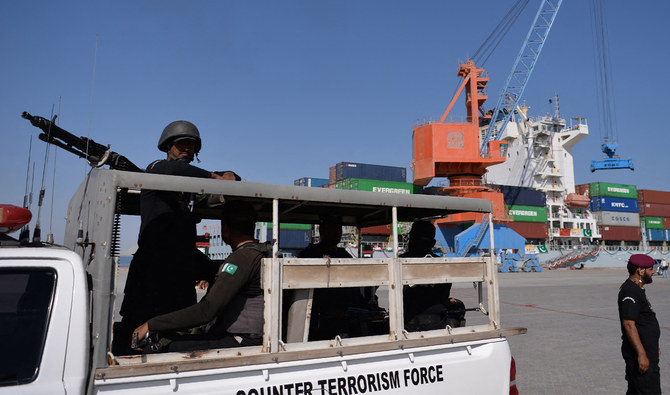
Pakistani security personnel patrol near a ship in Gwadar port, some 700 kms west of Karachi on November 13, 2016. (FP/File)
Short Url
Updated 20 March 2024
Follow

Eight militants who attacked Pakistan’s strategic Gwadar port killed — chief minister

  • One security personnel killed, two others injured during exchange, says official 
  • Gwadar port is located in Pakistan’s restive insurgency-hit Balochistan province 

QUETTA:​ Pakistan’s security forces have killed all eight “terrorists” who attacked the country’s southwestern Gwadar port, the chief minister of the province where the port is located said on Wednesday. 

Commissioner Makran Division Saeed Umrani told Arab News a group of unidentified gunmen attacked the Gwadar Port Authority (GPA) Complex on Wednesday afternoon, after which Pakistan Army and police personnel launched a security clearance operation. He confirmed one security personnel had been killed in the exchange while two others had been injured. 

Banned outfit Baloch Liberation Army (BLA) claimed responsibility for attacking the complex, saying that its fighters attacked the offices of Pakistan’s Inter-Services Intelligence (ISI) and Military Intelligence (MI). 

“Eight terrorists tried to attack the Gwadar Port Authority complex today,” Balochistan Chief Minister Sarfraz Bugti wrote on X. “All of them have been neutralized by security forces.”

Bugti said the message was loud and clear, that anyone who chooses violence would not be shown mercy by the state.

Gwadar port is key to the multi-billion-dollar China-Pakistan Economic Corridor (CPEC), a road and energy infrastructure project that aims to improve connectivity between the two countries. It is located in Pakistan’s southwestern Balochistan province, which has been the scene of a low-lying insurgency for the past two decades. 

Balochistan is Pakistan’s most sparsely populated and poor province by almost all economic indicators. Ethnic Baloch nationalists accuse the state of denying them a share in Balochistan’s mineral resources and now demand independence from the center. 

The state rejects these allegations and has vowed to quash any armed rebellion. 

China has invested heavily in mineral-rich Balochistan, including developing Gwadar port. Chinese targets have previously come under attack by several militant groups in Pakistan.

 In August, gunmen attacked a convoy of Chinese workers in Gwadar with the BLA claiming responsibility for the attack.


Pakistan says repaid over $13.06 billion domestic debt early in last 14 months

Updated 29 January 2026
Follow

Pakistan says repaid over $13.06 billion domestic debt early in last 14 months

  • Finance adviser says repayment shows “decisive shift” toward fiscal discipline, responsible economic management
  • Says Pakistan’s total public debt has declined from over $286.6 billion in June 2025 to $284.7 billion in November 2025

KARACHI: Pakistan has repaid Rs3,650 billion [$13.06 billion] in domestic debt before time during the last 14 months, Adviser to the Finance Minister Khurram Schehzad said on Thursday, adding that the achievement reflected a shift in the country’s approach toward fiscal discipline. 

Schehzad said Pakistan has been repaying its debt before maturity, owed to the market as well as the State Bank of Pakistan (SBP), since December 2024. He said the government had repaid the central bank Rs300 billion [$1.08 billion] in its latest repayment on Thursday. 

“This landmark achievement reflects a decisive shift toward fiscal discipline, credibility, and responsible economic management,” Schehzad wrote on social media platform X. 

Giving a breakdown of what he said was Pakistan’s “early debt retirement journey,” the finance official said Pakistan retired Rs1,000 billion [$3.576 billion] in December 2024, Rs500 billion [$1.78 billion] in June 2025, Rs1,160 billion [$4.150 billion] in August 2025, Rs200 billion [$715 million] in October 2025, Rs494 billion [$1.76 billion] in December 2025 and $1.08 billion in January 2026. 

He said with the latest debt repaid today, the July to January period of fiscal year 2026 alone recorded Rs2,150 billion [$7.69 billion] in early retirement, which was 44 percent higher than the debt retired in FY25.

He said of the total early repayments, the government has repaid 65 percent of the central bank’s debt, 30 percent of the treasury bills debt and five percent of the Pakistan Investment Bonds (PIBs) debt. 

The official said Pakistan’s total public debt has declined from over Rs 80.5 trillion [$286.6 billion] in June 2025 to Rs80 trillion [$284.7 billion] in November 2025. 

“Crucially, Pakistan’s debt-to-GDP ratio, around 74 percent in FY22, has declined to around 70 percent, reflecting a broader strengthening of fiscal fundamentals alongside disciplined debt management,” Schehzad wrote. 

Pakistan’s government has said the country’s fragile economy is on an upward trajectory. The South Asian country has been trying to navigate a tricky path to economic recovery under a $7 billion loan from the International Monetary Fund.