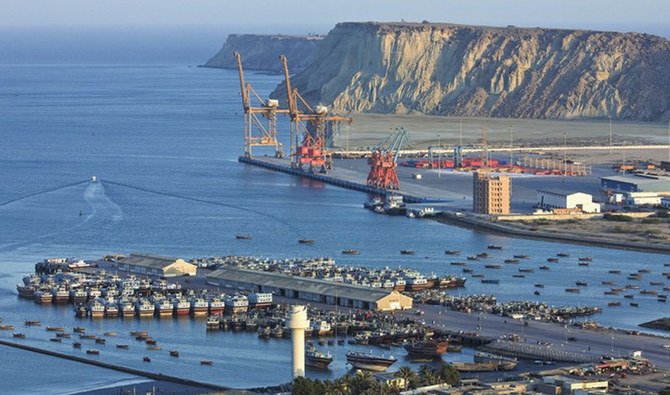
ISLAMABAD: US Ambassador Donald Blome visited the key strategic port city of Gwadar on Tuesday where he was briefed about the trade potential of the area and explored development opportunities for the southwestern province of Balochistan.
Located on the Arabian Sea near Iran, Gwadar is central to a multibillion-dollar regional connectivity project jointly launched by China and Pakistan. The two countries view the city as an industrial and shipping hub that will not only benefit their economies but also enhance trade opportunities for Central Asian economies with the rest of the world.
China and Pakistan have also worked together to develop a deep-sea in Gwadar while asking other regional and international actors to participate in the economic connectivity project, though the United States has largely remained aloof of their strategic endeavors.
“US Ambassador to Pakistan Donald Blome visited Gwadar, Balochistan, on September 12, to underscore the United States’ commitment to the people 0of Balochistan, a partnership that remains steadfast and robust,” said a statement released by the American embassy in Islamabad.
“Ambassador Blome also visited Gwadar Port and met with Port Authority Chairman Pasand Khan Buledi to learn about port operations and development plans, Gwadar’s potential as a regional trans-shipment hub, and ways to connect with Pakistan’s largest export market: the United States,” it added.
The embassy noted the United States and Balochistan had a history of collaboration while recalling that the administration in Washington had helped 661,000 people in the face of last year’s devastating floods by providing food and much-needed cash assistance.
It added that nearly 90,000 children were given nourishing meals to combat the threat of starvation in the province, where 41 health facilities had also been renovated with US support in the last one year.
Ambassador Blome also held productive discussions with political leaders, representatives from the Gwadar Chamber of Commerce, and a diverse group of government and private sector leaders during his visit.
He reiterated US support for Balochistan’s development while discussing economic growth, disaster relief and preparedness. Additionally, he mentioned the benefits of US trade and investment and highlighted various measures Pakistan could take to strengthen and improve its investment climate.
“Ambassador Blome’s meeting with members of the Gwadar Chamber of Commerce focused on ways to increase US trade and investment in the region’s business, logistics, tourism, fisheries, and blue economy sectors,” the embassy said in the statement.
“The group shared how growing these business-to-business relationships can help create inclusive, Pakistani-led growth that supports jobs across Balochistan,” it added. “They also discussed how deepening business partnerships can enhance technical skills in Balochistan and help increase bilateral trade.”
In a meeting with Pakistan Naval West Command, Ambassador Blome also discussed regional issues and emphasized a continued partnership in the years ahead.
Pakistani officials openly acknowledged earlier this year they had been finding its difficult to balance its relations with the US and China amid their growing rivalry on the world stage.
The country’s former defense minister, Khawaja Asif, told an American publication in a wide-ranging interview in June that Washington should avoid pushing Islamabad into situations where it was forced to make hard political or geostrategic choices.
Prior to that, Pakistan’s former state minister for foreign affairs, Hina Rabbani Khar, also pointed out it was not in her country’s interest to take sides as tensions mounted between the administrations in Beijing and Washington.
Last month, the US said it wanted Pakistan to succeed economically and had no issues with any country making “transparent investments” and following sustainable financing practices.
However, it added that had not seen that with respect to investments by China in countries around the world.


![]()

US envoy visits key strategic town of Gwadar, central to China-Pakistan regional connectivity endeavor
Short Url
https://arab.news/4f3s9
US envoy visits key strategic town of Gwadar, central to China-Pakistan regional connectivity endeavor
- The United States says it has a history of collaboration with Balochistan while mentioning assistance to flood-hit families
- Ambassador Blome holds meeting with the port authority officials, discuss Gwadar’s trans-shipment potential for trade
Latest updates


© 2026 SAUDI RESEARCH & PUBLISHING COMPANY, All Rights Reserved And subject to Terms of Use Agreement.