


Army officers killed in militant attack in northwest Pakistan laid to rest

In this handout photo, taken and released by Pakistan’s Inter-Service Public Relations (ISPR), President of Pakistan Asif Ali Zardari (1L), Chief of Army Staff of Pakistan Asim Munir (4L), and General Sahir Shamshad Mirza (6L), Chairman Joint Chief of Staff Committee, along with others attend the funeral prayers of two army officers, who were killed during a militant attack on a military post in Mir Ali area of North Waziristan district early Saturday, at Chaklala Garrison in Rawalpindi on March 17, 2024. (Photo courtesy: ISPR)
Short Url
Updated 17 March 2024
Follow

Army officers killed in militant attack in northwest Pakistan laid to rest

  • Pakistan’s president, foreign minister and army chief attend funeral prayers of the two army officers in Rawalpindi 
  • Seven soldiers were killed on Saturday when militants attacked a security checkpost in northwestern Pakistan 

ISLAMABAD: Two Pakistan Army officers killed in a militant attack in northwestern Pakistan a day earlier were laid to rest on Saturday night, the army’s media wing said on Sunday, with senior civil and military officials attending the funeral prayers for the deceased in the eastern city of Rawalpindi.
The two army officers, out of a total of seven soldiers, were killed when a group of militants attacked a security forces’ post in the Mir Ali area of the restive North Waziristan district on Saturday, the Inter-Services Public Relations (ISPR) had said.
The militants rammed an explosives-laden vehicle into the post that led to the collapse of a part of the security post building, killing the soldiers. Pakistani troops effectively engaged the attackers and killed all of them in an ensuing clearance operation, the army’s media wing said.
Funeral prayers of Lt. Col. Syed Kashif Ali, 39, and Captain Muhammad Ahmed Badar, 23, were offered at Chaklala Garrison in Rawalpindi.
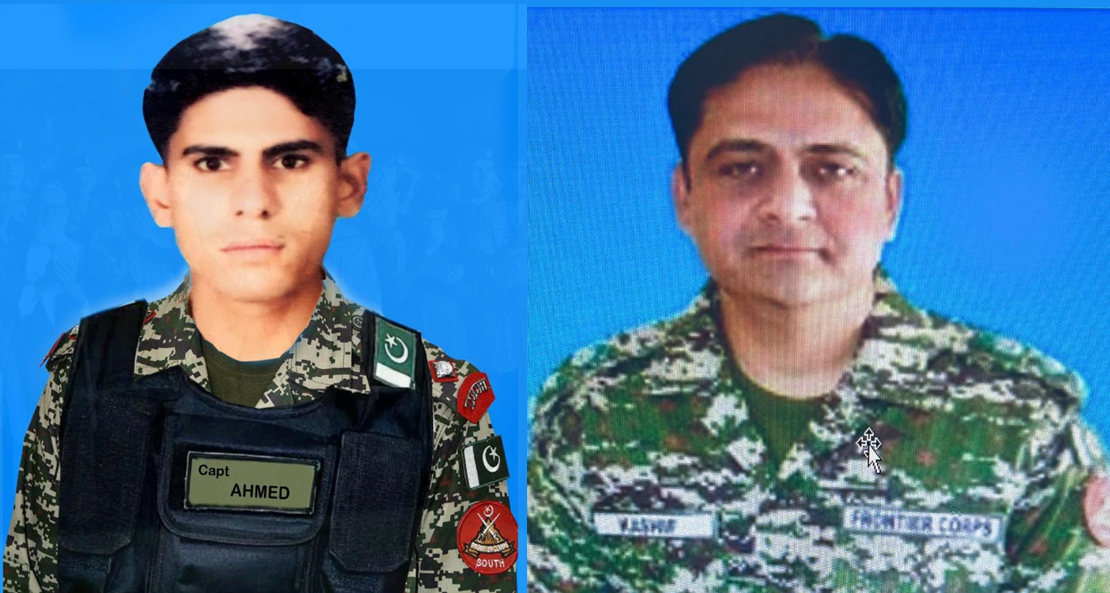


This handout photo, released by Pakistan’s Inter-Service Public Relations (ISPR), shows two Pakistan Army officers, Lt. Col. Syed Kashif Ali (right), 39, and Captain Muhammad Ahmed Badar (left), 23, who were killed during a militant attack in Mir Ali area of North Waziristan district, Khyber Pakhtunkhwa on March 16, 2024. (Photo courtesy: ISPR)​


“Honorable President of Islamic Republic of Pakistan, Asif Ali Zardari, Foreign Minister, Interior Minister, Chairman Joint Chiefs of Staff Committee, Chief of Army Staff, senior serving military and civil officers, relatives of the Shuhada [martyred] and locals of the area attended the funeral,” the ISPR said.

The ISPR said Pakistan Army has consistently upheld the ideals of unity, faith and discipline.
“This noble sacrifice stands as another glorious testament to the unflinching resolve of our gallant sons, who have never hesitated to offer the ultimate sacrifice for the defense of our motherland,” the army said.
President Zardari said the entire nation stands in solidarity with Pakistan’s armed forces.
The bodies of the soldiers killed have been taken to their native towns where they will be laid to rest with full military honor, the army’s media wing said.
Pakistan’s northwestern and southwestern regions that border Afghanistan have witnessed a surge in militancy in recent years, particularly after the Tehreek-e-Taliban Pakistan (TTP), a conglomerate of armed factions, called off a fragile ceasefire with the government in November 2022.
Last week, Pakistani forces killed 10 militants and injured three more in two separate operations in North Waziristan.
Pakistan says militants who have sanctuaries in Afghanistan have been involved in attacks inside its territory. Kabul denies the use of its land by any militant group.


Pakistan approves upgrades to national ID cards in push to strengthen digital ecosystem

Updated 6 sec ago
Follow

Pakistan approves upgrades to national ID cards in push to strengthen digital ecosystem

  • The amendments allow for QR-based verification, authentication controls, biometric expansion, and card format updates
  • The measures advance integrated digital governance through National Data Exchange Layer and broader digital ID ecosystem

ISLAMABAD: Pakistan has notified amendments to the National Identity Card and Pakistan Origin Card rules and introduced QR-based verification and stronger fraud controls, the National Database and Regulatory Authority (NADRA) said on Tuesday, amid efforts to strengthen the country’s digital ecosystem.

The amendments modernize Pakistan’s identity document framework by legally embedding QR-based verification, strengthening authentication controls across digital services, expanding biometric recognition and updating card formats for key citizen categories.

A core reform is the statutory introduction of the Quick Response (QR) code as a defined security and verification feature, authorizing the use of “QR code or any other technological feature” in lieu of current microchip enabling NADRA to adopt evolving verification technologies without repeated rule amendments.

This QR-enabled capability directly strengthens Pakistan’s Digital ID ecosystem and supports interoperability through the National Data Exchange Layer, according to the national database regulator.

“This establishes a robust legal basis for quick and secure verification of identity credentials in both offline and online environments,” NADRA said.

“This will also enable all citizens to carry similar card instead of currently prevalent two types of national identity cards one of which is with microchip and the other without.”

Pakistani state media reported in August that the country was developing digital identities of all its citizens to enable secure and efficient payments. The measures came as part of a broader effort to digitize the economy for greater transparency.

QR-based credentials allow rapid front-end validation of identity attributes in service delivery settings, while also enabling back-end systems to confirm authenticity and status through trusted exchanges. This is expected to improve speed, transparency and consistency of identity verification across government entities and regulated sectors, reduce manual handling, and lower the risk of fraud and impersonation, according to NADRA.

The amendments also strengthen the enforcement effect of card suspension. The Rules now clarify that where a card is suspended, all verification, authentication and related services linked to that card shall stand suspended forthwith. This closes a key risk area by ensuring that once a card is suspended, it cannot continue to be used through digital verification channels or institutional authentication processes.

“The amendments also introduce standardized identification for residents of Azad Jammu and Kashmir by requiring an inscription indicating ‘Resident of Azad Jammu and Kashmir’ in the manner specified by the Authority, thereby ensuring uniform geographic identification on the document,” NADRA said.

“Overall, these amendments strengthen the legal and technological foundations of Pakistan’s identity system by enabling secure QR-based verification, reinforcing the integrity of digital authentication services, improving biometric assurance,” it said. “They also advance readiness for integrated digital governance by supporting structured interoperability through the National Data Exchange Layer and a broader Digital ID ecosystem.”