

Pakistan PM pledges full support to armed forces on first military headquarters visit since election

In this handout picture, taken and released by Inter Services Public Relations (ISPR) on March 15, 2024, Pakistan’s newly elected Prime Minister Shehbaz Sharif (2L) and army chief General Asim Munir (R) salute after laying a wreath at Yadgar-e-Shuhada in Rawalpindi. (Photo courtesy: ISPR)
Short Url
Updated 16 March 2024
Follow

Pakistan PM pledges full support to armed forces on first military headquarters visit since election

  • The PM says Pakistan is destined for a peaceful rise and the role of the armed forces is crucial in that regard
  • The army chief says his institution will measure up to the nation’s expectations and deal with security challenges

ISLAMABAD: Prime Minister Shehbaz Sharif assured the country’s armed forces on Friday his administration would provide all necessary resources for them to effectively perform their professional responsibilities on his first visit to the army’s General Headquarters (GHQ) in Rawalpindi since his election to the country’s top political office.
The army has historically played an outsized role in the country’s politics, often exercising significant influence over governance and policy decisions, with a history of direct rule through military coups. Recently, however, its leadership has publicly denied intentions to interfere in political affairs, asserting a commitment to uphold democracy and remain apolitical, amid growing public scrutiny over its past involvements in political matters.
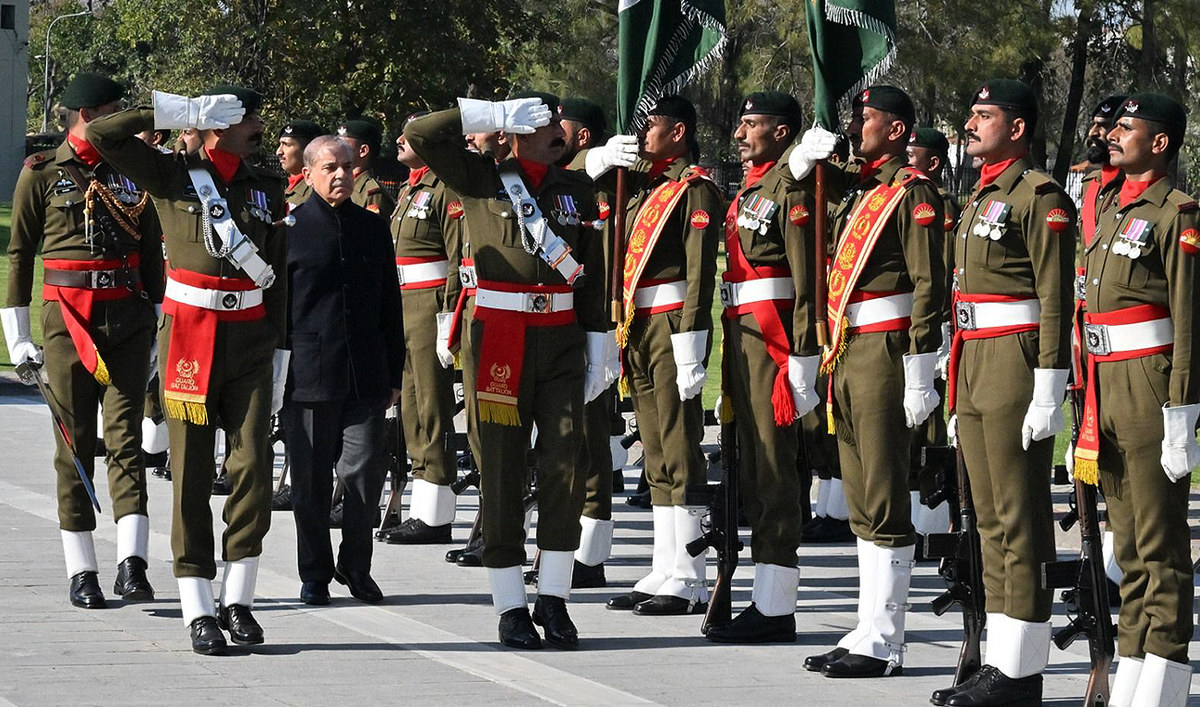


In this handout picture, taken and released by Inter Services Public Relations (ISPR) on March 15, 2024, Pakistan’s newly elected Prime Minister Shehbaz Sharif reviews a guard of honor at the General Headquarters in Rawalpindi, during his first visit to army headquarters after assuming office. (Photo courtesy: ISPR)

The prime minister, who was accompanied by the key members of his cabinet during the visit, was received by the army chief General Asim Munir upon arrival. During their stay at the GHQ, Sharif and his cabinet members engaged in discussions with the military leadership on matters of national security, regional stability and military preparedness.
They were briefed on the current security environment of the country, threat spectrum and the ongoing counterterrorism operations in different parts of the country.
“The PM assured that the Government shall provide all the resources required for ensuring operational readiness of the Armed Forces,” announced an official statement released by the army’s media wing, ISPR, after the visit. “He said that Pakistan is destined to rise and the role of the Armed Forces in ensuring peaceful rise of Pakistan cannot be over-emphasized.”
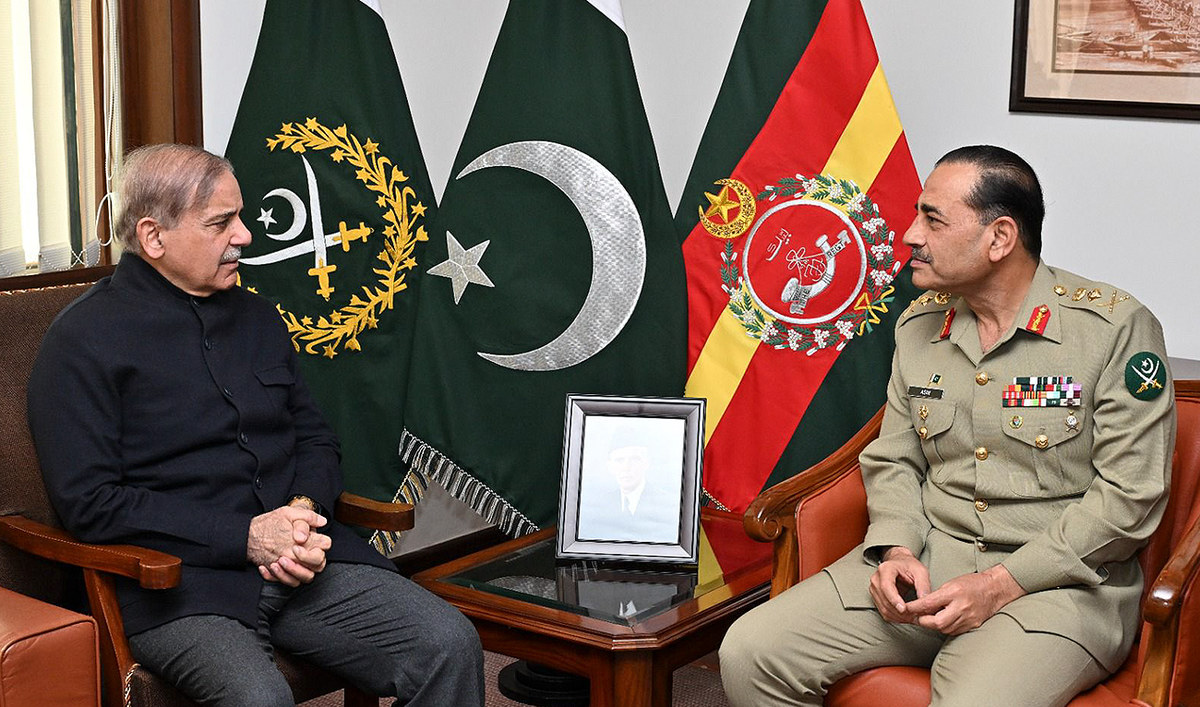


In this handout picture, taken and released by Inter Services Public Relations (ISPR) on March 15, 2024, Pakistan’s newly elected Prime Minister Shehbaz Sharif (L) speaks during a meeting with army chief General Asim Munir (R) on his first visit to army headquarters after assuming office in Rawalpindi. (Photo courtesy: ISPR)

The army chief thanked the prime minister for the visit and showing his confidence in the armed forces of Pakistan.
He said the army would continue to measure up to the nation’s expectations and resolutely support the government in addressing the security challenges facing the country.
Both the military and political leaders reiterated their commitment to upholding Pakistan’s national interests and working together for its security and prosperity.
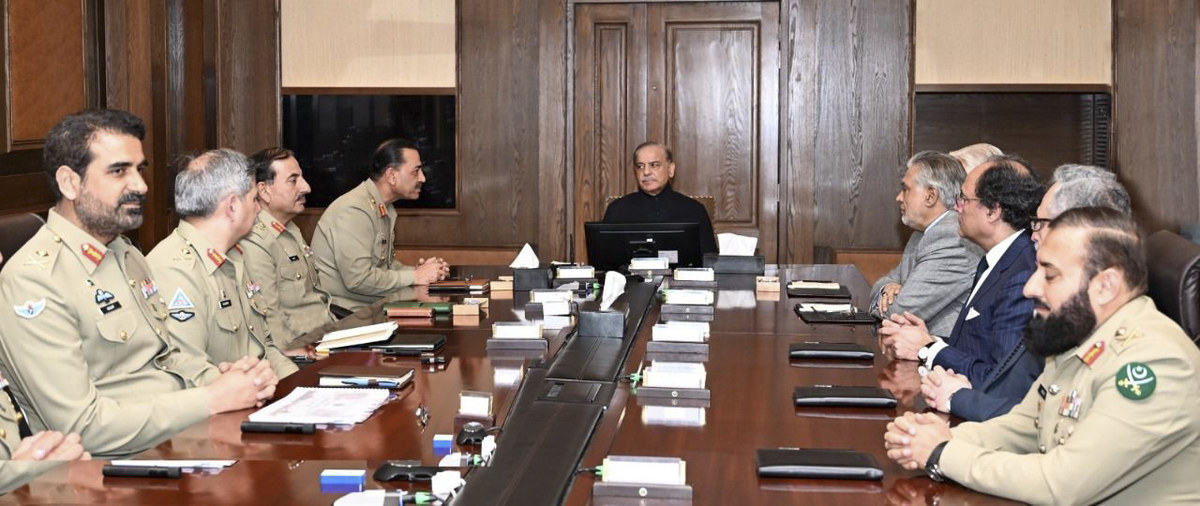


In this handout picture, taken and released by Inter Services Public Relations (ISPR) on March 15, 2024, Pakistan army chief General Asim Munir (4L) briefs newly elected Prime Minister Shehbaz Sharif (C) and the cabinet members (R) during a meeting on their first visit to army headquarters after assuming office in Rawalpindi. (Photo courtesy: ISPR)


Pakistan says defense pact with Saudi Arabia elevated brotherly ties to ‘new heights’

Updated 25 February 2026
Follow

Pakistan says defense pact with Saudi Arabia elevated brotherly ties to ‘new heights’

  • Pakistan, Saudi Arabia signed strategic defense pact last year pledging aggression against one will be treated as attack on both
  • Deputy PM Ishaq Dar says enduring bonds with Islamic and Arab nations form vital pillar of Pakistan’s foreign policy 

ISLAMABAD: Deputy Prime Minister Ishaq Dar said on Wednesday that Pakistan’s defense pact with Saudi Arabia elevated its brotherly ties with the Kingdom to “new heights,” stressing that close ties with Arab and Islamic nations form a key pillar of Islamabad’s foreign policy. 

Pakistan and Saudi Arabia signed a Strategic Mutual Defense Agreement on Sept. 17 last year, pledging that aggression against one country would be treated as an attack on both, enhancing joint deterrence and formalizing decades of military and security cooperation.

Both nations agreed in October 2025 to launch an economic cooperation framework to strengthen trade and investment ties. 

“In the Middle East, our landmark Strategic Mutual Defense Agreement with Saudi Arabia has elevated our brotherly ties to new heights,” Dar said while speaking at the Pakistan Governance Forum 2026 event in Islamabad. 

The Pakistani deputy prime minister was speaking on the topic “Navigating International Relations Amidst Changing Geo-Politics.”

Dar noted that Pakistan has reinforced partnerships with other Middle Eastern nations such as the UAE, Qatar, Jordan, Oman, Egypt and Bahrain. He said these partnerships have yielded “concrete agreements” in investment, agriculture, infrastructure, and energy sectors. 

“Our enduring bonds with Islamic and Arab nations form a vital pillar of our foreign policy, and we will continue to expand our partnerships across Asia, Latin America, and Africa,” he said. 

Dar pointed out that the presidents of Kazakhstan, Uzbekistan and Kyrgyzstan have undertaken visits to Pakistan in recent months, reflecting Central Asian nations’ desire to boost cooperation with Islamabad.

On South Asia, the Pakistani deputy PM said Pakistan has successfully transformed its fraternal ties with Bangladesh into “a substantive partnership.”

“Similarly, the trilateral mechanism involving China, Pakistan, and Bangladesh has been launched with a view to expanding and deepening regional cooperation and synergy,” the Pakistani minister said. 

He said Islamabad has strengthened its “all-weather” partnership with China via the second phase of the multi-billion-dollar China-Pakistan Economic Corridor agreement and “unwavering support” from both sides for each other’s core interests. 

Dar said Pakistan had also reinvigorated its partnership with the US, advancing cooperation in trade, technology, investment, and regional stability. 

“This calibrated approach has enhanced our ability to navigate complexity with skill and confidence, ensuring that our national interests are served without compromising our core foreign policy principles,” he said.