

Pakistan approves upgrades to national ID cards in push to strengthen digital ecosystem

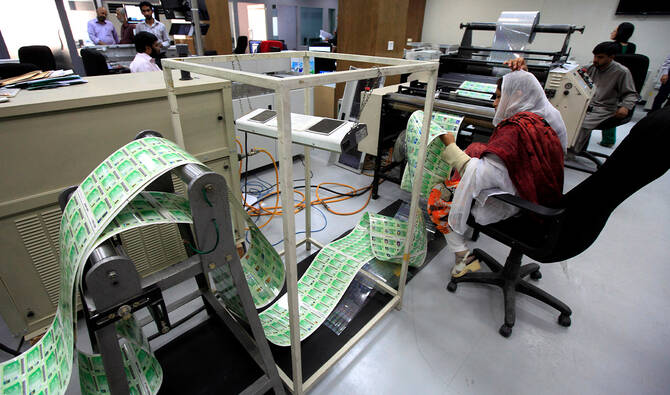
A worker of the National Database and Registration Authority (NADRA) checks newly printed identity cards of registered citizens at the NADRA head office in Islamabad, Pakistan, on November 14, 2012. (Reuters/File)
Short Url
Updated 24 February 2026
Follow

Pakistan approves upgrades to national ID cards in push to strengthen digital ecosystem

  • The amendments allow for QR-based verification, authentication controls, biometric expansion, and card format updates
  • The measures advance integrated digital governance through National Data Exchange Layer and broader digital ID ecosystem

ISLAMABAD: Pakistan has notified amendments to the National Identity Card and Pakistan Origin Card rules and introduced QR-based verification and stronger fraud controls, the National Database and Regulatory Authority (NADRA) said on Tuesday, amid efforts to strengthen the country’s digital ecosystem.

The amendments modernize Pakistan’s identity document framework by legally embedding QR-based verification, strengthening authentication controls across digital services, expanding biometric recognition and updating card formats for key citizen categories.

A core reform is the statutory introduction of the Quick Response (QR) code as a defined security and verification feature, authorizing the use of “QR code or any other technological feature” in lieu of current microchip enabling NADRA to adopt evolving verification technologies without repeated rule amendments.

This QR-enabled capability directly strengthens Pakistan’s Digital ID ecosystem and supports interoperability through the National Data Exchange Layer, according to the national database regulator.

“This establishes a robust legal basis for quick and secure verification of identity credentials in both offline and online environments,” NADRA said.

“This will also enable all citizens to carry similar card instead of currently prevalent two types of national identity cards one of which is with microchip and the other without.”

Pakistani state media reported in August that the country was developing digital identities of all its citizens to enable secure and efficient payments. The measures came as part of a broader effort to digitize the economy for greater transparency.

QR-based credentials allow rapid front-end validation of identity attributes in service delivery settings, while also enabling back-end systems to confirm authenticity and status through trusted exchanges. This is expected to improve speed, transparency and consistency of identity verification across government entities and regulated sectors, reduce manual handling, and lower the risk of fraud and impersonation, according to NADRA.

The amendments also strengthen the enforcement effect of card suspension. The Rules now clarify that where a card is suspended, all verification, authentication and related services linked to that card shall stand suspended forthwith. This closes a key risk area by ensuring that once a card is suspended, it cannot continue to be used through digital verification channels or institutional authentication processes.

“The amendments also introduce standardized identification for residents of Azad Jammu and Kashmir by requiring an inscription indicating ‘Resident of Azad Jammu and Kashmir’ in the manner specified by the Authority, thereby ensuring uniform geographic identification on the document,” NADRA said.

“Overall, these amendments strengthen the legal and technological foundations of Pakistan’s identity system by enabling secure QR-based verification, reinforcing the integrity of digital authentication services, improving biometric assurance,” it said. “They also advance readiness for integrated digital governance by supporting structured interoperability through the National Data Exchange Layer and a broader Digital ID ecosystem.”


Pakistan’s Mahnoor Omer named among TIME’s ‘Women of the Year’ for 2026

Updated 01 March 2026
Follow

Pakistan’s Mahnoor Omer named among TIME’s ‘Women of the Year’ for 2026

  • Omer moved a Pakistani court against the so-called ‘period tax’ in Sept. 2025 which has since sparked a national debate
  • Taxes on sanitary pads in Pakistan can add up to 40 percent to retail price, UNICEF says only around 12 percent women use such products

ISLAMABAD: Pakistani women’s rights activist Mahnoor Omer, who fought against taxes on menstrual products, has been named among the TIME magazine’s ‘Women of the Year’ for 2026.

Omer’s efforts have been recognized alongside 16 activists, artists, athletes and businesswomen in the TIME’s Women of the Year 2026 list, including Olympic gold medalist Sydney McLaughlin-Levrone and Oscar-nominated filmmaker Chloe Zhao.

Dissatisfied with the efforts to educate Pakistani girls about sexual violence, Omer founded the Noor Foundation at the age of 14 and held her own workshops with village girls about everything from climate change to menstruation, according to the TIME magazine.

Two years later, a conversation with a domestic worker about the price of pads made her realize that not everyone could afford these essentials. She moved a court against the so-called “period tax” in Sept. 2025 and the case has sparked a national debate on the subject, considered a taboo by many in Pakistan, since its first hearing late last year.

“A decade and one law degree after her interest in activism was sparked, Omer, now 25, is putting her passion and expertise to work in the name of gender equity,” TIME wrote about Omer on its website.

Taxes imposed on sanitary products in Pakistan can add up to 40 percent to the retail price. UNICEF estimates just 12 percent of women in the country use commercially produced pads or tampons. The alternative, using cloth, risks health impacts including rashes and infections, and can make it impossible for girls to attend school while menstruating.

Omer’s suit, which awaits the government response, has sparked a national discussion. She says she spoke about menstruation to her father and male cousins, who thanked her for standing up for their daughters.
The 25-year-old, who is currently enrolled in a master’s degree in gender, peace, and security at the London School of Economics, sees this case as just the first of many.

“I’m not free until every woman is free,” she was quoted as saying by TIME. “I want to leave no stones unturned in terms of what I can do with the next few decades, as a lawyer for the women in my country and gender minorities in general.”