

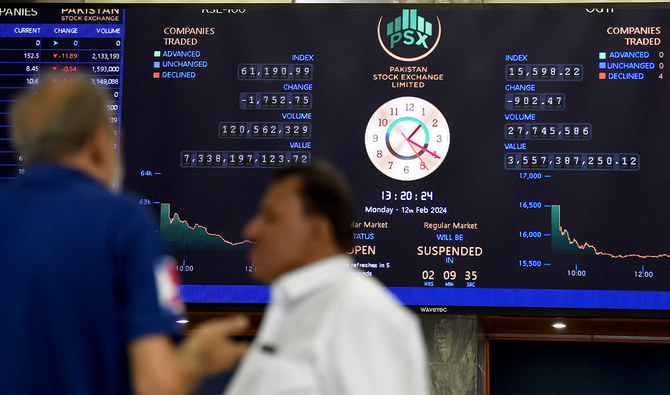

KARACHI: Pakistan’s equities ended the weekend trading session on a bearish note, as investor hopes for an interest rate cut in the upcoming monetary policy diminished, despite easing inflationary pressures, according to equity analysts.
Trading at the bourse remained subdued throughout the week, except for Thursday, when the benchmark KSE100 index surged by 1,015 points. This was triggered by the commencement of talks between the International Monetary Fund (IMF) and Pakistani authorities for the final review of the $3 billion bailout program.
On Friday, the KSE 100 index shed 247 points, closing at 64,816, which marked a 1.5 percent week-on-week decline, primarily due to the anticipated maintenance of the current interest rate and profit-taking.
“Uncertainty surrounding the outcome of the Pakistan-IMF review talks, coupled with expectations of a status quo in the upcoming monetary policy announcement, and the weekly inflation surge to 32.89 percent year-on-year, acted as catalysts for the bearish close on Friday,” Ahsan Mehanti, CEO of Arif Habib Corporation, commented.
Pakistan’s central bank is slated to meet on Monday to review the policy rate, which has been held steady at 22 percent across the last five consecutive monetary policy committee meetings. Investors are hopeful for some policy easing after inflation in February 2024 dipped to 23.1 percent from January’s 28.3 percent and February 2023’s 31.5 percent.
“Investors were optimistic that the central bank might soften its monetary stance, but surveys conducted by financial firms indicate that the majority of participants expect the status quo to be maintained,” Abdul Azeem, Head of Research at Spectrum Securities, said.
A survey by Topline Securities revealed that 55 percent of participants expect the policy rate to remain at 22 percent, while the remaining 45 percent predict a policy rate reduction. Of those anticipating a cut, 2 percent predict a decrease of 25 basis points (bps), 10 percent foresee a 50bps reduction, 24 percent expect a 100bps cut and 9 percent believe it will decrease by more than 100bps.
Additionally, a recent survey by the CFA Society Pakistan, affiliated with a global association of investment professionals, indicated that 67.3 percent of participants do not anticipate any change in the policy rate.“We believe the central bank will remain cautious and adopt a watch-and-see approach until the inflation trend continues to fall,” said Muhammad Sohail, CEO of Topline Securities.
He highlighted key risks to the inflation trajectory, including delays in the release of IMF funds, the IMF demanding additional tax measures to meet revenue targets in case of any shortfall and pressure on the dollar against the rupee, primarily due to delays in receiving dollar inflows.
The IMF mission in Pakistan is currently reviewing the quarterly performance of the country’s economic indicators under the $3 billion bailout program, with the majority of Pakistani analysts optimistic about a smooth review process.
“The review for the third and final tranche of the Standby Agreement is expected to go very smoothly,” said Dr. Sajid Amin, deputy executive director at the Sustainable Development Policy Institute (SDPI) in Islamabad, noting both parties are satisfied with the progress on the review targets.
The successful completion of the program will pave the way for the disbursement of the remaining $1.1 billion and will provide an opportunity to lay the groundwork for a new and extended IMF program.
“The country urgently needs a new IMF program to manage external financing needs and economic recovery,” Amin added. “It is encouraging to see that the new government has a clear approach, unlike the previous two instances where engagements with the IMF were delayed due to political issues.”
Pakistani financial analysts believe that a larger IMF program would boost investor confidence, potentially leading the stock market to reach new heights.
“The stock market is expected to scale new highs if the IMF agrees to an $8-9 billion program,” said Tahir Abbas, Head of Research at Arif Habib Limited.
He expected the key stock index, KSE100, might reach the 100,000 mark with the longer-term IMF program.


