




Sweet traditions: How these special post-fast desserts sweeten the Ramadan spread

1 / 3
Logaimat is deep fried dough soaked in honey, syrup or molasses and then topped off with sesame or nuts depending on the cuisine. (Supplied)
2 / 3
Popular in Saudi Arabia, Egypt, and Levantine countries, Qatayef are stuffed fried pancakes. (Supplied)
3 / 3
Dates are also used in many desserts during the holy month to make date cookies (mammoul). (Supplied)
Short Url
Updated 13 March 2024
Follow

Sweet traditions: How these special post-fast desserts sweeten the Ramadan spread

  • A look at timeless Arab desserts that are perfect for sharing with family

RIYADH: During Ramadan, Muslim families around the world bring a touch of sweetness to the iftar spread with traditional desserts that never go out of style.

Logaimat

Logaimat — meaning a bite or mouthful — is a staple dessert during the holy month. It is made of dough that is deep fried, then soaked in honey, syrup or molasses, and topped off with sesame or nuts depending on the cuisine.

This dumpling dish is thought to have been developed in Baghdad, where it was known as “judge’s bite” because legal adjudicators received the treat as their first payment.

Other theories suggest the sweet treat came from Greece, arriving in Egypt via Greek bakeries in Alexandria before spreading to neighboring countries and the Gulf region.

This crispy dessert is found in many Middle Eastern and European countries. It is a sweet dish that is known as lokma in Turkish and loukoumades in Greek.

In recent years, the dessert has gained popularity, with contemporary flavors such as Nutella and Lotus Biscoff.

Qatayef

Popular in Saudi Arabia, Egypt, and Levantine countries, qatayef are pancakes filled with white cheese or nuts. The dish is fried or baked, and served with syrup or honey. 
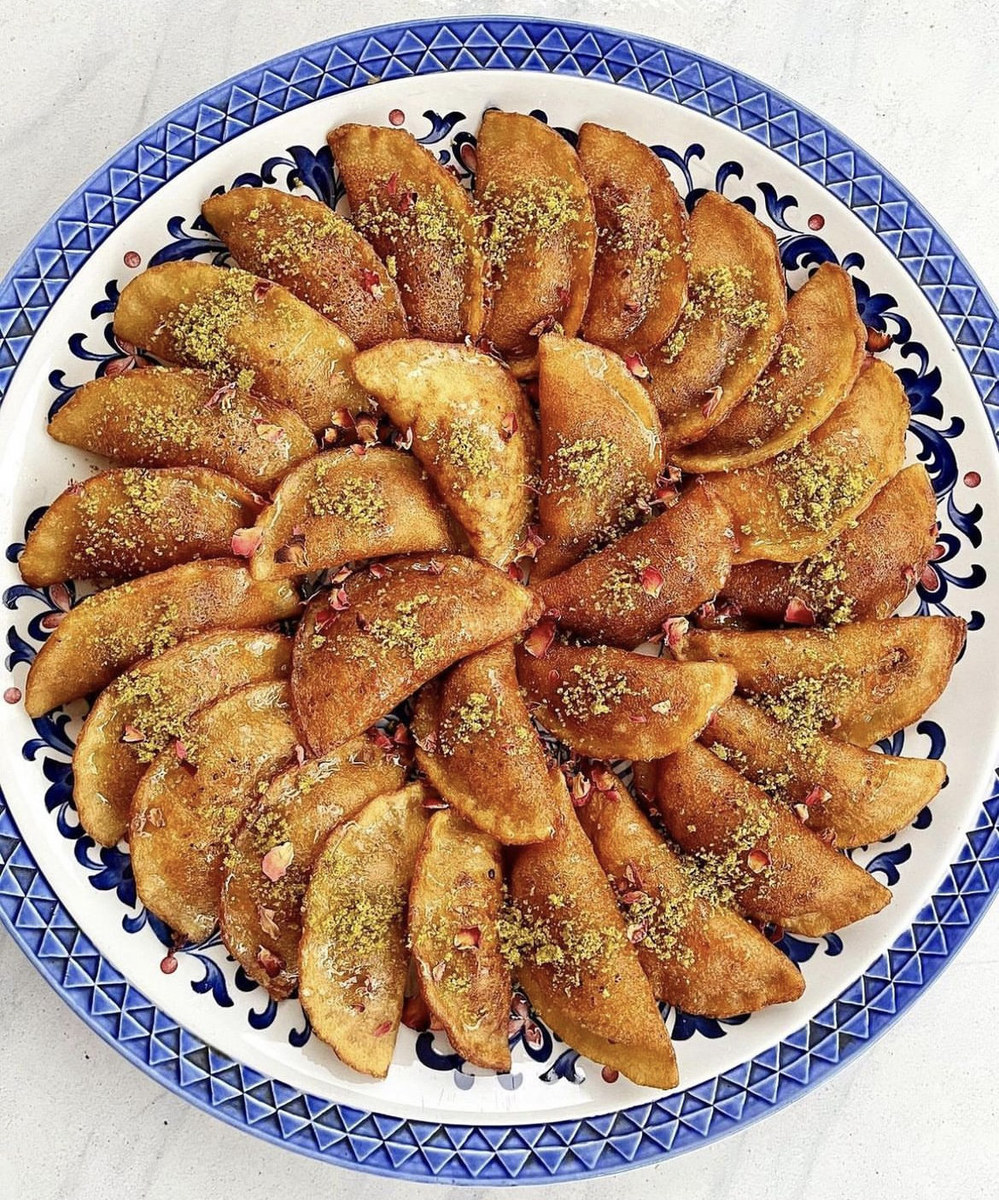


Popular in Saudi Arabia, Egypt, and Levantine countries, Qatayef are stuffed fried pancakes. (Supplied)

These crunchy, rich desserts are best served warm with cream, walnuts, or pistachios.

Kunafa

A traditional Arab dessert made of spun pastry, soaked in sugar syrup (attar) and layered with cream or cheese.

Kunafa originated in the Levant, and is said to have been introduced to what is now known as Egypt during the Fatimid era in the 10th to 12th centuries.

The sweet dessert is served either hard or soft. Hard kunafa is crunchy and made out of shredded phyllo dough. Soft kunafa is made of ground semolina dough.

This well-known dessert has notes of rose water and orange blossom. It is best served warm with crushed pistachios as garnish.

Honeycomb bread with cheese

Khailat nahal, which translates to honeycomb in Arabic, is a Yemeni dessert made of bread stuffed with cheese and soaked in syrup. This sweet and salty delicacy is perfectly paired with a warm cup of black tea.

Maqshush

Maqshush is a Saudi traditional dessert made of buckwheat pan bites topped with ghee, honey, date molasses or sugar. Locals often indulge in the delicious dessert when it is cold and rainy.

In 2023, maqshush was named Saudi Arabia’s national dessert.

Dates

Dates are a symbol of Saudi Arabia. The fruit represents an integral part of the Kingdom’s hospitality, as are offered with Arabic coffee at home, as well as in the office and at events of all kinds.

During the holy month, dates are a staple on the iftar table. Many Muslims break their fast by eating three dates and a glass of water, just as the Prophet Muhammad did. 



Dates are also used in many desserts during the holy month to make date cookies (mammoul). (Supplied)

With more than 200 varieties to choose from, dates come in a range of flavors, textures, colors and levels of sweetness.

Dates are also used in many desserts during the holy month to make mamoul cookies and sticky date pudding. They are also stuffed with dry fruits, pistachios, walnuts and almonds, and coated with chocolate for a sweet treat.


Threat to Kingdom’s security is ‘red line’ that will be ‘addressed and neutralized,’ Saudi envoy says

Updated 14 January 2026
Follow

Threat to Kingdom’s security is ‘red line’ that will be ‘addressed and neutralized,’ Saudi envoy says

  • Abdulaziz Alwasil tells UN Security Council the situation in southern Yemen is ‘a just cause with social and historic dimensions’ that can only be resolved through dialogue
  • Recent military activity in the south was unilateral, resulting in an escalation that harms the interests of Yemeni people and undermines efforts to address issues in the south, he said

NEW YORK CITY: Any attempt to threaten Saudi Arabia’s national security is a “red line” and will be met with decisive action, the Kingdom’s ambassador to the UN told the Security Council on Wednesday.

Speaking during a meeting of the council to discuss Yemen, Abdulaziz Alwasil said the situation in the south of the country is “a just cause with social and historic dimensions” that can only be resolved through dialogue.

“We stress that any attempt to threaten our national security is a red line, and we will not hesitate to take the necessary actions and steps to address it and neutralize it,” he added.

Alwasil reaffirmed Saudi Arabia’s support for Yemeni President Rashad Al-Alimi, the Presidential Leadership Council, and the Yemeni government in their efforts to achieve security, stability, development and peace while preserving national unity.

He said military activity by Southern Transitional Council forces in Hadramout and Al-Mahra on Dec. 2, 2025, was unilateral, did not have the approval of the Presidential Leadership Council, and was not carried out in coordination with the Coalition to Restore Legitimacy in Yemen.

It had resulted in an unjustified escalation that harmed the interests of the Yemeni people, undermined efforts to address the issues in the south, and ran counter to the coalition’s objectives, Alwasil added.

The Kingdom, working with its coalition partners, the Presidential Leadership Council and the Yemeni government, had moved to contain the situation by dispatching a military force to coordinate arrangements with the Southern Transitional Council in Aden, he said.

The aim was to ensure the return of the southern council’s forces to their previous positions outside of Hadramout and Al-Mahra, and the handover of camps to legitimate government forces and local authorities in line with agreed procedures, Alwasil added.

He expressed regret over the military operations that took place in Hadramout and Al-Mahra, close to Saudi Arabia’s southern border, which he said posed a direct threat to the Kingdom’s national security, as well as the security of Yemen and regional stability. Such steps were extremely dangerous, he added, and contradicted the principles on which the Coalition to Restore Legitimacy in Yemen had been founded.

Alwasil welcomed a prisoner and detainee exchange agreement signed in Muscat on Dec. 23, which he described as an important humanitarian measure to alleviate suffering and build confidence.

He praised Oman for hosting and sponsoring the consultations and supporting negotiations, and commended the efforts of UN’s special envoy for Yemen, Hans Grundberg, the International Committee of the Red Cross and all others that has played a part.

Regarding the political efforts to resolve the crisis, Alwasil said Saudi Arabia welcomed President Al-Alimi’s call for an inclusive conference in Riyadh to bring together all stakeholders to discuss just solutions to the situation in southern Yemen.

Preparations for the conference have begun, he added, in cooperation with the Yemeni government and southern representatives, reflecting the close ties between the two countries and their shared interests in stabilizing Yemen.

He urged all southern stakeholders to participate actively and constructively in the talks, to help find comprehensive and just solutions that meet the legitimate aspirations of the people of southern Yemen.

Alwasil called on all Yemeni forces and stakeholders to cooperate and intensify their efforts to reach a lasting political settlement that would ensure security and stability.

He described the southern issue as “a just cause with social and historic dimensions,” adding that “the only way to address it is through dialogue that leads to a comprehensive political solution” based on nationally and internationally agreed terms of reference.