

Saudi volunteers step up to serve pilgrims at the Two Holy Mosques

Volunteering in Makkah encompasses a broad range of tasks, including assisting pilgrims with their transportation to and from the Grand Mosque, managing airport transfers, distributing water bottles, serving meals, and translating for non-Arabic speakers. (SPA)
Short Url
Updated 13 March 2024
Follow

Saudi volunteers step up to serve pilgrims at the Two Holy Mosques

MAKKAH: Each year, Saudis from all throughout the Kingdom volunteer their time to assist pilgrims and make their visit to the Two Holy Mosques as easy as possible.

In Makkah, visitors witness the creativity and dedication of these young Saudi men and women, who use their knowledge, abilities, and skills to deliver exceptional services.

As part of Saudi Vision 2030, the Kingdom is encouraging volunteer activity with the goal of reaching 1 million volunteers by 2030.

Volunteering in Makkah encompasses a broad range of tasks, including assisting pilgrims with their transportation to and from the Grand Mosque, managing airport transfers, distributing water bottles, serving meals, and translating for non-Arabic speakers.

Rania Shodri, a pilgrimage guide and volunteer, said that volunteer work in Makkah is a great opportunity for those who want to contribute to society.

There is a host of opportunities for volunteers in the Kingdom across a variety of sectors, such as social services, healthcare, education, humanitarian aid, and dawah and guidance, Shodri said. People can also volunteer at hospitals, schools, social service offices, and the Two Holy Mosques.
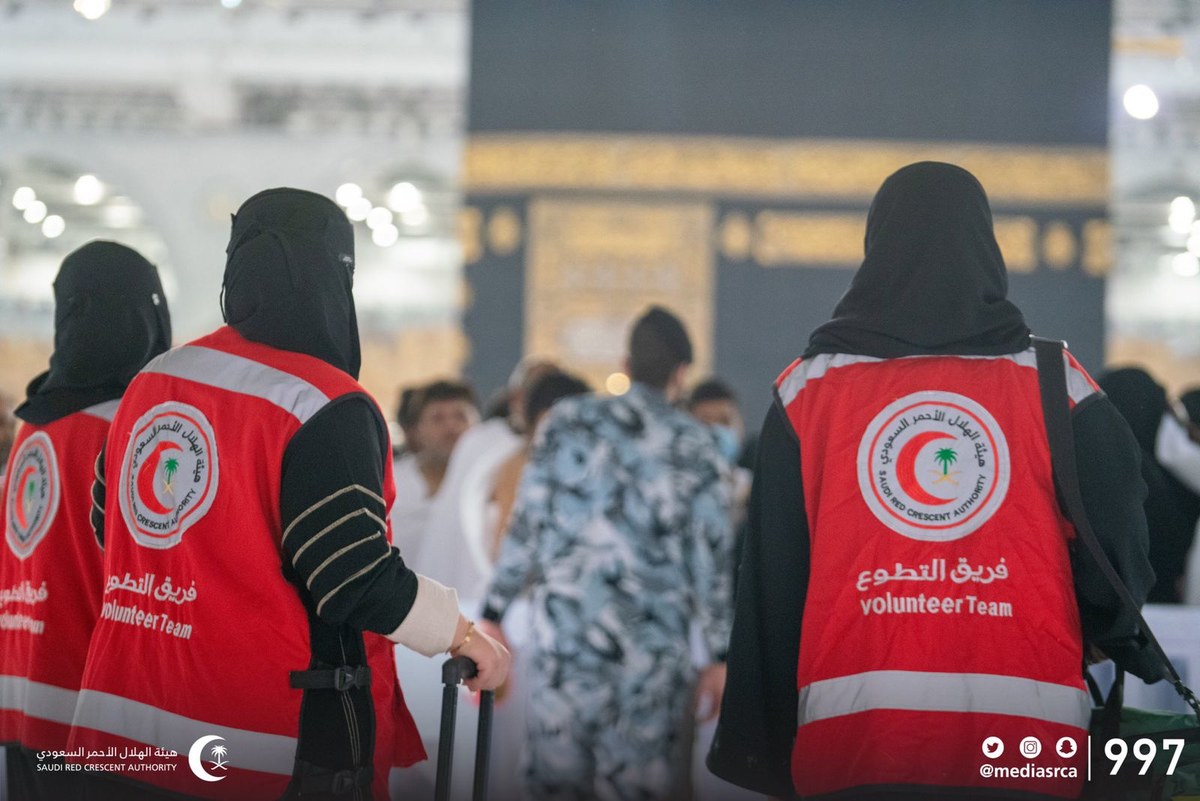


As part of Saudi Vision 2030, the Kingdom is encouraging volunteer activity with the goal of reaching 1 million volunteers by 2030. (Supplied)

Volunteers can also contribute to organizing events and programs, offering psychological and social support for those who need it, and participating in awareness and educational campaigns, she added.

Those wishing to volunteer can join local organizations in Makkah or contact the authorities responsible for organizing volunteer work and training volunteers.

According to Shodri, volunteer work in the Kingdom requires the highest level of discipline and commitment and, in some sectors, has specific requirements related to permits and training. Security procedures and special protocols might also be applicable due to the nature of the place and the event.

The General Presidency for the Affairs of the Two Holy Mosques told Arab News that there are three levels of volunteer work at the Great Mosque, depending on the skills required to carry out the tasks involved.

The first level is open to all as it requires a simple set of skills. The second level involves carrying out assignments based on skills acquired through practice and experience. The third is the professional level, which involves carrying out assignments that require expertise and a certain educational level.

The authority said that it aims to reach 2,500 volunteers by the end of Ramadan.

Entities involved in volunteer work span governmental authorities, licensed charitable and private associations, and universities and institutes, the authority added.

Information within the Great Mosque and courtyards is available in 50 languages, including English, French, Malay, Farsi, Urdu, Russian, Chinese, Hausa, Turkish, and Bengali. Teams at these sites also provide information regarding prayer times, lectures and exhibition visit dates.

Live translation for sermons and lessons, online live streaming, and wireless headphones are also among the services and amenities provided to visitors.

Barcodes on information cards facilitate access to the electronic services provided by the language and translation agency, including to the Manarat Al-Haramain platform, on which pilgrims can listen to the live translation of sermons and scholarly lessons in many languages.


As part of Saudi Vision 2030, the Kingdom is encouraging volunteer activity with the goal of reaching 1 million volunteers by 2030. (SPA)


Saudi Arabia, Estonia strengthen cyber defense cooperation

Updated 09 February 2026
Follow

Saudi Arabia, Estonia strengthen cyber defense cooperation

  • Renowned for its leadership in digital governance, Estonia sees cybersecurity as central to its partnership potential with Saudi Arabia, building on years of regional engagement through its technology firms

RIYADH: Estonia aims to deepen defense, cybersecurity, and artificial intelligence cooperation with Saudi Arabia as both nations look to advance technology‑driven defense and cybersecurity capabilities.

Hanno Pevkur, Estonia’s minister of defense, told Arab News at the World Defense Show in Riyadh on Monday that Estonia’s defense industry is eager to contribute to the Kingdom’s fast‑growing defense ecosystem.

“In the modern world, cooperation built on trust and technology is the best defense,” he said. “It is important for us to be here because we clearly see there is a possibility to increase cooperation, not only bilaterally between Saudi Arabia and Estonia, but across the region.”

At Estonia’s pavilion, a cooperation agreement was signed between an Estonian company and a Saudi firm during the show, he noted.

Pevkur also said Estonia’s defense sector has expanded rapidly in recent years, driven by technological innovation and partnership.

“Our defense industry is growing very rapidly, and we continue to see strong momentum,” he said.

He said Estonia’s strengths lie in digital and smart‑system integration rather than large‑scale weapons production.

“We will not build airplanes or tanks, but what we can do is integrate robotics, automation and drones to make existing systems smarter,” he said.

The minister said effective defense collaboration must link businesses and governments to achieve meaningful results.

“When we want to have real cooperation, we need it on all levels,” he said. “The biggest client for any defense company is the government, so we must treat this as one ecosystem where the public and private sectors work hand in hand.”

Renowned for its leadership in digital governance, Estonia sees cybersecurity as central to its partnership potential with Saudi Arabia, building on years of regional engagement through its technology firms.

Pevkur said several Estonian companies, including Nortal, have already assisted Gulf governments in developing open IT and digital‑service systems.

“As the most digitalized nation in the world, almost every service in Estonia can be done online, except getting married,” he said. “But with such digitalization, we also need strong cyberdefense.”

He said data protection and digital resilience are treated as matters of national sovereignty in Tallinn, the capital of Estonia.

“Data is what we own. When someone steals that data, it becomes a serious threat,” he added. “That is why cyberdefense is not just about technology, it is about trust, sovereignty and protection.”

Pevkur said Saudi Arabia’s advances in AI offer promising opportunities for collaboration.

“I know that Saudi Arabia is doing great work when it comes to AI,” he said. “For us, as a small country with limited human resources, AI is essential not just for defense but for everyday life.”

Pevkur added that Estonia has launched a national AI strategy to promote responsible development and closer coordination between government and industry. One Estonian company, he said, has developed a system that allows a single operator to control hundreds of drones through AI.

“It is quite easy to put a weapon into the hands of a robot, but we also need to define who is accountable for its actions,” he said.

“The big question for the future is whether we can allow a war to be fought entirely by AI, or if humans must always make the final ethical decisions.”

He said in his conclusion that governments must reach a common understanding on how AI will be used and regulated on the battlefield.