

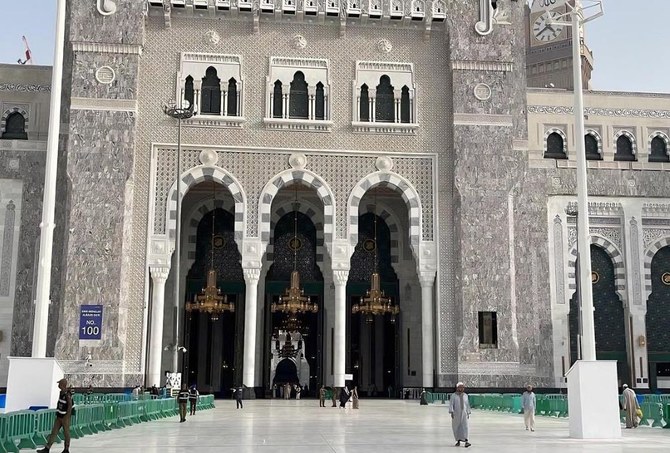
Grand Mosque authority designates doors for Umrah pilgrims

1 / 3
The General Presidency of Haramain has assigned specific doors in the Grand Mosque to receive Umrah pilgrims during the holy month of Ramadan. (SPA)
2 / 3
The General Presidency of Haramain has assigned specific doors in the Grand Mosque to receive Umrah pilgrims during the holy month of Ramadan. (SPA)
3 / 3
The General Presidency of Haramain has assigned specific doors in the Grand Mosque to receive Umrah pilgrims during the holy month of Ramadan. (SPA)
Short Url
Updated 12 March 2024
Follow

Grand Mosque authority designates doors for Umrah pilgrims

  • Doors administration, working together with the security authorities at the mosque, has opened 210 doors to prevent suffocation and overcrowding
  • Grand Mosque’s entrances and exits have been taken care of by the authority, with a focus on accommodating individuals with special needs

MAKKAH: The General Authority for the Affairs of the Grand Mosque and the Prophet’s Mosque has assigned specific doors in the Grand Mosque to receive Umrah pilgrims during the holy month of Ramadan this year.

The doors administration, working together with the security authorities at the mosque, has opened 210 doors to prevent suffocation and overcrowding.

The Grand Mosque’s entrances and exits have been taken care of by the authority, with a focus on accommodating individuals with special needs.

The initiative is being carried out in collaboration with government agencies that work within the Grand Mosque.

The authority told Arab News that Umrah pilgrims are allowed to use various entrances, including King Abdulaziz Gate, King Fahd Gate, Umrah Gate, Salam Gate, and doors 85-93 on the ground floor except for 88.

Additionally, they can use Ajyad Staircase, Ajyad Bridge, Shubaika Staircase 65-66, King Fahd Stairway 91-92, staircase 84, side crossings 78-80 for exit, staircase 74, regular stairs 71, 73, 85, 88, King Fahd staircase, and doors 75-77, 81-83.

The Shubaika staircase is reserved for emergencies along with the King Abdulaziz Gate.

On the first floor, pilgrims can use King Fahd Gate, Umrah Gate, Zubair Gate, Ajyad Bridge, Shubaika Bridge, Othman Bridge, King Fahd Gate elevators.

On the second floor, they can use Al-Arqam Stairway elevators, Umrah Gate elevators, Ajyad Stairway elevators, Marwa Stairway elevators, and the roof for individuals with disabilities.

The authority has assigned specific doors and entrances for women to access the women’s prayer halls.

Additionally, there are designated entrances for individuals with special needs, such as Al-Salam Gate, King Abdullah Gate, and the Marwa Staircase elevators.

The main duties of the door staff and guards at each door are to stop bags and luggage from entering, prohibit all foods except coffee and dates, restrict cameras without permission, and manage crowds.

Above the doors, there are signs with important information. For instance, there are signs that say the Grand Mosque is full and nobody can enter, and there are green signs that mean it is permissible to enter the Grand Mosque.

It is a good idea to take note of gate numbers so that pilgrims can easily find their way back.

Saudi youths and men are always present at the entrances of the Grand Mosque. They work tirelessly to guide visitors and pilgrims, making sure they can move around easily and find the quickest routes.

They are fluent in multiple languages and are available at every door to assist those who are lost. Their main goal is to ensure that everyone can perform their rituals without any difficulties.

Adel Al-Nimri, a historian from Makkah, mentioned that the Grand Mosque underwent various changes in its design and structure throughout different periods. The number and size of its doors also changed over time. The initial development of its distinctive characteristics can be traced back to 17 AH (A.D. 638) when Omar bin Al-Khattab was in power.

He added that the doors of the Grand Mosque in the beginnings did not have their traditional method of construction like doors. They represented the ends of the alleys and roads that overlooked the mataf at that time and were known as the doors of the Grand Mosque in Makkah.

He added that in the past, the entrances and exits to Makkah were marked by the doors of the people of Makkah and their homes, especially on the western, eastern, and southern sides.

People would open their doors and head toward the Grand Mosque and the Holy Kaaba. During Omar bin Al-Khattab’s reign, due to the increasing number of Muslims after the Islamic conquests, the building of the Grand Mosque became too small, so Omar bin Al-Khattab purchased the surrounding houses.

The first wall around the Grand Mosque was built during Omar bin Al-Khattab’s reign, with doors later added. The architectural shape of the doors originated during Othman bin Affan’s reign, and in some accounts, during Abdullah bin Al-Zubayr’s era. Therefore, the Grand Mosque took a cohesive urban design featuring a roof and two sides resembling doors in our modern times.


Ramadan volunteering initiatives encourage participation of community

Updated 5 sec ago
Follow

Ramadan volunteering initiatives encourage participation of community

  • Opportunities include assisting pilgrims by guiding visitors; organizational support such as site management, crowd control, and event assistance
  • Ministry of Islamic Affairs’ branch in Makkah has provided several volunteering opportunities to prepare the city’s mosques for Ramadan

MAKKAH: The General Directorate of Education in the Makkah region is providing more than 200 volunteering opportunities across 13 fields to promote volunteerism during Ramadan, support pilgrim services, and foster values of giving and social responsibility.

The initiative enables volunteers to contribute to community service during the holy month, highlighting education’s role in promoting national and humanitarian values, the Saudi Press Agency reported on Tuesday.

Opportunities include assisting pilgrims by guiding visitors; organizational support such as site management, crowd control, and event assistance; social initiatives through humanitarian projects and community service; and general volunteering work supporting various programs.

Other roles involve translation services for visitors; assisting people with disabilities; cultural programs; technical support and digital documentation; and environmental initiatives promoting sustainability.

Volunteers can also participate in training for capacity building, take on security and safety roles, and engage in health-related activities to raise preventive awareness.

Additionally, volunteers may support government agencies, strengthening field operations and coordination in serving pilgrims and the wider community.

The initiative reflects the commitment of Makkah’s education sector to promoting volunteerism and mobilizing community resources, in line with the Kingdom’s Vision 2030.

The Presidency of Religious Affairs at the Grand Mosque and the Prophet’s Mosque has launched several Ramadan volunteering opportunities in Madinah to enhance community participation, develop volunteer work, and promote its culture in society.

Opportunities include assisting with religious guidance; organizing worshippers’ rows; monitoring screens and electronic devices; and providing translation and field awareness services for visitors to the Prophet’s Mosque.

Interested participants can register through the National Volunteer Portal by selecting the “religious” field and searching for the Presidency of Religious Affairs of the Prophet’s Mosque to view available opportunities, the SPA added.

Umm Al-Qura University in Makkah has also announced 21 volunteering opportunities during Ramadan to promote volunteerism, empower community participation, and support services for pilgrims and visitors to the Grand Mosque.

Opportunities are in various fields, including simultaneous interpretation, first aid, meal distribution for fasting observers, medical services, guidance and counseling, and welcoming pilgrims.

Meanwhile, the Ministry of Islamic Affairs’ branch in Makkah has provided several volunteering opportunities to prepare the city’s mosques for Ramadan.

The ministry has reported some 60 openings, engaging 405 male and female volunteers. Activities include organizational and service tasks to ready mosques for worshippers during the holy month.

These efforts reflect the ministry’s commitment to promoting volunteerism and fostering community participation in serving mosques, ensuring a suitable environment for worship and performing rituals with ease and tranquility.