

Imran Khan party rejects accusation it conspired to get Pakistan’s GSP+ status withdrawn

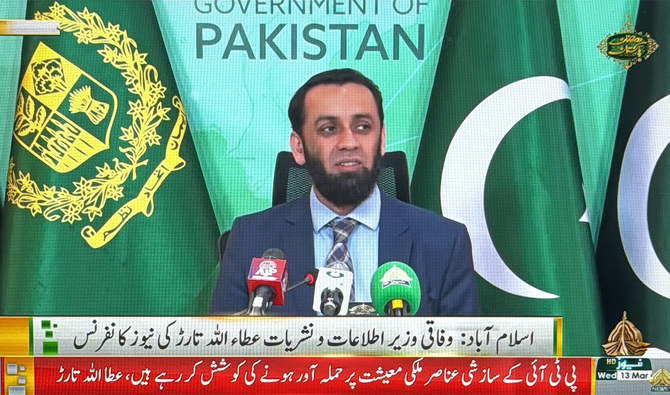
The screengrab taken from a video shared by PTV News shows Pakistan's information minister Attaullah Tarar addressing a press conference in Islamabad, Pakistan, on March 13, 2024. (PTV News)
Short Url
Updated 13 March 2024
Follow

Imran Khan party rejects accusation it conspired to get Pakistan’s GSP+ status withdrawn

  • Attaullah Tarar says PTI approached EU, initiated online campaign against Pakistan’s GSP+ status
  • PTI spokesperson says minister’s claim lacks credibility, party did not contact EU over GSP+ status

ISLAMABAD: Former prime minister Imran Khan’s Pakistan Tehreek-e-Insaf (PTI) party on Wednesday denied seeking the revocation of Pakistan’s special trade status with the European Union (EU) after the country’s newly appointed information minister, Attaullah Tarar, made the accusation in a news conference earlier in the day.

The EU’s Generalized Scheme of Preferences Plus (GSP+) policy allows developing states to export their products duty-free after ratifying 27 international conventions related to human rights, environment and governance.

Pakistan is one of the biggest beneficiaries of the scheme, which continues to make its exports to European markets competitive at a time when production costs in the country have substantially increased due to escalating fuel and power prices.

Tarar claimed the PTI had been attempting to convince the EU that its founding leader, Imran Khan, had not been receiving adequate facilities in prison, where he has been held on various charges following his conviction in a graft case last August.

“The PTI has approached the EU and started a series of online petitions urging the European authorities to withdraw Pakistan’s GSP+ status, alleging that their leader, Imran Khan, is not receiving adequate facilities in jail,” the information minister asserted during the press conference in the federal capital, labeling the campaign as a conspiracy against the country and an economic assault.

He noted that Khan had been afforded privileges not granted to other prisoners, including access to three rooms, a kitchen, a gallery for walking, exercise equipment, and his choice of food.

“The GSP+ status will remain intact regardless of the baseless campaign initiated by PTI,” Tarar emphasized.

In response, Khan’s party spokesperson, Raoof Hassan, denied the information minister’s claims, asserting they lacked credibility.

“We have not approached or written any such letter to the EU, and we have not ever thought of writing a letter,” he told Arab News. “Why should we do that?”

He said the PTI always issued a press statement whenever it took any action.

“During a recent visit, both EU and Commonwealth delegations met with various political parties, including PTI and no other engagement with the EU took place than this,” he said.

Hassan pointed out that even the party’s recent letter to the International Monetary Fund (IMF) explicitly said it aimed not to impede Pakistan’s funding.

“Upholding human rights is our constitutional duty,” he added, “and we will continue to advocate and highlight rights violations.”

The PTI spokesperson also said Khan had not made any personal demands during his incarceration and was only receiving the facilities he was entitled to according to the jail manual.


Pakistanis at remote border describe scramble to leave Iran

Updated 6 sec ago
Follow

Pakistanis at remote border describe scramble to leave Iran

  • Returning Pakistani nationals recount missile fire in Tehran, transport gridlock as people rush to exit Iran
  • PM Sharif condemns targeting of Iranian leader as embassies urge citizens to leave amid escalating strikes

TAFTANT, Pakistan: Pakistani nationals hauled suitcases across the border from neighboring Iran, describing missiles being launched and travel chaos as they scrambled to leave the country after the US and Israel launched strikes over the weekend.

AFP journalists saw a steady trickle of people passing through large metal gates at the remote border crossing between Iran’s Mirjaveh and Taftan in Pakistan’s western Balochistan province.

Powerful explosions have rocked Iran’s capital Tehran since Saturday, with embassies from countries around the world telling their citizens to leave.

“All our Pakistani brothers who were in Tehran and other cities had started to leave and were arriving at the terminal, which caused a lot of crowd pressure,” 38-year-old trader Ameer Muhammad told AFP on Monday.

“Due to the crowds, there were major transport problems.”

The isolated Taftan border lies around 500 kilometers (310 miles) from Balochistan’s capital and largest city, Quetta.

AFP journalists saw the Iranian flag flying at half-mast as soldiers stood guard.

Most people wheeled bulky luggage over the frontier’s foot crossing, while freight lorries formed a long line.

Irshad Ahmed, a 49-year-old pilgrim, told AFP he was staying at a hostel in Tehran when he saw missiles being fired nearby.

“There was an army base near the hostel, and we saw many missiles being fired,” he said.

“After that, we went to the Pakistani embassy so that they could evacuate us from there. They brought us here safely.”

Pakistan’s Prime Minister Shehbaz Sharif has said the killing of Ayatollah Ali Khamenei was a “violation” of international law.

“It is an age old convention that the Heads of State/Government should not be targeted,” Sharif wrote on X.

The “people of Pakistan join the people of Iran in their hour of grief and sorrow and extend the most sincere condolences on the martyrdom” of Khamenei, he added.

A teacher at Tehran’s Pakistani embassy, who gave his name as Saqib, told AFP: “Before we left, the situation was normal. The situation was not that bad.”

The 38-year-old said the strikes on Tehran on Saturday “pushed us to leave the city.”

“The situation became bad on Saturday night, when attacks caused precious lives to be lost,” he said.