

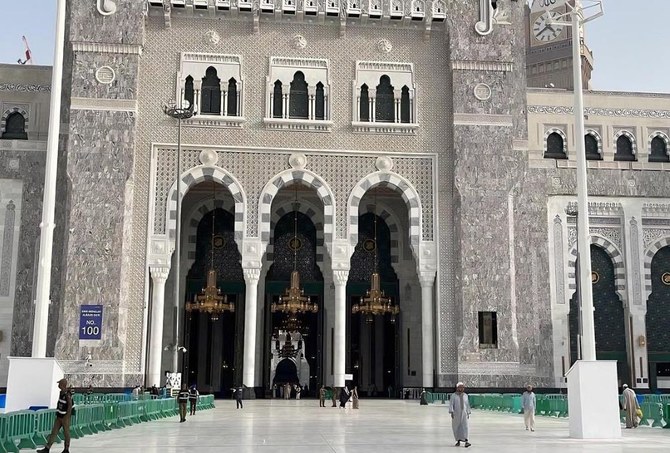
Grand Mosque authority designates doors for Umrah pilgrims

1 / 3
The General Presidency of Haramain has assigned specific doors in the Grand Mosque to receive Umrah pilgrims during the holy month of Ramadan. (SPA)
2 / 3
The General Presidency of Haramain has assigned specific doors in the Grand Mosque to receive Umrah pilgrims during the holy month of Ramadan. (SPA)
3 / 3
The General Presidency of Haramain has assigned specific doors in the Grand Mosque to receive Umrah pilgrims during the holy month of Ramadan. (SPA)
Short Url
Updated 12 March 2024
Follow

Grand Mosque authority designates doors for Umrah pilgrims

  • Doors administration, working together with the security authorities at the mosque, has opened 210 doors to prevent suffocation and overcrowding
  • Grand Mosque’s entrances and exits have been taken care of by the authority, with a focus on accommodating individuals with special needs

MAKKAH: The General Authority for the Affairs of the Grand Mosque and the Prophet’s Mosque has assigned specific doors in the Grand Mosque to receive Umrah pilgrims during the holy month of Ramadan this year.

The doors administration, working together with the security authorities at the mosque, has opened 210 doors to prevent suffocation and overcrowding.

The Grand Mosque’s entrances and exits have been taken care of by the authority, with a focus on accommodating individuals with special needs.

The initiative is being carried out in collaboration with government agencies that work within the Grand Mosque.

The authority told Arab News that Umrah pilgrims are allowed to use various entrances, including King Abdulaziz Gate, King Fahd Gate, Umrah Gate, Salam Gate, and doors 85-93 on the ground floor except for 88.

Additionally, they can use Ajyad Staircase, Ajyad Bridge, Shubaika Staircase 65-66, King Fahd Stairway 91-92, staircase 84, side crossings 78-80 for exit, staircase 74, regular stairs 71, 73, 85, 88, King Fahd staircase, and doors 75-77, 81-83.

The Shubaika staircase is reserved for emergencies along with the King Abdulaziz Gate.

On the first floor, pilgrims can use King Fahd Gate, Umrah Gate, Zubair Gate, Ajyad Bridge, Shubaika Bridge, Othman Bridge, King Fahd Gate elevators.

On the second floor, they can use Al-Arqam Stairway elevators, Umrah Gate elevators, Ajyad Stairway elevators, Marwa Stairway elevators, and the roof for individuals with disabilities.

The authority has assigned specific doors and entrances for women to access the women’s prayer halls.

Additionally, there are designated entrances for individuals with special needs, such as Al-Salam Gate, King Abdullah Gate, and the Marwa Staircase elevators.

The main duties of the door staff and guards at each door are to stop bags and luggage from entering, prohibit all foods except coffee and dates, restrict cameras without permission, and manage crowds.

Above the doors, there are signs with important information. For instance, there are signs that say the Grand Mosque is full and nobody can enter, and there are green signs that mean it is permissible to enter the Grand Mosque.

It is a good idea to take note of gate numbers so that pilgrims can easily find their way back.

Saudi youths and men are always present at the entrances of the Grand Mosque. They work tirelessly to guide visitors and pilgrims, making sure they can move around easily and find the quickest routes.

They are fluent in multiple languages and are available at every door to assist those who are lost. Their main goal is to ensure that everyone can perform their rituals without any difficulties.

Adel Al-Nimri, a historian from Makkah, mentioned that the Grand Mosque underwent various changes in its design and structure throughout different periods. The number and size of its doors also changed over time. The initial development of its distinctive characteristics can be traced back to 17 AH (A.D. 638) when Omar bin Al-Khattab was in power.

He added that the doors of the Grand Mosque in the beginnings did not have their traditional method of construction like doors. They represented the ends of the alleys and roads that overlooked the mataf at that time and were known as the doors of the Grand Mosque in Makkah.

He added that in the past, the entrances and exits to Makkah were marked by the doors of the people of Makkah and their homes, especially on the western, eastern, and southern sides.

People would open their doors and head toward the Grand Mosque and the Holy Kaaba. During Omar bin Al-Khattab’s reign, due to the increasing number of Muslims after the Islamic conquests, the building of the Grand Mosque became too small, so Omar bin Al-Khattab purchased the surrounding houses.

The first wall around the Grand Mosque was built during Omar bin Al-Khattab’s reign, with doors later added. The architectural shape of the doors originated during Othman bin Affan’s reign, and in some accounts, during Abdullah bin Al-Zubayr’s era. Therefore, the Grand Mosque took a cohesive urban design featuring a roof and two sides resembling doors in our modern times.


Talks held on opportunities for sustainable EU-Saudi business cooperation

Updated 4 sec ago
Follow

Talks held on opportunities for sustainable EU-Saudi business cooperation

  • Leading companies from both the EU and the Kingdom attended the event to discuss objectives and challenges
  • Dubravka Suica: All our pipelines (are) hydrogen-ready, which means gas pipelines, new modern gas pipelines, were built to be also hydrogen-ready

RIYADH: A high-level roundtable consultation on sustainable business was held on Tuesday in Riyadh to explore collaboration between the EU and Saudi Arabia’s private sectors.

Leading companies from both the EU and the Kingdom attended the event to discuss objectives and challenges.

Dubravka Suica, European commissioner in charge of EU relations with the Mediterranean and the Gulf, was in attendance. The meeting was held under the auspices of the Delegation of the European Union to the Kingdom of Saudi Arabia and was organized by the EU–GCC Cooperation on Green Transition Project in collaboration with the European Chamber of Commerce in Saudi Arabia.

The meeting brought together senior representatives from leading companies active in the circular economy, water technologies, clean energy, sustainable manufacturing, environmental innovation, and advanced materials, including Danfoss and ACWA Power.

Suica told Arab News that the EU is ready to seize future opportunities across various sectors, given Europe’s rich history of green development.

“All our pipelines (are) hydrogen-ready, which means gas pipelines, new modern gas pipelines, were built to be also hydrogen-ready. So, they can also be useful for the supply of hydrogen,” she said.

She added: “The only problem is that we are a market economy … We cannot guarantee anything because it is as it is, as you know.”

When asked about the EU plan to support European companies seeking to participate in sustainability-related projects, the commissioner commented that “EU Green Deal is something which we would like to make happen by 2050 to have Europe as a CO2-neutral continent.”

Presently, however, simplifying the process is a strategy that would benefit both sides of the equation, she added.

“There is a lot of burden to our companies and to your companies who want to work in Europe … We are now trying not to deregulate. We cannot do it, but we are trying a little bit to simplify,” Suica told Arab News.

During the meeting, participants discussed essential opportunities for collaboration in investment and technology deployment, reflecting serious intentions from both sides to support joint initiatives across the region.

Suica also highlighted the relevance of the Pact for the Mediterranean, launched in Barcelona last month, emphasizing its role in opening additional avenues for companies to expand further across the Middle East and North Africa region.

“Today’s consultation reaffirms our shared commitment to accelerating the green transition through meaningful partnerships between EU and Saudi companies, connecting our regions and bringing our peoples closer,” said Suica.

“The EU and the Kingdom of Saudi Arabia are committed to stepping up our partnership.

“Under the EU–Saudi Arabia Strategic Partnership Agreement and the Pact for the Mediterranean, we will have a broader regional framework to expand cooperation between EU and Saudi companies across the Middle East and North Africa.

“I am encouraged by the strong engagement we have seen today.”

Christophe Farnaud, ambassador of the EU to Saudi Arabia, Bahrain, and Oman, also commented on the subject during the meeting and supported the partnership talks.

He said: “Saudi Arabia and Europe are charting a new path for global cooperation in sustainable development. By bringing together leading companies from both sides, we aim to transform strategic dialogue into tangible opportunities that support innovation, diversification, and long-term sustainable growth.”