Sudan’s army claims control of national broadcast building

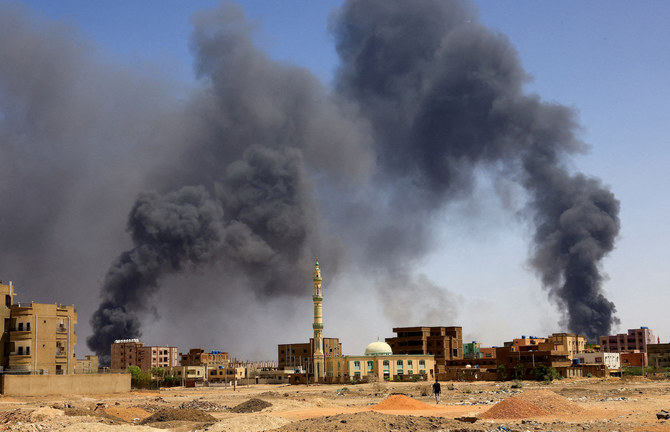
A man walks while smoke rises above buildings after aerial bombardment, during clashes between the paramilitary Rapid Support Forces and the army in Khartoum North, Sudan, May 1, 2023. (AFP)
Short Url
Updated 12 March 2024
Follow

Sudan’s army claims control of national broadcast building

  • The capture of the state broadcast building would extend its control from the north across “old Omdurman,” though the RSF retains southern and western areas of the city
  • On social media, supporters of the army cheered what they called the liberation of the “voice of the nation“

DUBAI: Sudan’s army said it had taken control of the state broadcast headquarters from the Rapid Support Forces (RSF) on Tuesday in what would be its most significant advance against its paramilitary rival in nearly 11 months of war.
The broadcast building lies in Omdurman, a city across the River Nile from Khartoum that forms part of Sudan’s wider capital and has seen heavy fighting around military bases, bridges and supply routes.
Battles have continued despite a call by the United Nations Security Council for a truce to allow desperately needed humanitarian aid into Sudan during the Muslim holy month of Ramadan, which began on Monday.
The truce call was welcomed by the RSF but rejected by a senior general in the army, which has claimed some recent gains in Omdurman after being on the back foot militarily through much of the war.
The capture of the state broadcast building would extend its control from the north across “old Omdurman,” though the RSF retains southern and western areas of the city.
Witnesses say the army, which has depended on air power and heavy artillery to try to counter the RSF’s infantry advantage, has deployed drones in Omdurman to regain ground.
There was no immediate comment from the RSF.
The RSF seized the state broadcast building as fighting broke out in mid-April 2023, and used it along with other public facilities for military operations.
National TV and radio have been broadcasting from Port Sudan, the Red Sea coastal city from which officials aligned with the army have operated since the RSF occupied large swathes of the capital early in the war.

’VOICE OF THE NATION’
A video posted by the army on Tuesday, the location of which was verified by Reuters, showed some of its troops within a kilometer of the radio and TV building cheering after they had seized vehicles and weapons.
On social media, supporters of the army cheered what they called the liberation of the “voice of the nation.”
“Today the army achieved a great victory, but what’s important is to get back security, health services and education,” said Safaa Ali, a 39-year old government employee from Omdurman who fled to Port Sudan in May.
“Our question is who will compensate us for the loss of all their property that was looted and their homes that were destroyed by this war,” she told Reuters by phone.
War between Sudan’s army and the RSF erupted in mid-April 2023 amid dispute over a plan for transition to civilian rule.
The two factions had staged a coup in 2021 that derailed a previous transition following the 2019 overthrow of autocratic former leader Omar Al-Bashir, before falling out.
The war has devastated the capital, led to waves of ethnically driven killings in the western region of Darfur and created the world’s biggest displacement crisis.
More than 8 million people have fled their homes and hunger is rising.
The conflict has also drawn in regional powers. Analysts say the United Arab Emirates has backed the RSF, while Egypt, Eritrea and Iran are aligned with the army.


Lebanese finance minister denies any plans for a Kushner-run economic zone in the south

Updated 45 min 44 sec ago
Follow

Lebanese finance minister denies any plans for a Kushner-run economic zone in the south

  • Proposal was made by US Envoy Morgan Ortagus but was ‘killed on the spot’
  • Priority is to regain control of state in all aspects, Yassine Jaber tells Arab News

DAVOS: Lebanon’s finance minister dismissed any plans of turning Lebanon’s battered southern region into an economic zone, telling Arab News on the sidelines of the World Economic Forum’s meeting in Davos that the proposal had died “on the spot.”

Yassine Jaber explained that US Envoy to Lebanon Morgan Ortagus had proposed the idea last december for the region, which has faced daily airstrikes by Israel, and it was immediately dismissed.

Jaber’s comments, made to Arab News on the sidelines of the World Economic Forum in Davos, were in response to reports which appeared in Lebanese media in December which suggested that parts of southern Lebanon would be turned into an economic zone, managed by a plan proposed by Jared Kushner, US President Donald Trump’s son in law.

Meanwhile, Jaber also dismissed information which had surfaced in Davos over the past two days of a bilateral meeting between Lebanese ministers, US Middle East Envoy Steve Witkoff and Kushner.

Jaber said that the meeting on Tuesday was a gathering of “all Arab ministers of finance and foreign affairs, where they (Witkoff and Kushner) came in for a small while, and explained to the audience the idea about deciding the board of peace for Gaza.”

He stressed that it did not develop beyond that.

When asked about attracting investment and boosting the economy, Jaber said: “The reality now is that we need to reach the situation where there is stability that will allow the Lebanese army, so the (Israeli) aggression has to stop.”

Over the past few years, Lebanon has witnessed one catastrophe after another: one of the world’s worst economic meltdowns, the largest non-nuclear explosion in its capital’s port, a paralyzed parliament and a war with Israel.

A formal mechanism was put in place between Lebanon and Israel to maintain a ceasefire and the plan to disarm Hezbollah in areas below the Litani river.

But, the minister said, Israel’s next step is not always so predictable.

“They’re actually putting pressure on the whole region. So, a lot of effort is being put on that issue,” he added.

“There are still attacks in the south of the country also, so stability is a top necessity that will really succeed in pushing the economy forward and making the reforms beneficial,” he said.

Lawmakers had also enacted reforms to overhaul the banking sector, curb the cash economy and abolish bank secrecy, alongside a bank resolution framework.

Jaber also stressed that the government had recently passed a “gap law” intended to help depositors recover funds and restore the banking system’s functionality.

“One of the priorities we have is really to deal with all the losses of the war, basically reconstruction … and we have started to get loans for reconstructing the destroyed infrastructure in the attacked areas.”

As Hezbollah was battered during the war, Lebanon had a political breakthrough as the army’s general, Joseph Aoun, was inaugurated as president. His chosen prime minister was the former president of the International Court of Justice, Nawaf Salam.

This year marks the first time a solid delegation from the country makes its way to Davos, with Salam being joined by Jaber, Economy and Trade Minister Amr Bisat, and Telecoms Minister Charles Al-Hage.

“Our priority is to really regain the role of the state in all aspects, and specifically in rebuilding the institutions,” Jaber said.