DUBAI: Iran is responsible for the “physical violence” that led to the death of Mahsa Amini in September 2022 and sparked nationwide protests against the country’s mandatory headscarf, or hijab, laws and its ruling theocracy, a UN fact-finding mission said Friday.
The stark pronouncement came in a wide-ranging initial report submitted to the UN Human Rights Council by the Fact-Finding Mission on Iran.
It also found that the Islamic Republic employed “unnecessary and disproportionate use of lethal force” to put down the demonstrations that erupted following Amini’s death, and that Iranian security forces sexually assaulted detainees.
The monthslong security crackdown killed more than 500 people and saw over 22,000 detained.
There was no immediate comment on the report from Iran. Iranian officials did not respond to requests for comment from The Associated Press on the mission’s findings.
The release of the report is unlikely to change the trajectory of Iran’s government, now more firmly in the hands of hard-liners after a low-turnout vote last week put them back in charge of the country’s parliament.
However, it provides further international pressure on Tehran amid wider Western concerns about its advancing nuclear program, Iran’s arming of Russia in Moscow’s war on Ukraine and the continued harassment and imprisonment of activists, including Nobel Peace Prize laureate Narges Mohammadi.
“The protests were unprecedented because of the leadership of women and youth, in their reach and longevity and, ultimately, the state’s violent response,” the report says.
Amini, 22, died on Sept. 16, 2022, in a hospital after her arrest by the country’s morality police over allegedly not wearing her hijab to the liking of the authorities. She was brought to Iran’s Vozara detention facility to undergo a “re-education class,” but collapsed after 26 minutes and was taken to a hospital 30 minutes later, according to the report.
Iran has denied being responsible for her death or that she had been beaten. At times, authorities have pointed to a medical condition Amini had from childhood after a surgery. The UN report dismissed that as a cause of her death.
The panel “has established the existence of evidence of trauma to Ms. Amini’s body, inflicted while in the custody of the morality police,” the report says.
“Based on the evidence and patterns of violence by the morality police in the enforcement of the mandatory hijab on women, the mission is satisfied that Ms. Amini was subjected to physical violence that led to her death,” it said.
The report stops short, however, of blaming anyone specifically for harming Amini.
The protests that followed Amini’s death started first with the chant “Women, Life, Freedom.” However, the protesters’ chanting and cries soon grew into open calls of revolt against Iranian Supreme Leader Ayatollah Ali Khamenei.
The UN report found Iranian security forces used shotguns, assault rifles and submachine guns against demonstrators “in situations where there was no imminent threat of death or serious injury” to them, “thereby committing unlawful and extrajudicial killings.”
It also found a pattern of protesters being shot intentionally in the eye.
“The mission notes the deterrent and chilling effect of such injuries, as they permanently marked the victims, essentially ‘branding’ them as protesters,” the report says.
Some of those detained faced sexual violence, including rape, the threat of rape, forced nudity, groping and electrocution of their genitals, according to the report.
“The security forces played on social and cultural stigma connected to sexual and gender-based violence to spread fear and humiliate and punish women, men and children,” the report says.
The panel also acknowledged it continued to investigate the 2023 death of teenager Armita Garavand, who died after falling on the Tehran Metro in what activists allege was an attack over her not wearing a hijab.
Geravand’s parents appeared in a state media video at the time saying a blood pressure issue, a fall or perhaps both contributed to their daughter’s death.
“In actions reminiscent of Ms. Amini’s case, the state authorities took measures to obfuscate the circumstances leading to Ms. Garavand’s death,” the report says.
It also noted a suspected spate of poisonings targeting Iranian schoolgirls, without drawing conclusions on what transpired in the incidents.


UN probe: Iran responsible for the ‘physical violence’ that killed Mahsa Amini in 2022

https://arab.news/2q3gp
UN probe: Iran responsible for the ‘physical violence’ that killed Mahsa Amini in 2022

- Islamic Republic employed ‘unnecessary and disproportionate use of lethal force’ to put down the demonstrations that erupted following Amini’s death


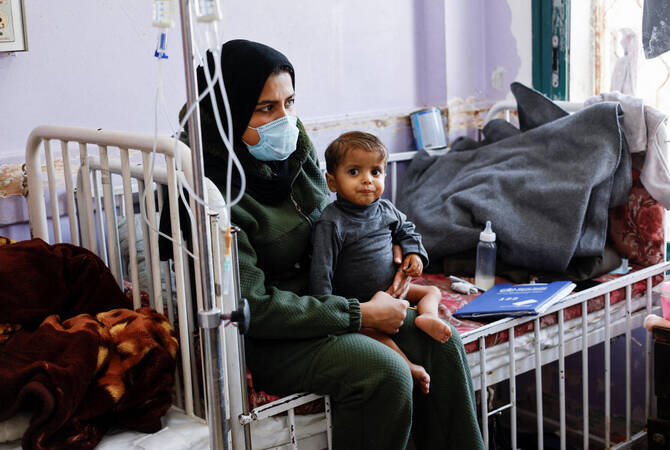
Halt to MSF work will be ‘catastrophic’ for people of Gaza: MSF chief
- MSF slammed the move, which takes effect on March 1, as a “pretext” to obstruct aid
- “Ceasing MSF activities is going to be catastrophic for the people of the Gaza Strip and the West Bank,” he said
GENEVA: Israel’s ban on Doctors Without Borders’ humanitarian operation in Gaza spells deeper catastrophe for the Palestinian territory’s people, the head of the medical charity told AFP on Monday.
Israel announced on Sunday that it was terminating all the activities in Gaza and the West Bank by the organization, known by its French acronym MSF, after it failed to provide a list of its Palestinian staff.
MSF slammed the move, which takes effect on March 1, as a “pretext” to obstruct aid.
“This is a decision that was made by the Israeli government to restrict humanitarian assistance into Gaza and the West Bank at the most critical time for Palestinians,” MSF secretary-general Christopher Lockyear warned in an interview with AFP at the charity’s Geneva headquarters.
“We are at a moment where Palestinian people need more humanitarian assistance, not less,” he said. “Ceasing MSF activities is going to be catastrophic for the people of the Gaza Strip and the West Bank.”
MSF has been a key provider of medical and humanitarian aid in Gaza, particularly since war broke out after Hamas’s October 7, 2023 attack on Israel.
The charity says it currently provides at least 20 percent of hospital beds in the territory and operates around 20 health centers.
In 2025 alone, it carried out more than 800,000 medical consultations, treated more than 100,000 trauma cases and assisted more than 10,000 infant deliveries.
It also provided more than 700 million liters of water, Lockyear pointed out.
‘Impossible choice’
Israel announced in December that it planned to prevent 37 aid organizations, including MSF, from working in Gaza for failing to submit detailed information about their Palestinian employees. The move drew widespread condemnation from NGOs and the United Nations.
It had alleged that two MSF employees had links with Palestinian militant groups Hamas and Islamic Jihad, which the medical charity vehemently denies.
“If Israel has any evidence of such things, then they should share that evidence,” Lockyear said, insisting that “there’s been no proof given to us.”
He decried “an orchestrated campaign to delegitimize us,” calling on other countries to defend efforts to bring desperately-needed humanitarian aid into Gaza.
“They should be speaking to Israel, pressuring Israel to ensure that there is a reverse of any banning of humanitarian organizations.”
Lockyear said MSF, which counts around 1,100 staff inside Gaza, had been trying to engage with Israeli authorities for nearly a year over the requested lists.
But it had been left with “an impossible choice,” he said.
“We’ve been forced to choose between the safety and security of our staff and being able to reach patients.”
‘Can only get worse’
The organization said it decided not to hand over staff names “because Israeli authorities failed to provide the concrete assurances required to guarantee our staff’s safety, protect their personal data, and uphold the independence of our medical operation.”
Lockyear insisted that was a “very rational” decision, pointing out that 15 MSF staff had been killed in Gaza during the war, out of more than 500 humanitarian workers and more than 1,700 medical workers killed in the Strip.
Lockyear highlighted that without independent humanitarian organizations in Gaza, an already “catastrophic” situation “can only get worse.”
“We need to increase massively the humanitarian assistance that’s going into Gaza,” he said, “not restrict it, not block it.”


