Saudi non-oil exports to GCC nations surge by 42% to hit $5.55bn

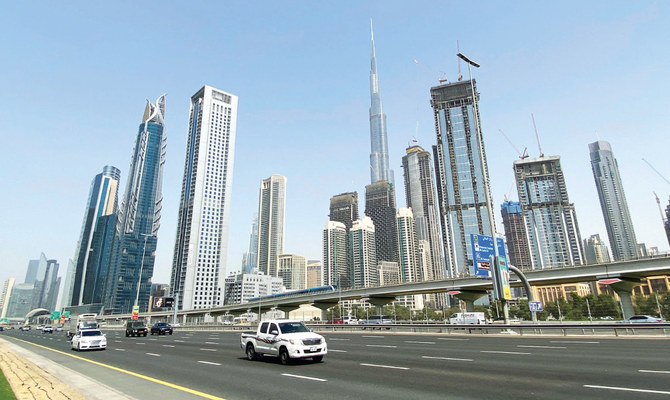
Among the GCC nations, the UAE emerged as the top destination, receiving 67 percent of the non-oil shipments from Saudi Arabia, totaling SR14 billion. (Reuters)
Short Url
Updated 06 March 2024
Follow

Saudi non-oil exports to GCC nations surge by 42% to hit $5.55bn

  • Saudi Arabia aims to revolutionize its container shipping sector, mirroring its efforts in non-oil industries

RIYADH: Saudi Arabia’s non-oil exports to Gulf  Cooperation Council countries saw a 42 percent annual increase in the final three months  of 2023, according to official data.

Information released by the Kingdom’s General Authority of Statistics showed the total value of these transactions reached SR20.8 billion ($5.55 billion), primarily due to an increase in re-exports, which rose by 106 percent to hit SR11.34 billion. 

Re-exports – goods imported into a country and then exported to another without significant processing or alteration – accounted for 55 percent of total non-oil shipments to Bahrain, Kuwait, and Oman, as well as Qatar, and the UAE.

Among these GCC nations, the UAE emerged as the top destination, receiving 67 percent of the non-oil shipments from Saudi Arabia, totaling SR14 billion. Of these transactions, approximately 61 percent were re-exports, representing a 97 percent growth during this period.

Factors contributing to this surge in re-exports could include the solid economic bonds among GCC nations, fostering a unified market that facilitates the free flow of goods and services.

Saudi Arabia’s strategic position as a central hub within the GCC region could also minimize transportation expenses and transit durations due to its proximity. 

Moreover, the Kingdom’s modern and well-developed infrastructure, encompassing ports, airports, and road networks, further streamlines the movement of goods, potentially influencing this uptick in re-exports.

Additionally, the GCC region’s strategic location on major trade routes allows for efficient redistribution of goods and services. Taking advantage of this, the countries are developing logistics hubs to facilitate the movement of both domestic and transit goods.

Saudi Arabia also aims to revolutionize its container-shipping sector, mirroring its efforts in non-oil industries like electric cars and renewable energy.

With plans to expand inland logistics hubs and improve rail connections, the country seeks to increase annual container throughput to 40 million twenty-foot equivalent units by 2030.

This ambition aligns with the grand scale of projects such as the $500 billion NEOM scheme, featuring a 170-km. city and a container port with a 9 million TEU capacity.

The giga-project will also include the Oxagon port, slated to become the largest floating structure globally, situated at the nexus of three continents.

The robust economic ties between the UAE and Saudi Arabia are further demonstrated through their mutual investments.

By the end of 2022, the UAE had amassed a significant foreign direct investment stock of SR104 billion in Saudi Arabia, as reported by the General Authority of Statistics. This substantial investment
plays a pivotal role in bolstering their economic partnership, fostering growth, and has paved the way for the expansion of non-oil trade activities between the two nations.

Transport equipment accounted for 31 percent of non-oil exports to the UAE from the Kingdom in the final quarter of 2023, reaching a value of SR4.39 billion in what is a 145 percent increase. 

Machinery and electrical parts constituted another 27 percent, totaling SR3.75 billion with a 67 percent rise.

Additionally, chemical industry products accounted for 10 percent, reaching SR1.44 billion – a 17 percent increase during this period.

Among the GCC countries, trade with Qatar experienced the most substantial growth, with non-oil exports to the country soaring by 439 percent. Of these exports, 61 percent comprised transport equipment amounting to SR888 million, while 18 percent were chemical industry products totaling SR255 million.

Saudi Arabia and Qatar are actively working to enhance their economic, military, sports, and cultural ties. This push comes after the meeting of the Saudi-Qatari Coordination Council, attended by Crown Prince Mohammed bin Salman and Qatar’s Emir, Sheikh Tamim bin Hamad, in December.

The leaders consider the council vital for communication and coordination, underlining the importance of expanding cooperation to drive sustainable growth and prosperity for both nations and their citizens.

The non-oil trade balance with the GCC saw a substantial 90 percent annual increase in the fourth quarter of 2023, although imports still exceeded non-oil exports by SR489 million.

Around 68 percent of Saudi Arabia’s imports from the GCC countries originated from the UAE, which saw a 22 percent rise to SR14.37 billion. 

In contrast, imports from other nations in the economic bloc decreased, with Kuwait experiencing the most significant decline of 49 percent to SR351 million.

Mineral products account for the largest share of imports from the UAE at 33 percent, amounting to SR4.8 billion, followed by pearls and other jewelry at 19 percent, totaling SR2.7 billion. 

Industrial equipment, chemicals, and plastics made up 16 percent at SR2.3 billion.


AI will never replace human creativity, says SRMG CEO 

Updated 30 January 2026
Follow

AI will never replace human creativity, says SRMG CEO 

  • Speaking to Maya Hojeij, senior business anchor at Asharq with Bloomberg, Jomana R. Alrashid expressed pride in SRMG platforms that had absorbed and adopted AI

RIYADH: Jomana R. Alrashid, CEO of Saudi Research and Media Group, highlighted how AI cannot replace human creativity during a session at The Family Office’s “Investing Is a Sea” summit at Shura Island on Friday. 

“You can never replace human creativity. Journalism at the end of the day, and content creation, is all about storytelling, and that’s a creative role that AI does not have the power to do just yet,” Alrashid told the investment summit. 

“We will never eliminate that human role which comes in to actually tell that story, do the actual investigative reporting around it, make sure to be able to also tell you what’s news or what’s factual from what’s wrong ... what’s a misinformation from bias, and that’s the bigger role that the editorial player does in the newsroom.”

Speaking on the topic of AI, moderated by Maya Hojeij, senior business anchor at Asharq with Bloomberg, the CEO expressed her pride in SRMG platforms that had absorbed and adopted AI in a way that was “transformative.”

“We are now translating all of our content leveraging AI. We are also now being able to create documentaries leveraging AI. We now have AI-facilitated fact-checking, AI facilities clipping, transcribing. This is what we believe is the future.”

Alrashid was asked what the journalist of the future would look like. “He’s a journalist and an engineer. He’s someone who needs to understand data. And I think this is another topic that is extremely important, understanding the data that you’re working with,” she said.

“This is something that AI has facilitated as well. I must say that over the past 20 years in the region, especially when it comes to media companies, we did not understand the importance of data.”


The CEO highlighted that previously, media would rely on polling, surveys or viewership numbers, but now more detailed information about what viewers wanted was available. 

During the fireside session, Alrashid was asked how the international community viewed the Middle Eastern media. Alrashid said that over the past decades it had played a critical role in informing wider audiences about issues that were extremely complex — politically, culturally and economically — and continued to play that role. 

“Right now it has a bigger role to play, given the role again of social media, citizen journalists, content creators. But I also do believe that it has been facilitated by the power that AI has. Now immediately, you can ensure that that kind of content that is being created by credible, tier-A journalists, world-class journalists, can travel beyond its borders, can travel instantly to target different geographies, different people, different countries, in different languages, in different formats.”

She said that there was a big opportunity for Arab media not to be limited to simply Arab consumption, but to finally transcend borders and be available in different languages and to cater to their audiences. 


The CEO expressed optimism about the future, emphasizing the importance of having a clear vision, a strong strategy, and full team alignment. 

Traditional advertising models, once centered on television and print, were rapidly changing, with social media platforms now dominating advertising revenue.

“It’s drastically changing. Ultimately in the past, we used to compete with one another over viewership. But now we’re also competing with the likes of social media platforms; 80 percent of the advertising revenue in the Middle East goes to the social media platforms, but that means that there’s 80 percent interest opportunities.” 

She said that the challenge was to create the right content on these platforms that engaged the target audiences and enabled commercial partnerships. “I don’t think this is a secret, but brands do not like to advertise with news channels. Ultimately, it’s always related with either conflict or war, which is a deterrent to advertisers. 

“And that’s why we’ve entered new verticals such as sports. And that’s why we also double down on our lifestyle vertical. Ultimately, we have the largest market share when it comes to lifestyle ... And we’ve launched new platforms such as Billboard Arabia that gives us an entry into music.” 

Alrashid said this was why the group was in a strong position to counter the decline in advertising revenues across different platforms, and by introducing new products.

“Another very important IP that we’ve created is events attached to the brands that have been operating in the region for 30-plus years. Any IP or any title right now that doesn’t have an event attached to it is missing out on a very big commercial opportunity that allows us to sit in a room, exchange ideas, talk to one another, get to know one another behind the screen.” 

The CEO said that disruption was now constant and often self-driving, adding that the future of the industry was often in storytelling and the ability to innovate by creating persuasive content that connected directly with the audience. 

“But the next disruption is going to continue to come from AI. And how quickly this tool and this very powerful technology evolves. And whether we are in a position to cope with it, adapt to it, and absorb it fully or not.”