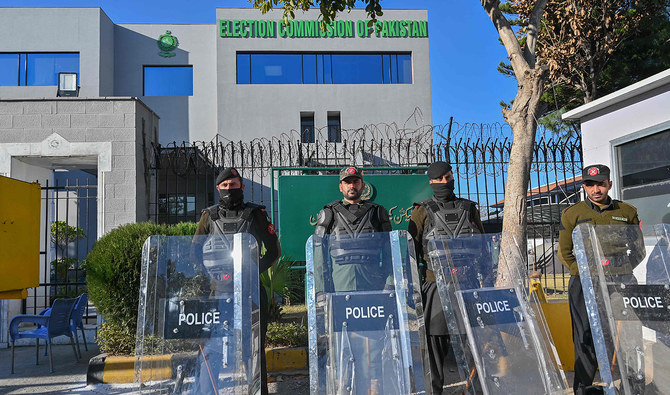
ISLAMABAD: Pakistan’s election regulator on Wednesday reserved its judgment on petitions filed by the Sunni Ittehad Council (SIC) party seeking its share of reserved seats for women and religious minorities in the National Assembly, a day before the inaugural session of the lower house of Pakistan’s parliament is held.
The SIC’s numbers in parliament were bolstered after candidates backed by former prime minister Imran Khan’s Pakistan Tehreek-e-Insaf (PTI) party joined it after the Feb. 8 elections, aiming to secure a share in the reserved seats. Khan-backed candidates won the highest number of seats in the polls but since a court ruling in January forced them to contest as independents, they cannot form a government on their own and are not entitled to the reserved seats.
Khan-backed candidates joined the SIC to avoid that technicality but the party has not been allocated a share in the reserved seats in national and provincial legislatures so far. The SIC has filed at least four separate applications with the Election Commission of Pakistan (ECP) seeking its share of the reserved seats.
The inaugural session of Pakistan’s National Assembly is scheduled to take place on Feb. 29 at 10:00 a.m. Khan’s PTI has warned that any assembly session held before reserved seats are not officially notified would be “illegal.” The PTI has also dismissed the Sindh and Punjab Assembly sessions held earlier this week where the Pakistan Peoples Party (PPP) and the Pakistan Muslim League-Nawaz (PML-N) elected their members as chief ministers of the provinces.
A five-member bench of the ECP, chaired by Chief Election Commissioner Sikandar Sultan Raja on Wednesday, heard petitions filed by the SIC and other political parties, including the PPP, the PML-N and the Muttahida Qaumi Movement-Pakistan (MQM-P) concerning the reserved seats.
“It is the legal right of the Sunni Ittehad Council to get the reserved seats,” Barrister Ali Zafar, representing the SIC, argued before the bench, insisting it had become a parliamentary party after it was joined by independent candidates backed by Khan.
The PTI’s rivals argue that the SIC is not a parliamentary party as its candidates had not contested the Feb. 8 polls from its platform.
Zafar urged the ECP to decide the matter “as early as possible,” saying that reserved seats allocation would also affect the upcoming presidential and Senate elections. He accused the Pakistani election regulator of resorting to “intentional delay” in the matter.
The chief election commissioner responded by saying the ECP had held at least three meetings to discuss the allocation of reserved seats, and decided to hear the matter after a “detailed consultation.”
“The SIC is a registered political party with an electoral symbol and it could not be denied of its share in the reserved seats,” Zafar argued.
Farooq H. Naek, the PPP’s counsel, argued that the SIC had not submitted a priority list with the ECP before elections and had missed the deadline to claim their share in the reserved seats. Likewise, the PML-N’s counsel, Azam Nazir Tarar, said that a political party should contest elections, win at least a few seats to get their share in the reserved seats. However, he said the SIC did not contest polls as a party.
“Reserved seats cannot be given to independents as per law,” Tarar argued.
Farogh Nasim, the MQM-P’s lawyer, pointed out that the SIC was not a parliamentary party hence the ECP should allocate the reserved seats to his party as per its quota.
“The SIC chief himself contested this election as an independent, therefore the party does not deserve the reserved seats,” he added.
The election commission reserved its judgment on the matter after the arguments were concluded.


![]()

Pakistan’s election body reserves verdict on reserved seats for party joined by Khan-backed candidates
Short Url
https://arab.news/nrjse
Pakistan’s election body reserves verdict on reserved seats for party joined by Khan-backed candidates
- Sunni Ittehad Council, joined by ex-PM Khan’s candidates, are seeking reserved seats for women, minorities
- The inaugural session of Pakistan’s lower house of the parliament is scheduled to take place on February 29
Latest updates


© 2026 SAUDI RESEARCH & PUBLISHING COMPANY, All Rights Reserved And subject to Terms of Use Agreement.