

Saudi Arabia’s homebuilding will have reduced carbon footprint: ROSHN CEO

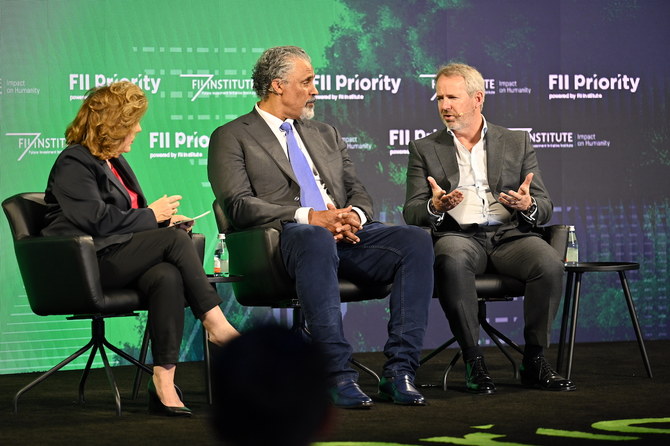
ROSHN will open an innovation center in Riyadh next year, says CEO David Grover at the FII Priority Summit on Thursday in Miami. (Supplied)
Short Url
Updated 23 February 2024
Follow

Saudi Arabia’s homebuilding will have reduced carbon footprint: ROSHN CEO

  • ROSHN seeking to source concrete with less pollutants, says David Grover
  • Kingdom-owned firm is seeking partnerships with environmentally-friendly suppliers

MIAMI: Saudi Arabia’s construction of homes between now and 2030 will have a reduced carbon footprint compared to current traditional developments.

This is according to David Grover, group CEO of ROSHN, who was speaking at the FII Priority Summit on Thursday in Miami.

“Google tells me that there are 211,000 homes in Miami. We’re developing 400,000 homes between now and 2030 — twice the amount of residential that Miami has,” said Grover who leads the multi-asset class real estate developer, which is a giga-project wholly owned by the Kingdom’s Public Investment Fund.

“We know that we need 75 million cubic meters of concrete in the next seven years, just for our core residential program” and so, “we definitely have a big obligation, as a developer, in terms of how we can minimize the carbon footprint,” he told the audience.

Making concrete causes a lot of pollutants and so ROSHN is committed to finding partners that can reduce the need for cement and concrete, said Grover.

Partanna, for example, which is the brainchild of former NBA champion Rick Fox, produces alternatives to Portland cement that are made with recycled ingredients.

“We take industry waste and combine them together at room temperature and through the process of our patents, we absorb CO2 at a very alarming rate, which is positive for our environment,” Fox explained.

ROSHN wants to be an “investor” and “contribute towards the supply chain bringing forward technology,” said Grover.

For example, it has invested in a company that makes environmentally friendly carbon-capture paint, which means that painting a home with this product is equivalent to planting 12 oak trees around that property in terms of its capacity to absorb carbon dioxide.

The construction and real estate industry can be a bit “dull” and “a bit of a dinosaur industry” so, “we’re a bit slow globally in terms of actually bringing in technology, best practice and AI,” said Grover.

He added: “It’s a real obligation we have as a company to be seen as a leading light not just within Saudi, but also as a global player.”

As part of this effort, next year, ROSHN will open an innovation center in Riyadh that will see it invest in startups as it looks to bring in young talent and fresh ideas.

For Fox, the partnership with ROSHN and the Kingdom is built on shared values.

“It’s not just talk, it’s actual action,” he said. Moreover, its scale “provides the opportunity to attract the right partners and investment that understand this is for the long haul,” he added.

“We’re going to go on a journey here and we’re not going to be for everybody to begin with; we’re going to be the right teammate and the right partner for those that care about changing the world,” said Fox.


Global trade isn’t deglobalizing — it’s reshuffling, Harvard economist says

Updated 09 February 2026
Follow

Global trade isn’t deglobalizing — it’s reshuffling, Harvard economist says

ALULA: Global trade is not retreating into deglobalization despite geopolitical shocks, but is instead undergoing a structural reshuffling led by US-China tensions, according to Harvard University economist Pol Antras. 

Presenting research at the AlUla Emerging Market Economies Conference, Antras said there is no evidence that countries are systematically turning inward. Instead, trade flows are being redirected across markets, creating winners and losers depending on export structure and exposure to Chinese competition. 

This comes as debate intensifies over whether supply-chain disruptions, industrial policy and rising trade barriers signal the end of globalization after decades of expansion. 

Speaking to Arab News on the sidelines of the event, Antras said: “I think the right way to view it is more a reorganization, where things are moving from some countries to others rather than a general trend where countries are becoming more inward looking, in a sense of producers selling more of their stuff domestically than internationally, or consumers buying more domestic products than foreign products.”  

He said a change of that scale has not yet happened, which is important to recognize when navigating the reshuffling — a shift his research shows is driven by Chinese producers redirecting sales away from the US toward other economies. 

He added that countries are affected differently, but highlighted that the Kingdom’s position is relatively positive, stating: “In the case of Saudi Arabia, for instance, its export structure, what it exports, is very different than what China exports, so in that sense it’s better positioned so suffer less negative consequences of recent events.” 

He went on to say that economies likely to be more negatively impacted than the Kingdom would be those with more producers in sectors exposed to Chinese competition. He added that while many countries may feel inclined to follow the United States’ footsteps by implementing their own tariffs, he would advise against such a move.  

Instead, he pointed to supporting producers facing the shock as a better way to protect and prepare economies, describing it as a key step toward building resilience — a view Professor Antras underscored as fundamental. 

Elaborating on the Kingdom’s position amid rising tensions and structural reorganization, he said Saudi Arabia holds a relative advantage in its economic framework. 

“Saudi Arabia should not be too worried about facing increased competitive pressures in selling its exports to other markets, by its nature. On the other hand, there is a benefit of the current situation, which is when Chinese producers find it hard to sell in US market, they naturally pivot to other markets.” 

He said that pivot could benefit importing economies, including Saudi Arabia, by lowering Chinese export prices. The shift could increase the Kingdom’s import volumes from China while easing cost pressures for domestic producers.