


World leaders in business, finance and technology gather in Miami for city’s 2nd FII Priority Summit

The second FII Priority summit, which begins on Thursday, explores the pivotal role of vibrant cities like Miami in global innovation, economic growth, AI safety, human-centered finance, supply chains, and climate solutions. (Shutterstock)
Short Url
Updated 21 February 2024
Follow

World leaders in business, finance and technology gather in Miami for city’s 2nd FII Priority Summit

  • The two-day summit at the Faena Forum features a comprehensive agenda around the theme: “On the edge of a new frontier”
  • Attendees will explore how the latest breakthroughs in everything from sustainability to AI can address shared challenges

MIAMI: World leaders in business and finance are meeting in Miami this week to discuss potential solutions to the planet’s ongoing conflicts and climate change, as well as artificial intelligence.

The second edition of the Future Investment Initiative Priority Summit to be hosted in the city kicks off on Feb. 22, featuring a comprehensive agenda centered around the theme: “On the edge of a new frontier.”

According to FII, the summit offers an interactive program designed to showcase disruptive technology, connect ideas to investments, help changemakers align, and accelerate innovation for the betterment of business and society.

Running for two days at the Faena Forum, Miami Beach, FII Priority Miami 2024 will provide a platform for more than 800 global business and finance leaders, made up of CEOs, investors, academics, scientists, cultural icons, policymakers, entrepreneurs, media professionals, and members of the FII Institute.

This year’s program will explore how disruptive technologies and innovation can address humanity’s fundamental priorities and challenges.

“The world feels like an increasingly troubled place, with violent conflicts, cost of living crises, climate change, AI uncertainties, pandemic threats and other big problems,” Richard Attias, the CEO of the FII Institute, told Arab News.

“And so, it has never been more important to convene leaders from investment, business and government to address the root causes and come up with practical answers. The call for leadership and unity has never echoed more urgently.”
The organizers of FII Priority say the world stands at a crossroads where the interplay between investment, economic growth, and rapidly emerging technologies can either unlock extraordinary benefits or pose an ominous threat to humanity’s collective future.

The accelerating pace of technological advancements, from AI to biotechnology, holds immense promise in addressing global challenges, improving quality of life, and propelling economic growth to new heights.

However, experts are concerned that the unchecked pursuit of these innovations, devoid of ethical considerations and thoughtful governance, has the potential to lead societies down a perilous path.

The summit is committed to fostering positive change through effective solutions across various domains, including global connectivity, mining, AI, health-tech, sports, circular economy, food, economies of the future, art, culture, and other key areas.



This year’s program will explore how disruptive technologies and innovation can address humanity’s fundamental priorities and challenges. (Shutterstock)

Over the course of 36 sessions featuring some 85 speakers, attendees will explore how the latest breakthroughs in AI, robotics, healthcare, finance, and sustainability can be seamlessly incorporated into the international community’s response to collective challenges.

Topics the event will cover include how innovators can act to resolve citizen concerns at a global level, the role of vibrant cities — such as Miami — in bridging economic opportunities and promoting market growth, in addition to AI safety and regulation, human-centered macro-finance, supply chains, and climate solutions.

The three-part “AI Town Hall” discussion will bring together industry experts and thought leaders to delve into the multifaceted landscape of AI.

Speakers will engage in conversations on the efficient scaling of AI businesses, the substantial investment opportunities presented by AI, and establishing alignment among all sectors in AI governance issues, spanning ethics, data, and intellectual property rights.



Over the course of 36 sessions featuring some 85 speakers, attendees will explore how the latest breakthroughs in AI, robotics, healthcare, finance, and sustainability can be seamlessly incorporated into the international community’s response to collective challenges. (Shutterstock)

The intersection of macroeconomic challenges and geopolitical tensions poses a threat to global prosperity and security. The FII Institute, which scrutinizes global citizen priorities, engaging leaders in finance, policymaking, business, and governance, will integrate its insights into the relevant strategic decisions.

This is considered an especially hot topic, as this year sees national elections involving nearly half the world’s population, making citizens’ attitudes an important consideration.

Building on conversations that took place in Hong Kong and Riyadh, the sessions will also discuss workable environmental, social and governance solutions in the Global South with the support of developed markets, driving global alignment on AI regulation and investment for more equitable access to education and healthcare.  

The FII Miami Summit will feature a traditional one-hour “board of changemakers” session with leading financiers discussing the global macroeconomic picture. Speakers include Stephen Schwarzman of Blackstone, Jenny Johnson of Franklin Templeton, and Mary Callahan Erdoes of JP Morgan to name but a few.

Other distinguished speakers exploring global economic trends, financial markets, and policy dynamics include Yasir Al-Rumayyan, the governor of the Saudi Public Investment Fund and the chairman of FII Institute; Princess Reema bint Bandar Al-Saud, Saudi Arabia’s ambassador to the US; and Khalid A. Al-Falih, the Saudi minister of investment.



Richard Attias, the CEO of the FII Institute, said “The FII Miami Summit is a call for action and for investing in humanity before opportunities slip away.” (Shutterstock) 

Moreover, the summit will explore the transformative power of sports, as new global sporting partnerships aim to leverage US sporting expertise and traditions to benefit societies where sports have not been a priority in the past.

“The FII Miami Summit is a call for action and for investing in humanity before opportunities slip away,” Attias said. “The clock is ticking, and there is no time like the present to make a difference.”

Last year’s FII Priority Summit in Miami built on the dialogue started after the results of a worldwide survey titled the “PRIORITY Report.”

In October 2023, Saudi Arabia hosted the seventh FII Summit in Riyadh, drawing more than 5,000 delegates. The summit showcased perspectives from an illustrious lineup of 500 speakers, delving into pivotal sectors aligned with the overarching theme, “The New Compass.”

It was during this summit that the findings of a global poll, titled “FII Priority Compass,” sampling 50,000 people from 23 countries, highlighted increasing discontent across a range of issues.

Commissioned by the FII Institute, in partnership with Accenture, the survey identified predominant issues of concern to citizens across the world. The data plays a role in shaping year-round discussions, policy advisory, and investment decisions at the FII Institute.



During the seventh FII Summit last October in Riyadh, the findings of a global poll, titled “FII Priority Compass,” sampling 50,000 people from 23 countries, highlighted increasing discontent across a range of issues. (FII)

The annual research exercise, which polls individuals from a range of ages, backgrounds and countries, informs policy development and provides data for leaders, CEOs, policymakers, and organizations to identify with accuracy the sentiments of 60 percent of the world’s population.

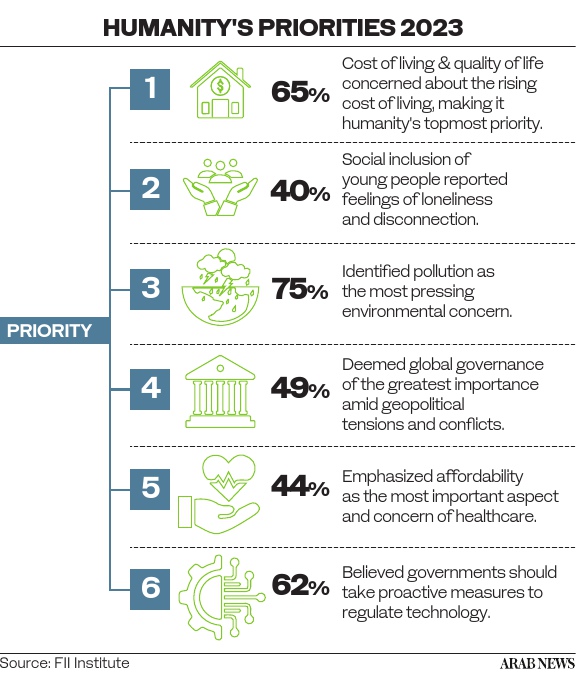
The October 2023 report found a 20 percent drop in people’s satisfaction with their personal lives compared to 2022. It found that 65 percent are distressed about the cost of living and quality of life.

It also discovered that 38 percent view social disconnection and lack of inclusion as a priority concern, that pollution is a concern for 75 percent, and that 44 percent globally are concerned about how to afford healthcare.

While 72 percent of those surveyed recognize that technology has democratized access to information, 47 percent of Africans worry about misleading information.

The findings of this survey will no doubt guide the discussions and policy solutions explored this week in Miami.


Saudi Arabia faces demographic shift as birth rates decline; sectors rethink strategies

Updated 5 sec ago
Follow

Saudi Arabia faces demographic shift as birth rates decline; sectors rethink strategies

RIYADH: Saudi Arabia is approaching a demographic crossroads, with birth rates dropping from 44 births per 1,000 people in 1980 to 16 in 2023, according to World Bank data.

Experts warn that the implications extend beyond human capital, healthcare, education, and real estate, affecting large cars, family homes, and insurance systems, as the population ages and the proportion of young people declines.

Experts speaking to Al-Eqtisadiah noted that by 2050, Saudi Arabia will face a significant aging challenge, as the population pyramid will expand in the middle and upper age groups relative to its base, signaling a shift from a youthful growth phase.

They added that these changes could reduce the number of new entrants to the labor market while increasing retirees, putting financial pressure on pension systems unless early reforms are implemented, such as raising the retirement age and promoting long-term savings.

The Kingdom’s population currently stands at approximately 34.6 million, with projections reaching 47.7 million by 2050, according to population pyramid data.

Saudi Arabia is not alone: Japan, South Korea, and China have experienced sharp declines in birth rates, resulting in demographic crises and extensive government interventions.

Arab experiences, including Tunisia, Morocco, and Lebanon, also show the long-term economic effects of falling fertility.

Demographic change brings economic challenges

Ihsan Buhulaiga, economic expert and founder of Joatha Consulting, told Al-Eqtisadiah that declining birth rates in Saudi Arabia are not primarily an economic challenge, but a societal issue related to preserving national identity and Saudi culture. He emphasized the need for forward-looking policies and effective initiatives to address these changes.

Buhulaiga added that declining fertility has concerned many countries. Some, like Japan, struggled due to reliance on traditional policies, while others, such as Sweden, succeeded through bold, progressive approaches.

He noted that declining population growth leads to an aging society, a reduced labor force, and increased pressure on healthcare and social systems, requiring policies tailored to each country’s context.

UN projections indicate that population growth will slow to 0.72 percent by 2050, with fertility rates dropping from 2.12 to around 1.8 children per woman. Saudi Arabia’s total fertility rate fell from 2.8 in 2011 to 2 in 2024, while fertility among Saudi women specifically declined from 3.8 to 2.7 in 2024, according to the General Authority for Statistics.

Buhulaiga highlighted the challenge of an expanding population pyramid in its middle and upper segments compared to its base — more seniors relative to births and young people — which shifts society toward stability and potentially aging, compared with the previous phase of youthful growth.

Rising burdens on pensions and long-term healthcare

Ayman Zuhri, population and migration studies expert, told Al-Eqtisadiah that continued declines in birth rates are gradually changing the age structure, reducing new entrants to the labor market while increasing the proportion of seniors.

Life expectancy gains expand the senior population, transforming the population pyramid from a traditional pyramid shape to a more columnar form over the coming decades.

Zuhri highlighted two sides of declining fertility: the “demographic opportunity” occurs when fertility drops from high to medium levels, reducing the child dependency burden and expanding the working-age population, which can drive economic growth if accompanied by quality education and productivity improvements.

The second stage is aging, where low fertility and longer life expectancy increase pension and healthcare burdens and shrink the national labor force, prompting reliance on technology, migration, or both.

Saudi births declined from 465,000 in 2017 to 417,000 in 2022 — a drop exceeding 10 percent in six years. The sharpest decline occurred among the 20-to 24-year-old group, down more than 40 percent, while women aged 35 to 44 saw a slight increase, reflecting delayed childbearing.

Zuhri stressed that continued fertility decline alongside rising life expectancy sets Saudi society on an aging trajectory, challenging pensions, healthcare, and workforce sustainability, emphasizing investment in education, workforce skills, and national labor productivity.

Lower purchasing power and shrinking demand for large cars, detached homes

Mohammed Al-Abbas, economic expert and writer, noted that Saudi household sizes are shrinking, though the precise cause remains unclear.

He warned that continued low fertility over the next decade would significantly affect human capital, productivity, and purchasing power, with implications for imported goods.
Al-Abbas believes that the real estate sector will be among the hardest hit, as smaller households reduce demand for independent homes, large urban developments, furniture, family cars, and construction materials. 

By 2050, the share of those aged 65 and above is expected to rise from 10 percent today to nearly 16 percent, changing the ratio from one senior per 10 people to one per six.

Women’s careers a factor in lower fertility

A study by Princess Nourah bint Abdulrahman University surveyed 2,172 Saudi women aged 18 to 50 from various regions. Participants from the central and eastern regions reported the highest rates of viewing childbirth as a barrier. 

Reasons included pursuing higher education, focusing on careers, and striving for financial stability.

Zuhri noted that declining fertility is not only linked to economic factors but also reflects substantial social changes regarding women’s roles, education, and work. Countries investing in women’s empowerment are better positioned to leverage demographic shifts positively.

Recruitment and labor market implications

Buhulaiga said that Vision 2030’s focus on reducing oil dependence and expanding non-oil sectors, including services requiring growing workforces, means expatriate inflows are likely to continue, maintaining the working-age population until aging gradually appears after 2040.

The Kingdom relies heavily on foreign labor, which accounted for about 41.6 percent of the population in 2022. As Vision 2030 targets are met — diversifying the economy, increasing foreign investment, and attracting skilled talent — migration is expected to rise. This will affect age distribution, particularly the 20-to 60-year-old working-age group.

Al-Abbas noted that a significant decline in fertility would have a major impact on human capital, putting pressure on labor markets and public services such as education and healthcare, and potentially increasing reliance on foreign labor despite efforts to build a national workforce.

Education investment at risk

Al-Abbas said the education sector will be highly affected, as declining student numbers in early and general education stages will reduce investment demand.

Zuhri added that fewer students could improve quality if resources are efficiently used, but would require restructuring educational infrastructure.

Changes in healthcare, insurance, and pensions

As the population ages, demand for chronic and long-term care rises, altering health spending and increasing demand for geriatric medical staff and long-term nursing.

Al-Abbas explained that declining birth rates mean a larger segment of seniors will require care different from that needed by younger populations, representing a major shift in healthcare priorities. 

Health insurance, he added, is also expected to face profit declines, as most insured individuals enter old age when health issues are more prevalent.

Regarding pensions, he noted that continued declines will place substantial pressure on retirement systems, highlighting the need for proactive reforms. 

Zuhri added that fewer new entrants relative to retirees will create financial strain on pension systems unless early restructuring occurs, including raising retirement age, adjusting contributions, and promoting long-term savings.

International experiences

Japan, South Korea, and China have faced demographic crises due to sharp fertility declines, requiring extensive government interventions.

Arab experiences in Tunisia, Morocco, and Lebanon also show that the impact of falling fertility depends on accompanying economic policies.

In Tunisia and Morocco, lower fertility eased numerical pressure but did not produce significant gains due to unemployment and weak investment.

In Lebanon, declining fertility coincided with heavy youth emigration, creating gaps in sectors like healthcare.

Countries facing low population growth adopt diverse policies based on cultural, economic, and social contexts. Policies to encourage childbirth often include financial incentives, flexible parental leave, and support for work-family balance. 

Awareness campaigns have also been used in Japan and South Korea to change social attitudes toward early parenthood.

Training older workers and investing in technology

To address labor shortages, some countries have adopted flexible immigration policies to attract skilled young workers, as seen in Canada and Australia, while others focus on integrating and upskilling migrants, similar to Germany’s approach with Syrian refugees.

Increasing workforce productivity and investing in technology involves ongoing training for older workers in Singapore and Japan, as well as automation and AI to offset labor gaps, particularly in healthcare and industry.

Extending working life and reforming pension systems have been applied in Italy and the Netherlands by raising retirement ages. Sweden encourages part-time work for seniors to ease system pressure. 

Improving healthcare and extending active life expectancy, as in the EU, involves preventive health measures and programs for active aging.

Finally, restructuring the economy to adapt to aging involves strengthening sectors like elderly care in China and reducing reliance on young labor by developing technological industries, as in Russia.

Solutions for Saudi Arabia

Zuhri recommends leveraging the demographic opportunity through education, digital skills, and higher female labor participation, while transitioning to a skilled, tech-driven economy. 
He also advocates pension reforms, family support, and managed migration to attract talent.

He emphasized that these policies mitigate the impact of declining fertility on the labor market and support sustainable economic stability while maintaining fertility levels close to replacement.

Buhulaiga highlighted successful solutions from countries such as Sweden, which relied on family support, immigration, and improved work-life balance, while enhancing seniors’ economic contribution.

Japan, despite failing to reverse its fertility decline, focused on offsetting population shortfalls through technology and extended working life.

Canada relies on organized immigration to fill labor gaps and ensure sustainable population growth.

Sweden: a balanced model

Buhulaiga views Sweden’s experience as a balanced approach to declining fertility. The country offers paid parental leave of 480 days, approximately 16 months, at 80 percent of salary, with 90 days allocated to each parent to promote shared childcare and gender equality.

The government provides monthly child allowances and low-cost childcare services, facilitating mothers’ return to work and maintaining a stable fertility rate of around 1.7–1.8 children per woman.

Sweden encourages work-life balance through flexible schedules and the right to return to jobs after parental leave. Seniors are supported through gradual retirement age increases, incentives to work beyond retirement, preventive healthcare, active aging programs, and part-time work opportunities.

Buhulaiga emphasized that without policies to boost citizens’ productivity, reliance on foreign labor — occupying higher-paid and safer jobs — would increase. He stressed engaging citizens in emerging economic sectors through empowerment, vocational training, and leadership preparation.

He called for leveraging international models like Sweden’s to encourage young people to have children and highlighted the importance of digital transformation and AI adoption.

This reduces dependence on low-and medium-skilled labor, raises productivity without inflating foreign labor numbers, and allows citizens to enter the workforce while balancing childbearing with economic participation.