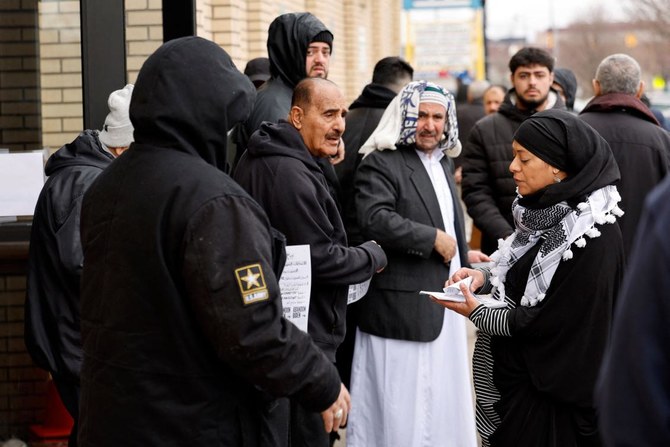
Dearborn: It’s common to hear residents chatting in Arabic just as often as English in this Detroit suburb’s stores or mosques, those buildings themselves often sporting bilingual signage out front.
But no matter the language, residents in this Arab American and Muslim stronghold in the Midwestern state of Michigan are convinced President Joe Biden, as he steadfastly stands by Israel in its war in Gaza, is not listening to them.
“Vote for Palestine. No Biden,” political organizer Samra’a Luqman says in English, passing out fliers outside a mosque after prayers.
“Don’t vote for Biden,” the activist with Yemeni origins adds in Arabic.
“Of course,” respond many passersby.
As the Gaza Strip death toll climbs, residents here — once firmly in the Democratic fold — are turning against the president in a crucial swing state he won by just 150,000 votes in 2020.
Some are hoping to pressure Biden to back off from his Israel support and call for a ceasefire. Others, like Luqman, say they would never vote for him.
“He’s committing the genocide. He’s funding it,” Luqman, a campaign leader with a group called Abandon Biden, tells AFP.
A campaign is underway by Luqman and others urging voters to vote “uncommitted,” or write in “Free Palestine” on their ballots in the state’s primary next week — a symbolic gesture, since Biden faces no serious challengers for the Democratic nomination.
“This is a campaign about pressuring our current president who can do something about the mass killing of children,” says Abbas Alawieh, a former Democratic chief of staff on Capitol Hill and member of the Listen to Michigan campaign group.
“In this community there are a lot of people who are directly harmed by war,” the Lebanese-born Alawieh tells AFP.
Biden, he says, “is threatening to lose this community. Not just in November, but perhaps for a generation to come.”
The war started when Hamas launched its attack on October 7, resulting in the deaths of about 1,160 people in Israel, mostly civilians, according to an AFP tally of official Israeli figures.
But concern has mounted amid the high civilian toll in Israel’s retaliatory campaign, now at 29,313 people dead, according to the health ministry in Hamas-run Gaza.
Listen to Michigan began as a pressure campaign, but some voters say their frustration with the president is permanent.
Voting for Biden was the “worst mistake of my life,” says Mohamed Alemara, a 23-year-old medical student of Iraqi descent.
“You don’t kill 30,000 of our people and expect us to vote for you.”
Arab Americans’ vows to ditch Biden often baffle liberal political pundits.
What will Muslims and Arabs do, the thinking goes — vote for Donald Trump, the Republican behind the “Muslim ban” immigration policy, whose supporters flirt with ideas like “Christian nationalism“?
“We’re not a stupid community,” says Luqman. “I’ve survived a Muslim ban, but those kids in Gaza have not survived Joe Biden.”
“My intention is not to vote in an Islamophobe, another genocidal maniac,” she adds. Yet she tells AFP, “the only way I would vote for Biden is if he resurrected” the Gaza dead.
In America’s two-party system, where voters often hold their nose to pick candidates they don’t back 100 percent, 27-year-old nurse Fatima Elzaghir says that “at this point, the lesser evil is Trump.”
Others, like Alawieh, reject the premise of the question.
“How dare you come to me and say, ‘Oh, but later, Trump will be your fault,’” he says.
“Call your representative. Tell them you want a ceasefire.... Once we stop the bloodshed, then we can talk about the political consequences.”
Biden will also have to deal with Michigan’s unions — where some are defecting from the labor-friendly president’s camp.
Many union and workingclass voters already support Republicans, drawn in by their conservative social policies.
But for Merwan Beydoun, a steel mill worker and member of the United Autoworkers Union, Gaza was the breaking point.
“Furious” at Biden, whom the UAW endorsed, Beydoun stopped his contributions to the union’s political arm.
Beydoun says he still believes “in a lot of Democratic policies” and would rather not say how he’ll vote in November. But to earn Beydoun’s vote, the president “needs to wake up” and “change his ways.”
The Biden administration has tried to assuage Arab and Muslim voters’ concerns in part by portraying the president as frustrated with Benjamin Netanyahu’s government.
But US weapons have flowed to Israel since October 7, while Washington’s efforts to broker a second pause in fighting have failed, and on Tuesday the US blocked a UN Security Council resolution calling for a ceasefire.
“My intention is to punish Biden for what he’s doing now,” says Luqman. “For the betrayal that he’s done to me and all the community members that have voted for him.”

In Michigan, Arab American voters vow to ‘punish’ Biden
Short Url
https://arab.news/nr5w2
In Michigan, Arab American voters vow to ‘punish’ Biden
- As Gaza Strip death toll climbs, residents once firmly in the Democratic fold — are turning against the president in a crucial swing state he won by just 150,000 votes in 2020.
Culture being strangled by Kosovo’s political crisis
PRIZREN: Kosovo’s oldest cinema has been dark and silent for years as the famous theater slowly disintegrates under a leaky roof.
Signs warn passers-by in the historic city of Prizren that parts of the Lumbardhi’s crumbling facade could fall while it waits for its long-promised refurbishment.
“The city deserves to have the cinema renovated and preserved. Only junkies gathering there benefit from it now,” nextdoor neighbor butcher Arsim Futko, 62, told AFP.
For seven years, it waited for a European Union-funded revamp, only for the money to be suddenly withdrawn with little explanation.
Now it awaits similar repairs promised by the national government that has since been paralyzed by inconclusive elections in February.
And it is anyone’s guess whether the new government that will come out of Sunday’s snap election will keep the promise.
- ‘Collateral damage’ -
Cinema director Ares Shporta said the cinema has become “collateral damage” in a broader geopolitical game after the EU hit his country with sanctions in 2023.
The delayed repairs “affected our morale, it affected our lives, it affected the trust of the community in us,” Shporta said.
Brussels slapped Kosovo with sanctions over heightened tensions between the government and the ethnic Serb minority that live in parts of the country as Pristina pushed to exert more control over areas still tightly linked to Belgrade.
Cultural institutions have been among the hardest-hit sectors, as international funding dried up and local decisions were stalled by the parliamentary crisis.
According to an analysis by the Kosovo think tank, the GAP Institute for Advanced Studies, sanctions have resulted in around 613 million euros ($719 million) being suspended or paused, with the cultural sector taking a hit of 15-million-euro hit.
- ‘Ground zero’ -
With political stalemate threatening to drag on into another year, there are warnings that further funding from abroad could also be in jeopardy.
Since February’s election when outgoing premier Albin Kurti topped the polls but failed to win a majority, his caretaker government has been deadlocked with opposition lawmakers.
Months of delays, spent mostly without a parliament, meant little legislative work could be done.
Ahead of the snap election on Sunday, the government said that more than 200 million euros ($235 million) will be lost forever due to a failure to ratify international agreements.
Once the top beneficiary of the EU Growth Plan in the Balkans, Europe’s youngest country now trails most of its neighbors, the NGO Group for Legal and Political Studies’ executive director Njomza Arifi told AFP.
“While some of the countries in the region have already received the second tranches, Kosovo still remains at ground zero.”
Although there have been some enthusiastic signs of easing a half of EU sanctions by January, Kurti’s continued push against Serbian institutions and influence in the country’s north continues to draw criticism from both Washington and Brussels.
- ‘On the edge’ -
Across the river from the Lumbardhi, the funding cuts have also been felt at Dokufest, a documentary and short film festival that draws people to the region.
“The festival has had to make staff cuts. Unfortunately, there is a risk of further cuts if things don’t change,” Dokufest artistic director Veton Nurkollari said.
“Fortunately, we don’t depend on just one source because we could end up in a situation where, when the tap is turned off, everything is turned off.”
He said that many in the cultural sector were desperate for the upcoming government to get the sanctions lifted by ratification of the agreements that would allow EU funds to flow again.
“Kosovo is the only one left on the edge and without these funds.”
Signs warn passers-by in the historic city of Prizren that parts of the Lumbardhi’s crumbling facade could fall while it waits for its long-promised refurbishment.
“The city deserves to have the cinema renovated and preserved. Only junkies gathering there benefit from it now,” nextdoor neighbor butcher Arsim Futko, 62, told AFP.
For seven years, it waited for a European Union-funded revamp, only for the money to be suddenly withdrawn with little explanation.
Now it awaits similar repairs promised by the national government that has since been paralyzed by inconclusive elections in February.
And it is anyone’s guess whether the new government that will come out of Sunday’s snap election will keep the promise.
- ‘Collateral damage’ -
Cinema director Ares Shporta said the cinema has become “collateral damage” in a broader geopolitical game after the EU hit his country with sanctions in 2023.
The delayed repairs “affected our morale, it affected our lives, it affected the trust of the community in us,” Shporta said.
Brussels slapped Kosovo with sanctions over heightened tensions between the government and the ethnic Serb minority that live in parts of the country as Pristina pushed to exert more control over areas still tightly linked to Belgrade.
Cultural institutions have been among the hardest-hit sectors, as international funding dried up and local decisions were stalled by the parliamentary crisis.
According to an analysis by the Kosovo think tank, the GAP Institute for Advanced Studies, sanctions have resulted in around 613 million euros ($719 million) being suspended or paused, with the cultural sector taking a hit of 15-million-euro hit.
- ‘Ground zero’ -
With political stalemate threatening to drag on into another year, there are warnings that further funding from abroad could also be in jeopardy.
Since February’s election when outgoing premier Albin Kurti topped the polls but failed to win a majority, his caretaker government has been deadlocked with opposition lawmakers.
Months of delays, spent mostly without a parliament, meant little legislative work could be done.
Ahead of the snap election on Sunday, the government said that more than 200 million euros ($235 million) will be lost forever due to a failure to ratify international agreements.
Once the top beneficiary of the EU Growth Plan in the Balkans, Europe’s youngest country now trails most of its neighbors, the NGO Group for Legal and Political Studies’ executive director Njomza Arifi told AFP.
“While some of the countries in the region have already received the second tranches, Kosovo still remains at ground zero.”
Although there have been some enthusiastic signs of easing a half of EU sanctions by January, Kurti’s continued push against Serbian institutions and influence in the country’s north continues to draw criticism from both Washington and Brussels.
- ‘On the edge’ -
Across the river from the Lumbardhi, the funding cuts have also been felt at Dokufest, a documentary and short film festival that draws people to the region.
“The festival has had to make staff cuts. Unfortunately, there is a risk of further cuts if things don’t change,” Dokufest artistic director Veton Nurkollari said.
“Fortunately, we don’t depend on just one source because we could end up in a situation where, when the tap is turned off, everything is turned off.”
He said that many in the cultural sector were desperate for the upcoming government to get the sanctions lifted by ratification of the agreements that would allow EU funds to flow again.
“Kosovo is the only one left on the edge and without these funds.”
© 2025 SAUDI RESEARCH & PUBLISHING COMPANY, All Rights Reserved And subject to Terms of Use Agreement.